


 22:35
22:35
 kaniamazdar


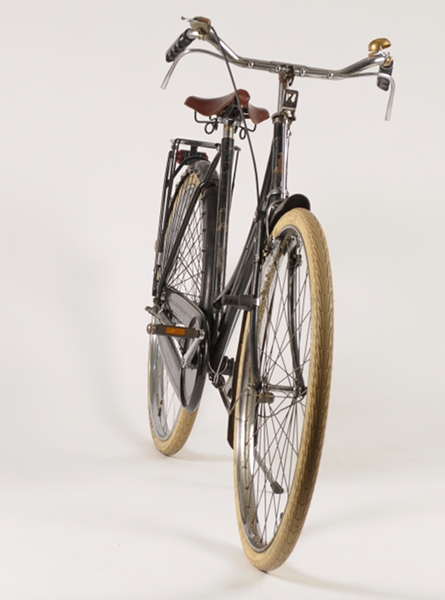

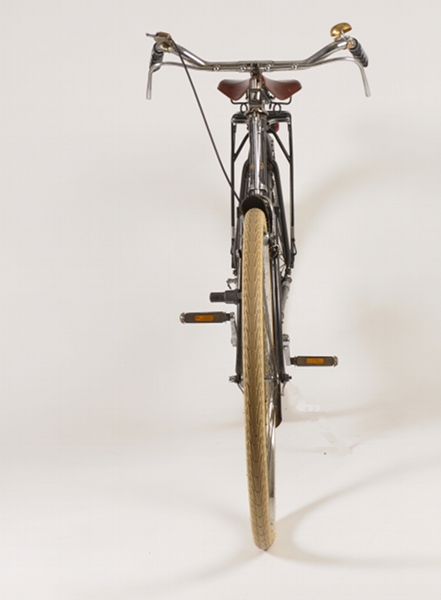

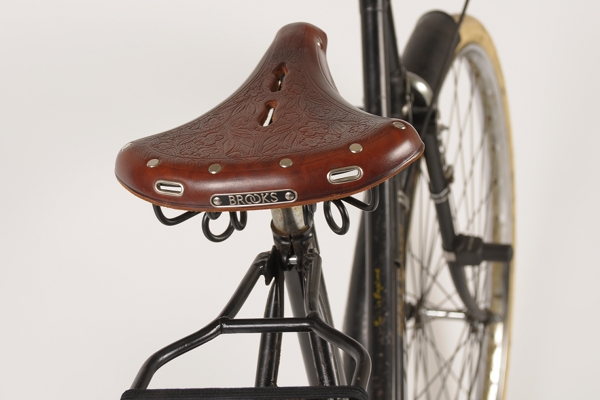
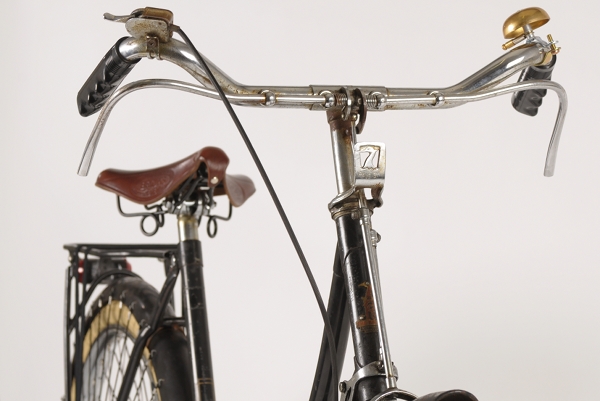
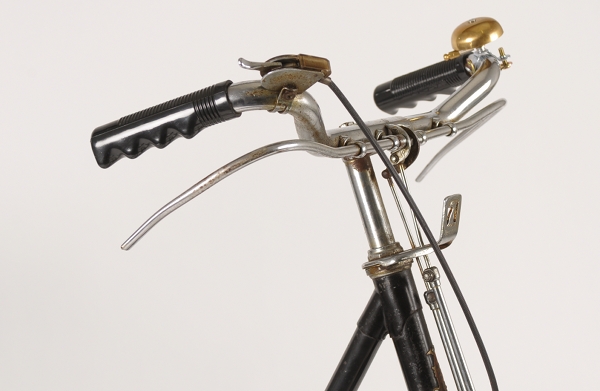
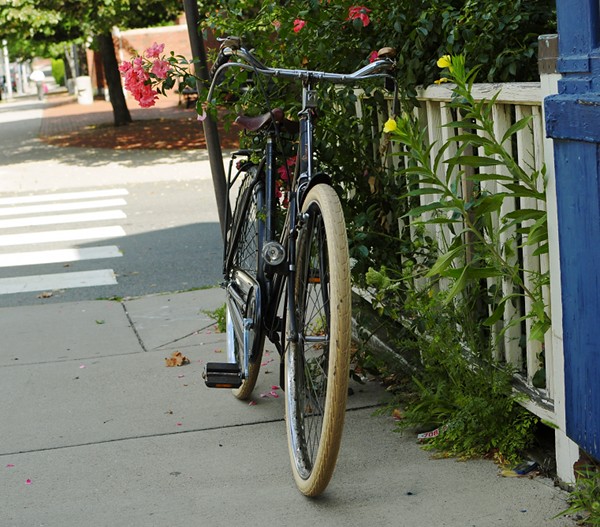 Behold my beloved Raleigh DL-1 Lady Tourist! Lovely as usual, is she not?
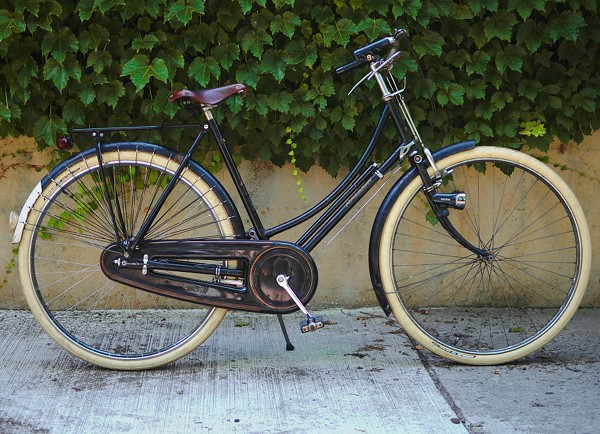 Ah, but some things about her are not at all "as usual". Can you tell that the lady has had major surgery? Probably not, and that's the beauty of it; her classic roadster features have been left intact.
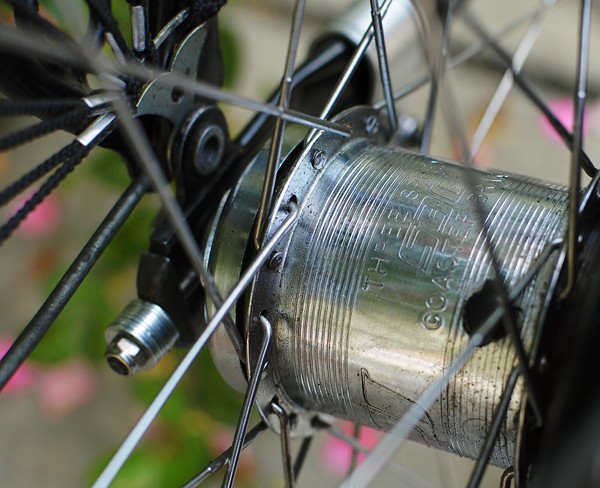 But oh, what's this here? Why yes, it's a Sturmey-Archer S3C coaster brake hub! And with it, the bicycle has been magically transformed to an unmatched state of fabulousity.
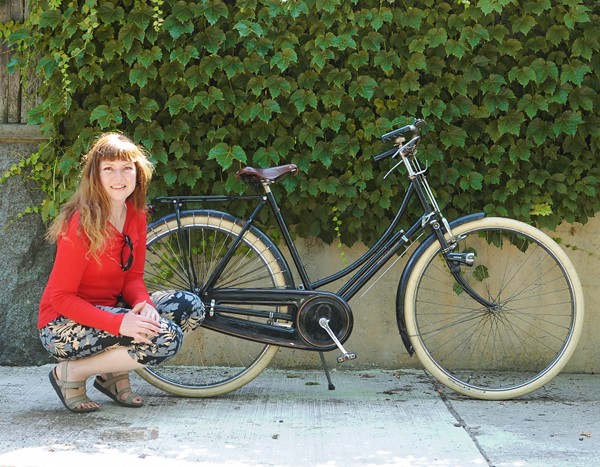 For those unfamiliar with the saga: The Raleigh DL-1 is basically the holy grail of vintage "Roadsters," particularly the lady's loop frame. These bicycles are elegant, comfortable and surprisingly fast. There is only one tragic drawback: They were made with rod brakes, which is a braking system that is not the greatest even in dry weather, and completely ineffective in the rain. I got my DL-1 last summer and it has been my preferred bicycle ever since, despite the poor braking power. Still, I hoped that someday a conversion to a more effective braking system would make it perfect. Imagine my elation that this day has come!
 If you are wondering how we did this, I will first say that it is definitely a "don't try this at home" project unless you are mechanically inclined, or have a spouse who is. But to summarise: You will need to get a 3-speed coaster brake hub and to have a new wheel built around it. You cannot put the coaster brake hub in the old wheel, because these hubs were designed for a different number of spokes. If you are planning to keep the original rod brakes (which you have to, unless you want to replace the handlebars), the new wheel needs to have a 28" rod-brake rim. These are distinct from regular rims, in that they have a special notch for the rod brake pads to grip. Yellow Jersey sells these rims, and they can also build you the wheel if you send them the coaster brake hub.
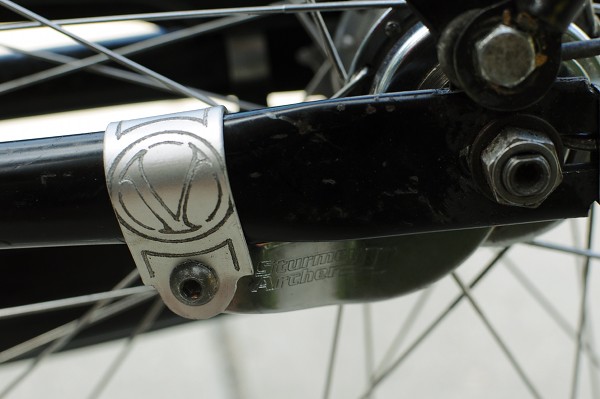 And that is what we did: I got the hub from an acquaintance who happened to have one (and who sent this monogrammed reaction arm clamp to go with it!), and had the wheel built by Yellow Jersey. Upon receiving the new wheel in the mail, we stayed up half the night attaching it to the bike. There are various little nuances that made it, shall we say, challenging - but it is doable. I will post a more detailed account on Boston Retro Wheelmen soon; for now I still have PTSD from the process. But let's be frank: A mild case of PTSD is a small sacrifice for the miracle of a secret coaster brake on a classic rod-brake roadster!
 After the coaster-brake wheel installation, I spent the following day riding the bike everywhere; it was difficult to get me off of it! I tried hills, high-traffic routes, bridges - all kinds of situation where the brakes would be put to the test. I even got stuck in the pouring rain on my way home from downtown Boston - which was not intentional, but perfectly timed for testing the brakes in wet weather. If you've been reading this blog, you know I like coaster brakes, and this one performs fantastically. Upon back-pedaling, it comes to a soft (non-jolting) but reliable stop, making hand braking completely unnecessary, other than for preventing the bicycle from rolling when stopped at a traffic light. One funny thing about this hub, is that it is very-very loud: a steady ticking noise when pedaling, amplified tenfold when coasting. Well, at least they can hear me approach!
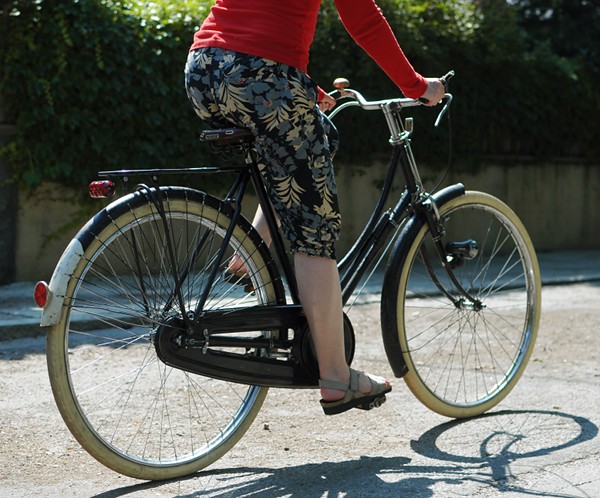 It did not take me long to get used to the DL-1 having a coaster brake and to adapt my braking patterns accordingly. With the rod brakes, I used to plan my stops in advance and I feared rain. Now I am free from worrying about such things and can fully enjoy this wonderful bicycle. There are other ways of installing effective brakes on the DL-1, like attaching the rods to a rollerbrake hub or replacing the whole rod system with standard brakes and conventional handlebars. But I chose the coaster brake, both because I like the system in itself, and because it allowed me to preserve everything about this bicycle exactly as it was - making it my very own Coaster Roadster.
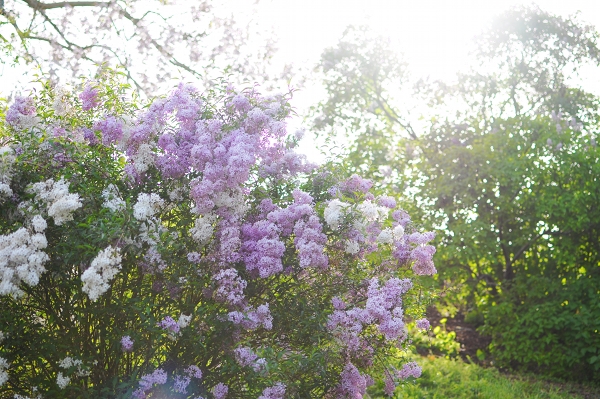 "Lilac Sunday" at the Arnold Arboretum in Boston is an annual celebration of their extensive collection of lilac plants. The lilac is one of my favourite flowers. I find the soft colour beautiful, and the smell intoxicating.
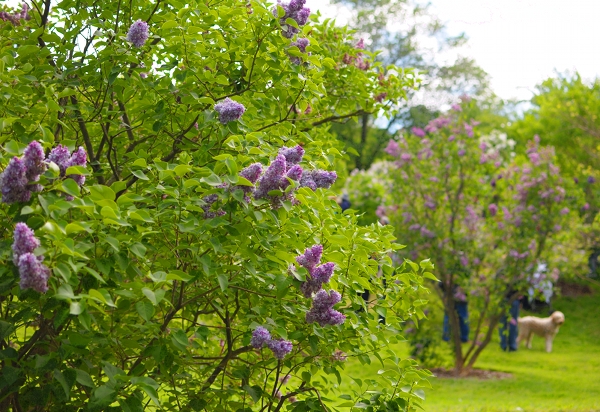 I had never been to a flower festival before and did not know what to expect. The Arboretum's "lilac collection" is basically a small hill covered with dozens of lilac plants of every variety imaginable.
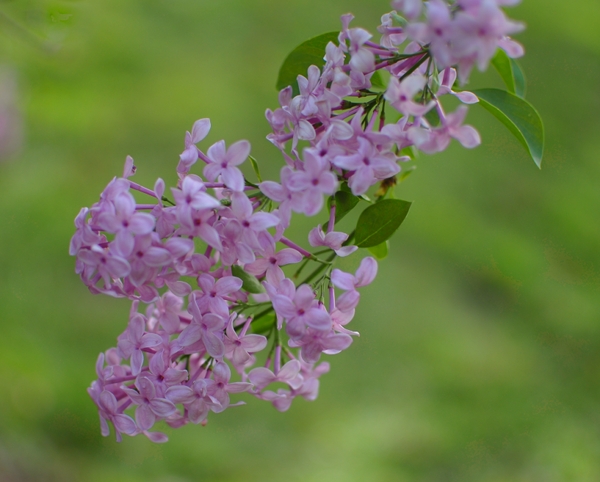 The lilacs' colours included everything from classic pale purple, to white, to ink-blue, to cherry-blossom pink.
 The form of the flowers can vary quite a bit as well - from sparse, crisply outlined petals to fluffy, soft clusters.
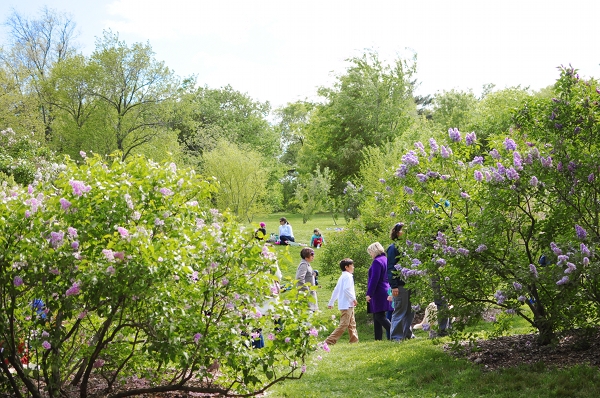 Hundreds of people at a time wandered up and down the hill to pay homage to the lilacs - smelling them, photographing them, having picnics beneath them.
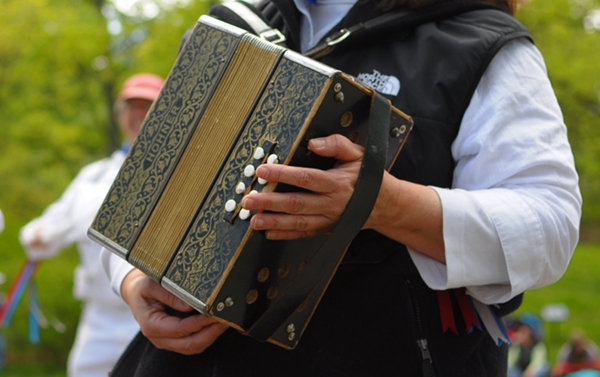 There were also musical and dance performances from several local folk groups.
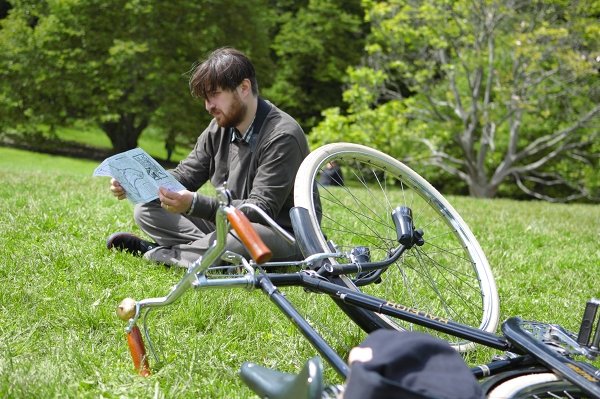 The festival was so well-attended, that there were probably more people than lilacs - but we did find a spot on the grass nearby.
 Did I mention I love lilacs? It was blissful to see so many in one place.
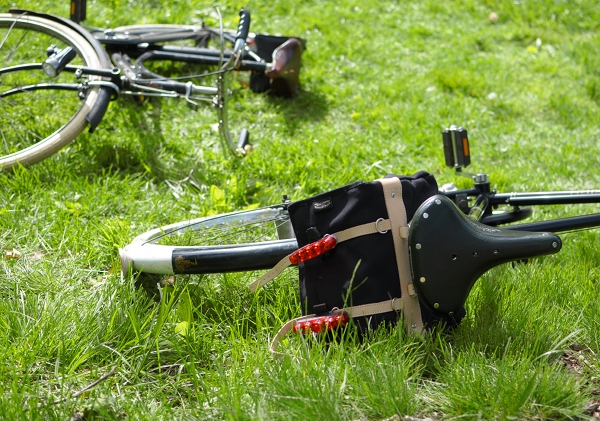 The Roadsters were happy as well, especially as they finally got to cycle along Boston's Emerald Necklace all the way to the Arboretum.
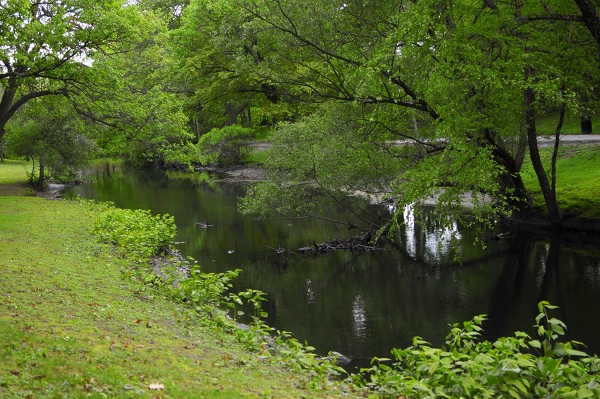 The Emerald Necklace is a series of green spaces throughout greater Boston, connected by routes that are meant to be walkable and cycle-able. It includes the Back Bay Fens, the Jamaica Pond, the Riverway, and other small parklands. The project was designed by Frederick Law Olmsted in the 1800's and is fascinating to read about, especially if you are interested in the history of urban planning and park design.
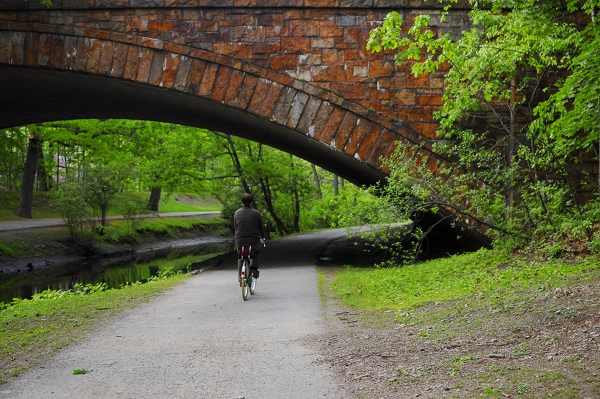 We had wanted to cycle along the entire Necklace for a while, but never had any cause to go in that direction of Boston until now.
 As an urban green sanctuary, the Emerald Necklace is heavenly, with its lush vegetation and delicate bodies of water. As a cycling route... Well, it's frustrating. Throughout much of it, the trails are frequently interrupted by intersections and the crossings range from awkward to dangerous. Motor vehicles just do not yield - not even slowing down as bikes or pedestrians attempt to cross. Even on those intersections where there are lights, the same happens with cars turning: they do not even pause, let alone yield to pedestrians or bicycles.
 An additional issue, is that unless you already know how to navigate the Necklace, it is difficult to find your way from one cluster of green to another; there are no signs or markings. We had a map from the Emerald Necklace Concervancy and still had trouble navigating.
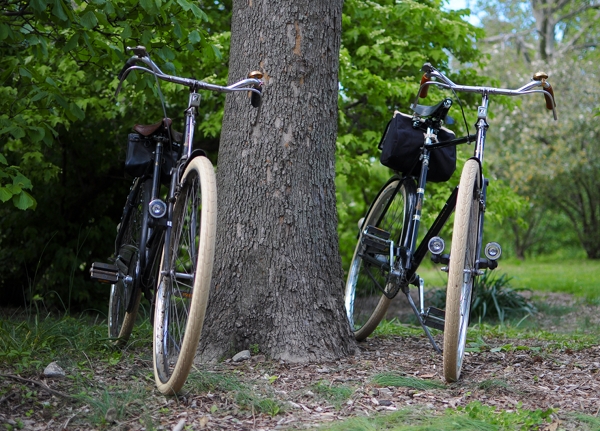 On the way back finding our way got a bit easier and we even discovered some secluded dirt paths that the Roadsters liked better than the paved trails.
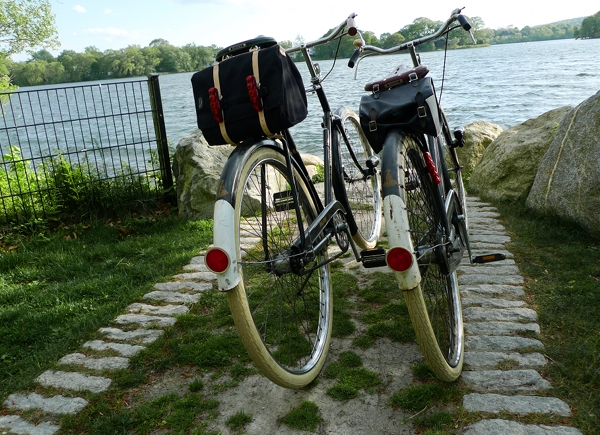 I think you've met these friends of ours before?
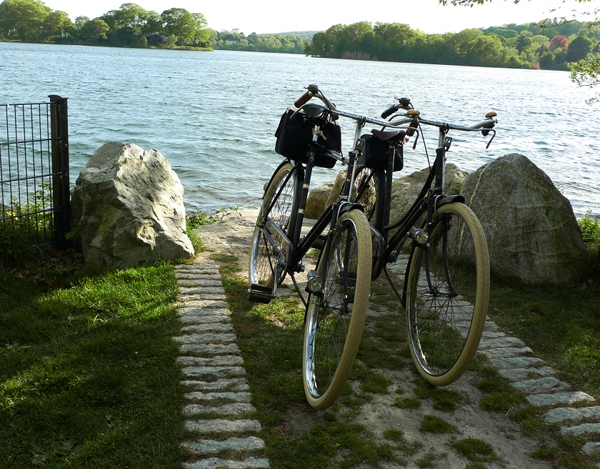 They haven't been out together for a while, but finally we convinced them both to join us.
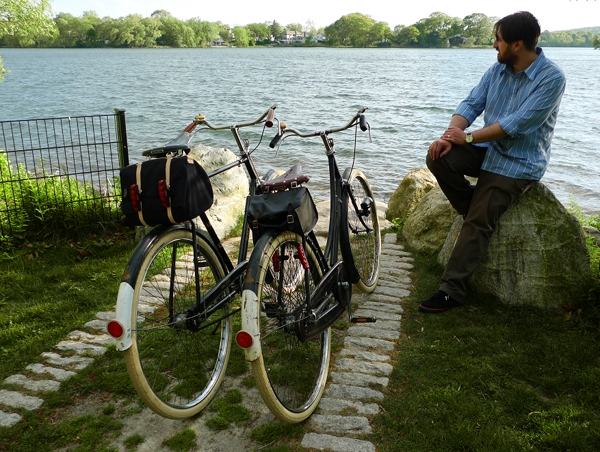 The evening involved conversation,
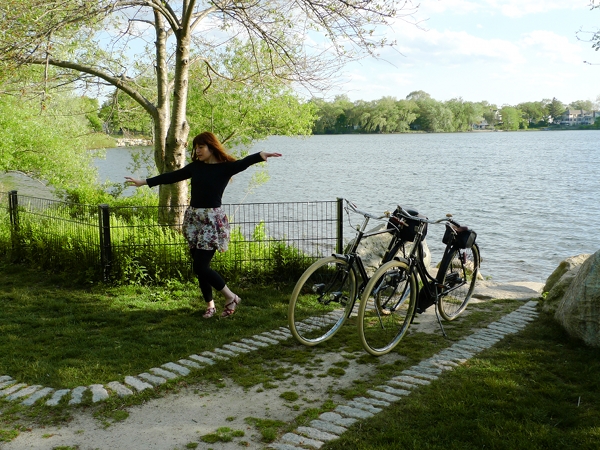 dancing,
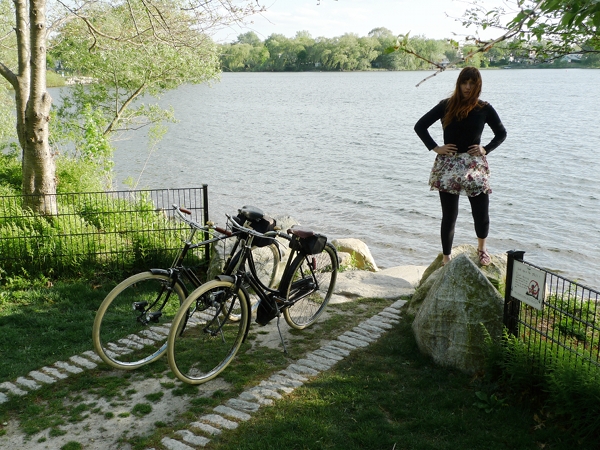 rock climbing,
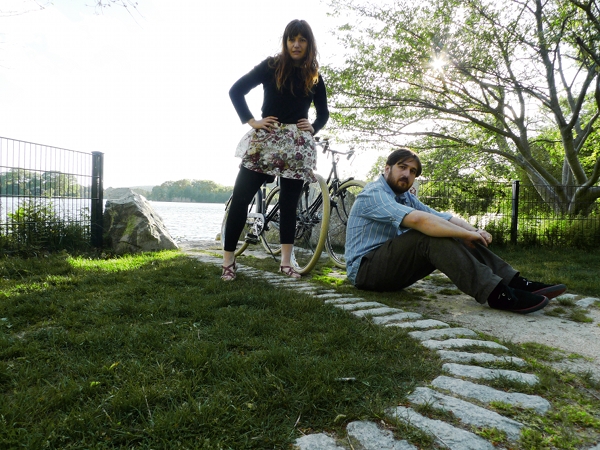 and attempts at group portraits.
 Our small entourage attracted some local bicycle enthusiasts, and soon we were chatting about refurbishing vintage frames to the bewildered glances of passers-by, until it grew dark and each party headed home. Our rod-brake friends always do seem to get all the attention. Must be their matching outfits.
 English Roadsters were designed for long country rides, and there is nothing quite like experiencing them in this setting. My Raleigh DL-1 in particular seems to thrive on long distances and can pick up speed to an amazing degree if you just give it an open road.
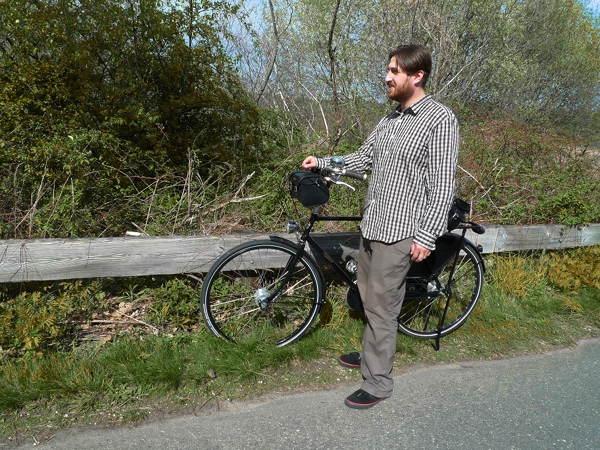 The Co-Habitant is a strong cyclist and he likes to go fast. When we are on equivalent bicycles (for example, both on our Pashleys or both on our Motobecane roadbikes), I have a hard time keeping up with him unless he intentionally controls his speed for my sake. However, when he is on his Pashley and I am on my vintage Raleigh, I can keep up with him perfectly. The Raleigh DL-1 is a powerful and well-designed machine despite its sweet "old timer" appearance.
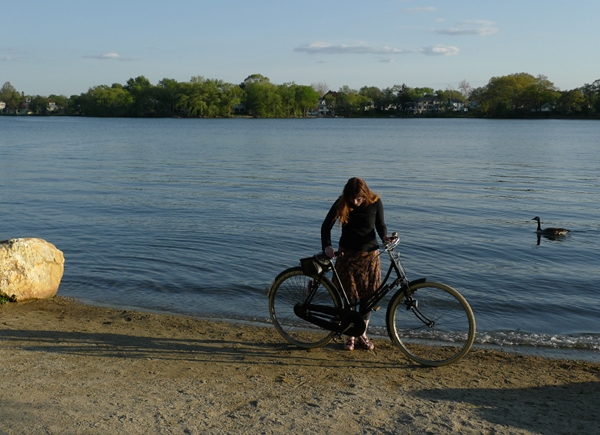 And the vintage Sturmey Archer AW 3-speed hub is downright magical. First gear is excellent for uphill cycling in mildly hilly areas. Second is my versatile go-to gear for flat terrain when I want to go at a conservative speed. And third gear allows me to pedal downhill, as well to increase speed after maxing out second gear on flat terrain. I have honestly never felt the need for more gears on this bicycle, and don't understand why none of the modern 3, 5, 7, or 8-speed hubs I have tried have the same great feeling.
 If my devious plan to install a coaster brake on this bicycle works out, it will be so perfect that I am almost afraid to think about it lest I jinx it. For now, we dream as we watch the sunset.
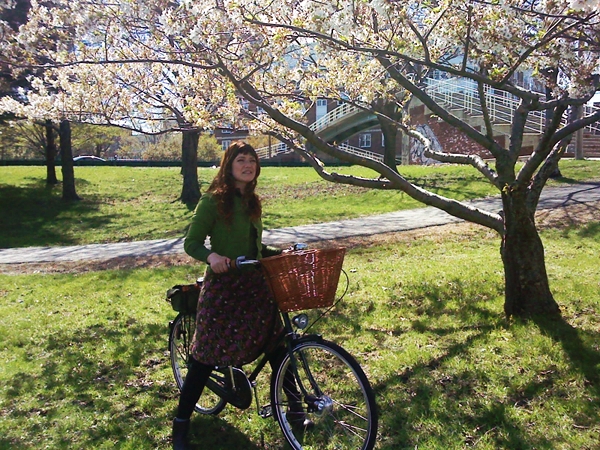 It is also best if you want to cycle at a leisurely pace and get the most out of the scenery - like the beautiful and fleeting spring blossoms.
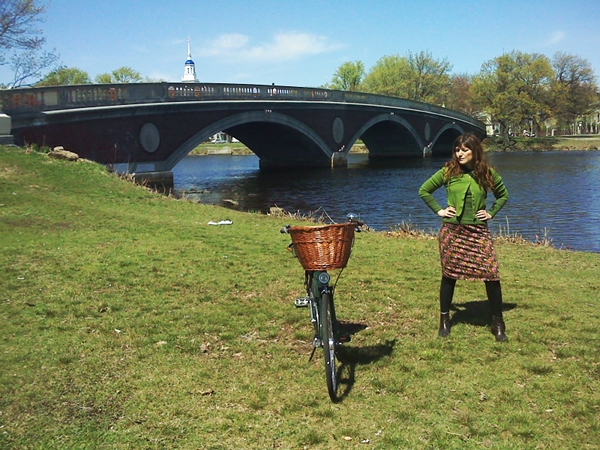 These pictures were meant to have a "green on green" theme as a follow-up to the "blue on blue", but they were taken with a mobile phone and the green colour of the Pashley frame is completely invisible. But conceptually it is there: green grass, green sweater set, green Pashley. (Just imagine the bike looks green, okay?)
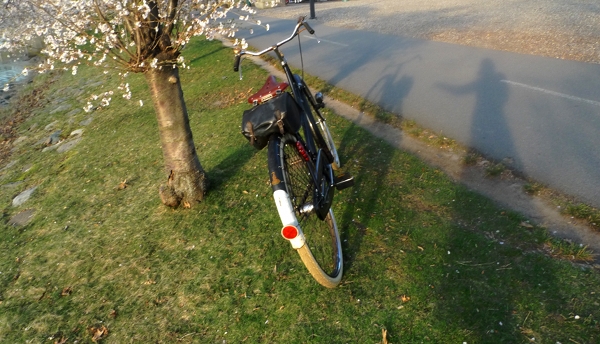 I long to have a "one and only," dependable, perfect loop-frame bicycle. Unfortunately, I think that the lovely Pashley might not be the one. For whatever reason, my vintage Raleigh DL-1 Lady's Tourist just works better with my anatomy. However, the DL-1 is not perfect either: lacking the Pashley's dependable brakes and all-weather capabilities. Over the past 9 months I have been agonising about how to resolve this and toying with different possibilities, but now I have finally taken action: I will be turning the Raleigh DL-1 into "superbike" by installing a secret coaster brake whilst leaving the rod brakes intact. And, assuming that this works out ...I will be selling the Pashley. Can't believe I just committed this to text, but there it is. I have not made it official yet or posted the bike for sale anywhere, but if you live in the area and think you might be interested, get in touch. Who knows - maybe you'll meet the loopy best friend of your dreams!
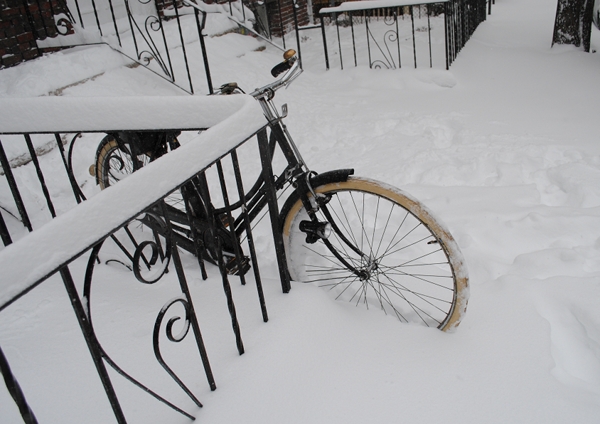 On Sunday, we had a truly beautiful winter day. Because the blizzard hit Boston on a weekend, the snowplows were not as active as they would have been during the working week. For the first half of Sunday, the entire neighborhood lay covered in a blanket of pristine white snow, and only around lunchtime did people begin emerging from their houses to reluctantly shovel their driveways.
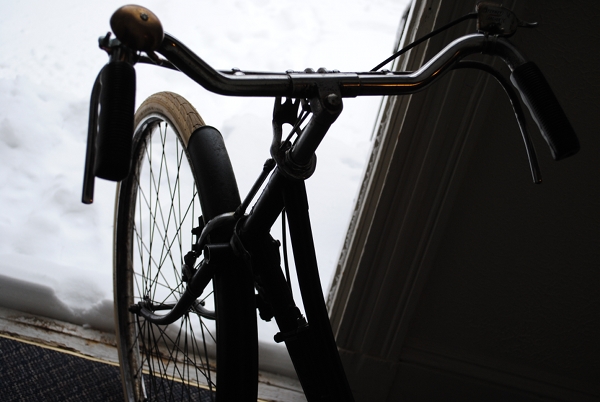 Despite being down with a minor cold, Velouria could not sit still in the blizzard. Stir-crazy in our small apartment and desperate to feel the fresh snow under her tires, she begged me to come out just for a bit, at least to give it a try. How could I resist her charms?
 She posed for me next to the fence while I photographed her this way and that. A kickstand was not necessary, because the foot-deep snow enveloped her wheels and functioned as a bicycle rack. With her black frame and cream tires, Velouria was stunning in the snow. The aesthetic experience of seeing her thus even made up for carrying her down the front stairs - which had been semi-visible when the Co-Habitant left for work several hours earlier, but were now completely buried in snow. With the bike in my arms, I slowly extended my toe and felt each step under the snow before proceeding onto it. With the 40lb DL-1 this was doable, but I would not have been able to execute the same maneuver with the heavier Pashley.
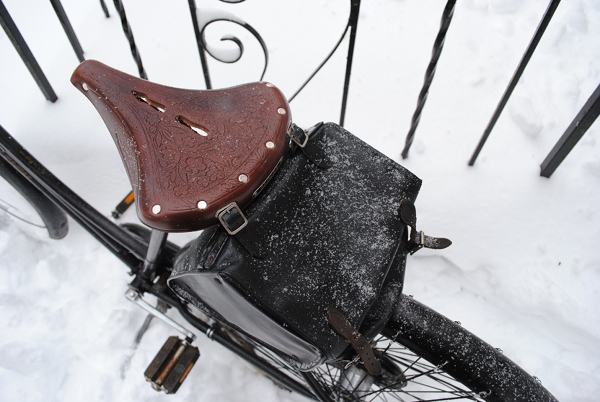 The snow was still falling as we prepared to head out, quickly covering the saddle with a thin layer of powder.
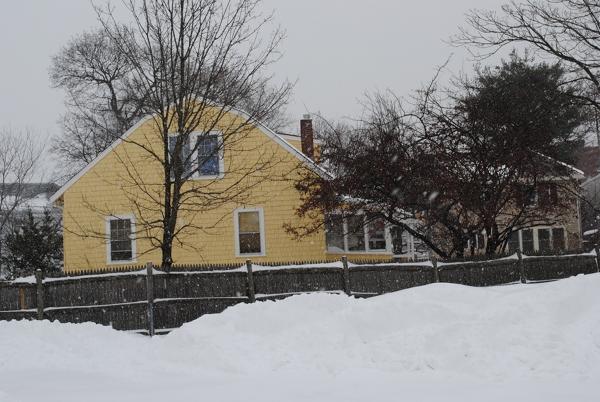 Upon Velouria's advice, the voyage I chose was an easy and safe one: a trip to a grocery store that is just a 6 minute walk (3 minute ride under normal conditions) from our house via a secret route through dead-end back streets. There would hardly be any cars there, and if I found myself unable to ride I could just walk the bicycle the rest of the way to the store and back.
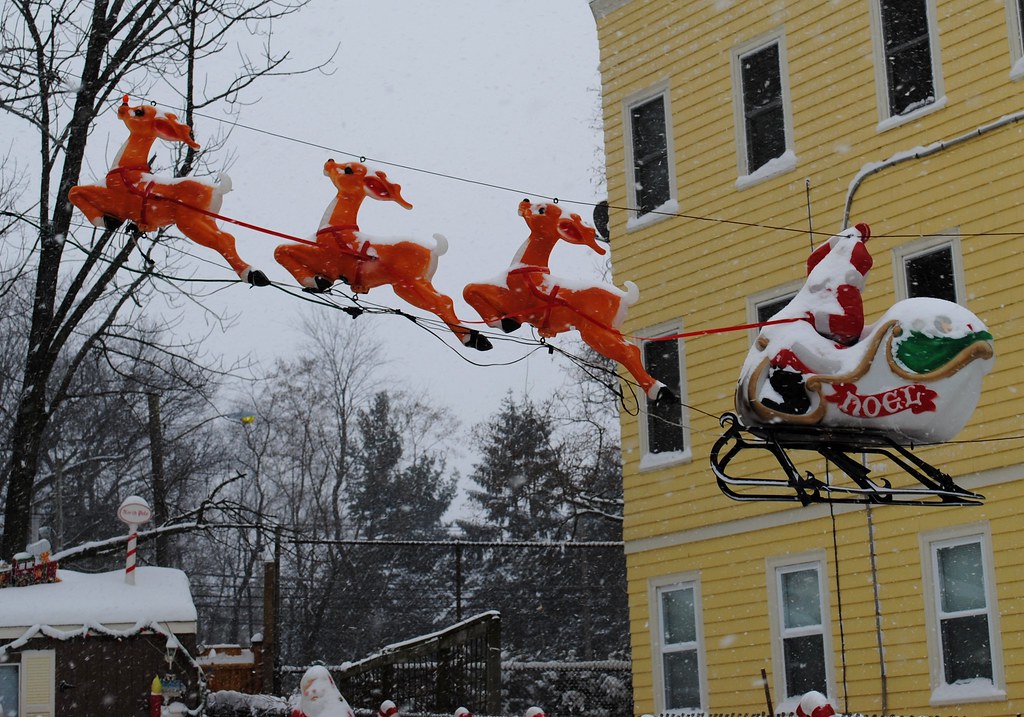 I took my camera along and had grandiose plans to stop every so often and photograph Velouria against the backdrop of various winter scenes. However, the visibility was so poor and the snow so... snowy, that getting off the bicycle to pose it became the farthest thing from my mind once we were underway. Instead I offer you views of a few landmarks.
 "No Outlet" - Hah! Perhaps not for cars, but for a bicycle the gaps between fences will do just fine.
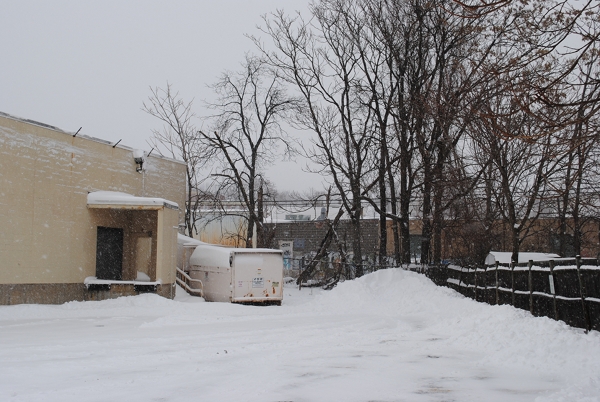 Arriving to the grocery store via the back parking lot.
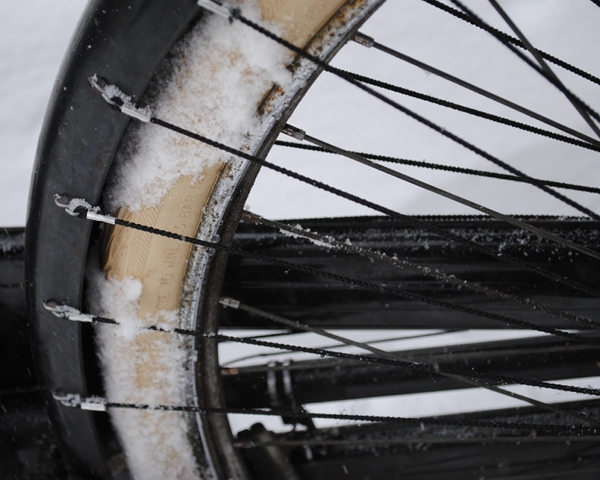 I did not experience a sense of slipping on the snow while going straight or while making turns, but again, I was intentionally cycling very slowly. The tires on my DL-1 are the Schwalbe Delta Cruisers, 28" x 1 1/2". By the time I returned home from the grocery store (having purchased a bag of raw cranberries and some chocolate), the snow had made its way into every single crevice of the wheels, covering the spaces between the spokes and dress-guard cords.
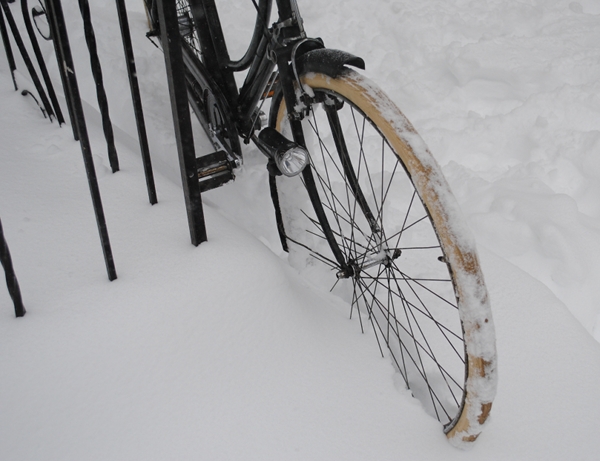 If you click to enlarge the picture above, you can see that the snow also made its way into the gaps around the brakes. This is a problem not just for bicycles with rod brakes, but for any bicycle with rim brakes. The snow lodges itself in between the rim of the wheel and the brake pad immediately, increasing stopping time considerably. Because I was cycling so slowly, this did not really matter; at that speed I could stop the bicycle by merely putting a foot down. But if you plan to cycle with anything resembling normal speed, I think drum or disk brakes are the only solutions that will provide adequate stopping power.
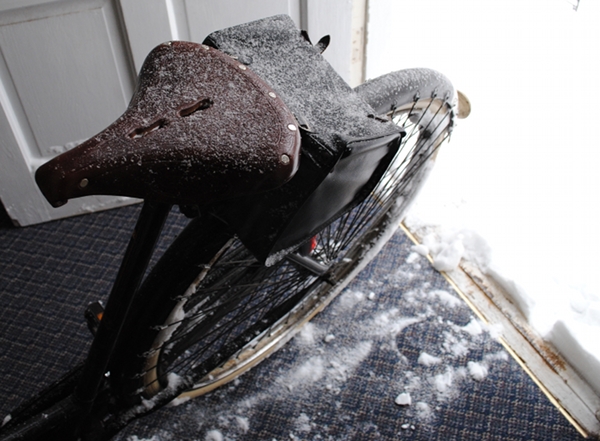 This short but beautiful winter adventure was more than enough for me and Velouria. We were happy to return to the warmth of our home - both of us trailing lots of snow. That snow on the saddle accumulated during the time it took me to drag the bicycle up the front stairs. If you don't want snow on your leather saddle, consider swapping it out for a vinyl one for the winter. For me, a little precipitation on the leather is okay though.
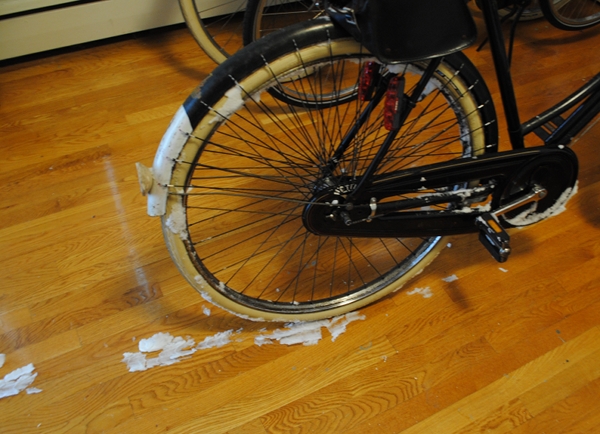 I did experience a panicked sense of remorse when I saw the extent of snow accumulation on the bicycle once we got home, and the next 30 minutes after this photo was taken were spent with a rag, frantically wiping off the moisture. I have been assured however, that the snow in itself is not bad for the bicycle; it is only the salt that is damaging. Thankfully, the roads had not been salted yet at the time of our ride. Velouria enjoyed the refreshing tour through our local Winter Wonderland. She is up for doing it all again - as long as I promise to go slowly, keeping her rod brakes in mind.


