Showing posts with label bags. Show all posts

Friday, 12 August 2011

Traveling by Bike

Bike Travel!
As you may have noticed, we are staying on the coast for a little while - our annual working vacation. This is something we've been doing at the end of every summer for the past six years. When we lived further North, we used to go to a place in Maine, and after moving to Boston we began staying on Cape Cod. I've been writing about that for the past two summers, and it's funny how over time our trips became increasingly bicycle-oriented. Two years ago we went by car as usual, but for the first time took bikes and cycled around a bit during our stay. Last summer we arrived by car again, but got around entirely by bicycle once there and attempted some high mileage day-trips. This summer we no longer have a car and really did not want to rent one just for the trip. So after discovering that Cape Ann was accessible by commuter rail, we decided to come here instead and do the whole trip on bikes. Another reason for choosing Cape Ann, is that it is a popular starting point for long rides up the coast of Northern New England. There are no decent routes north directly out of Boston, and what cyclists often do is take the commuter rail up here before proceeding north. So that was the plan: To arrive on our bicycles, to get around by bike, and to cycle up the coast as far and as often as possible in the course of our stay.

Rivendell and Surly Go Traveling
Our main challenge was figuring out how to transport our belongings. This is not a bicycle-specific trip, so we needed more than a change of cycling clothing and rain gear. We are living here for two weeks and doing all the same things we do at home - including work-related stuff. We needed our regular clothing and footwear, personal hygiene products, bedding, towels, laptops, a variety of electronic devises, some necessary books and documents, and our camera equipment - in addition to the cycling clothing, tool kits and raingear. And all of that we fit into the luggage you see here.

Rivendell with Handlebar Bag, Saddlebag and Panniers
For a number of logistical reasons, we decided the most practical course of action would be to turn one person into the pack mule - and since I already had a front rack and a large handlebar bag on my bike, it made sense that this would be me. I had planned to eventually get a touring-specific rear rack for my Rivendell anyway, and so that is what I did. Between the two of us, we packed a total of five bags for the trip - four on my bike and one on the Co-Habitant's.

Rivendell with Handlebar Bag, Saddlebag and Panniers
The rear rack on my bike is a Nitto Campee with removable lowrider panels, to which we attached a set of Carradice panniers, while using the rack's platform to support a Sackville SaddleSack. These bags plus the Carradice saddlebag on the Co-Habitant's Surly contained our clothing, bedding and laptops. My Ostrich handlebar bag contained camera equipment, electronics and various other miscellaneous items. Everything was packed very tightly, and I estimate that my bicycle weighed around 100 lb when all was said and done.

Rivendell with Handlebar Bag, Saddlebag and Panniers
The ride to the train station from our house is 4 miles through some of the busiest parts of the city. I have never ridden with my bike loaded up like this before, and the prospect of trying it for the first time in Boston traffic was nerve-wrecking. Overall, the bicycle handled fine. Once it got going, I could not feel the weight at all, and the heavy handlebar bag did not affect steering. But at very slow speeds - especially when starting and stopping - there was a fishtailing effect in the rear that took some getting used to. Also, with so much weight on the bike, the brakes were less effective than usual, which I had to keep in mind when stopping on a downhill. The frame itself had an interesting feel to it  - as if it was "yielding" to the weight (mildly flexing?). The resulting ride quality was in some ways nicer than with the bicycle unloaded. Having survived this ride in traffic, loaded touring on the open road does not seem in the least daunting. Going slower than usual is, of course, a given - but the reduction in speed was not as drastic as I thought it might be. Even cycling uphill (which I got to experience once we arrived to Cape Ann and rode from the train station to the place we are staying!) was not as difficult as I expected. Thanks to a helpful reader after my description of our previous commuter rail experience, we were able to board the elusive bike train, which made the trip more pleasant still.

Carradice Pannier
Once we arrived and settled in, we removed the lowrider panels from the rear rack, transforming my bike from a full-on pack-mule into a lighter ride that could still carry food and equipment when necessary. I will write more about this particular rear rack in a separate post; it is pretty neat and versatile.

Drying
The place where we are staying is somewhere between a cabin and a shack on the architectural spectrum and is the size of a small garage. It is situated on a rocky cliff overlooking the ocean, and there is a beach down the road. Despite the stormy weather, we love being here - just the two of us and our bikes. Yesterday the sun finally came out and we did a 50 mile "warm-up" ride, hoping for more soon. And it feels great that we were able to drag all of our stuff up here without needing a car. It was important to us that this did not feel like a compromise compared to the previous times we've gone away, and it most definitely does not. We were able to fit everything we need into our bicycle bags, and not having to deal with a car here feels extremely relaxing. I highly recommend giving traveling by bicycle a try!

Wednesday, 27 July 2011

A Look at Berthoud Handlebar Bags and Thoughts on Attachment Options

Berthoud Handlebar Bag, Model 25
I finally received a Giles Berthoud handlebar bag for the Randonneur. It's the Model 25 in gray, which is their medium size and features elastic ties for the pockets instead of leather straps.

Berthoud Handlebar Bag, Model 25
The visual presence of this bag is almost too much for me. There is something about its colour scheme and construction that says "I am French and I am exquisite," and I find this both interesting and intimidating.

Berthoud Handlebar Bag, Model 25
But happily, the Berthoud does not overwhelm the aesthetics of the bicycle. The size is a perfect fit. And the darker fabric and lighter leather combination parallels the contrast between the frame and lugwork. In comparison, the Ostrich handlebar bag on my own bike is more drab and also more bulky.

Berthoud Handlebar Bag, Front Pocket
The bag has a large front pocket,

Berthoud Handlebar Bag, Side Pocket
two side pockets

Berthoud Handlebar Bag, Pockets and Rack Attachment
and two rear pockets. The top flap closes toward, rather than away from the cyclist, which is the opposite of what I am used to with the Ostrich and makes it counterintuitive for me to use - but this is of course user-specific. You can see that leather straps are provided for wrapping around the back of the rack. However, there are no provisions for securing the bag to the rack's platform, which surprised me (Ostrich includes straps for this). I know that some devise DIY systems, and if you've done so I'd love to hear about your process.

Berthoud Handlebar Bag, Books and Clothing
There are leather straps provided for attaching the bag to the handebars, though most opt for installing a decaleur. And here is where we are experiencing a little glitch. Ideally, the owner would prefer to forgo a decaleur: He plans to ride both with and without the bag, and a bagless decaleur sticking out of the bicycle doesn't look great (I agree). The handlebar straps hold the bag up fine, but without being secured on the bottom it bounces on the rack when filled with stuff and going over bumps.  I am also told that the bag can move from side to side without a decaleur, though I haven't experienced this yet during my one test ride so far (with 10lb of weight in the bag).

Berthoud Handlebar Bag, Handlebar Straps
As far as decaleurs go, we had planned to use one of these if going without proved impossible, but I have since been warned that using it with the Nitto lugged stem (as opposed to the regular Technomic stem) is not a good idea, for complicated reasons related to clamp compatibility that I won't go into here.  An alternative would be Berthoud's own decaleur, but it too apparently presents issues with the lugged stem - plus it is fairly obtrusive without the bag on. A headset-mounted decaleur is not possible here, because it would sit too low. So I am seeking a solution, and  also wondering whether securing the bag at the bottom would in itself solve the problem. The bag is not nearly as large as my Ostrich, and I know that some do manage to use it without a decaleur. Sharing of experiences in this regard would be most appreciated.

Saturday, 2 July 2011

A Little Give-Away for the Long Weekend

[image via Po Campo & Planet Gear]

Longing for something lovely, US-made and free to go with your celebration of freedom from monarchy this week-end? How about a Po Campo Spare Pocket from PlanetGear? This curious item is a water-resistant mini-purse that attaches to your wrist, ankle, or bicycle handlebars. The fabric is a beautiful "contrast damask" with reflective bird detail. I am not one to carry a purse, let alone a tiny purse, so that whole genre of accessories rather mystifies me! I can see attaching this to the handlebars though.

PlanetGear is a women owned retail club offering discounts on gear, clothing and travel destinations, as well as referral programs and monthly specials. I am not a member and am not affiliated with the company, but it looks interesting and hey - if they want to give you free stuff, how can I stand in the way?

If you would like the Spare Pocket, simply post a comment describing your week-end cycling plans (if you don't have any, make some up!) and I will then pick a random entry. US entries only for this one, and please include your contact information in the comment. Recipient will be chosen on Friday July 8th, and you may enter any time up till then. Thank you to PlanetGear for the give-away, thank you everyone for reading, and enjoy the holiday!

Thursday, 23 June 2011

Po Campo Loop Pannier: a Ladylike Briefcase to Fit Any Bike

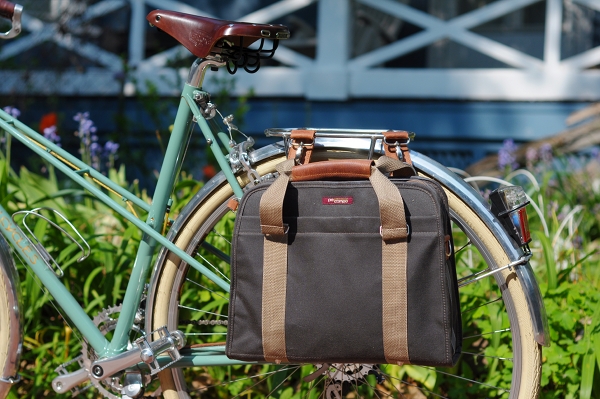
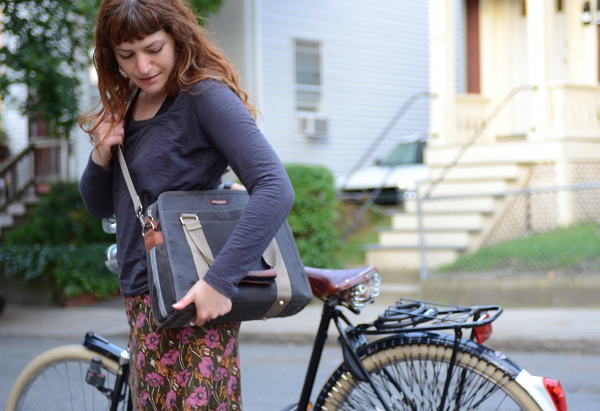
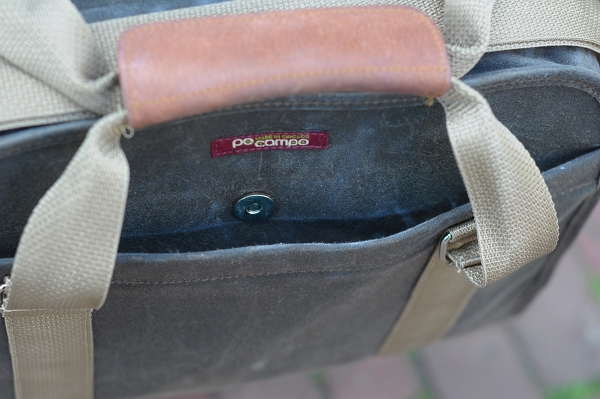
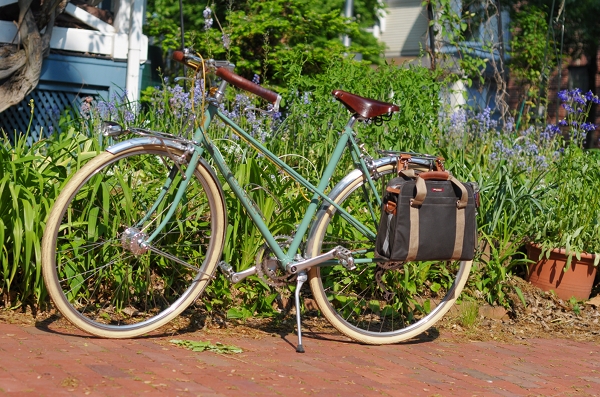
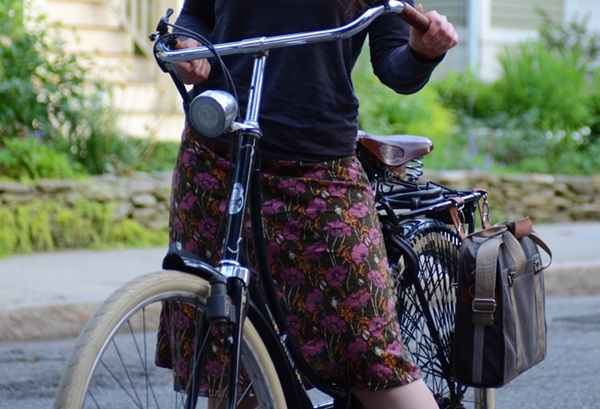
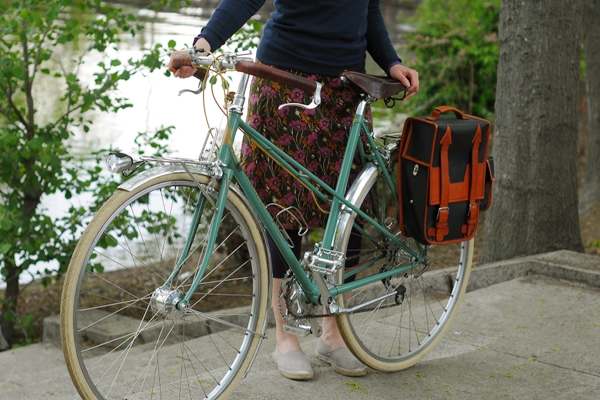
Po Campo is a small Chicago-based company that has been making a variety of bicycle-compatible women's handbags since 2009. This year they introduced a larger, briefcase-like pannier to their lineup and I acquired one in trade a couple of months ago. The Loop Pannier is available in several floral patterns, but I opted for the more subdued waxed canvas version. It is umber with tan straps, metal buckles, and honey leather trim. At 14"x10"x3.5" the size is small enough so that there is no heel strike on bikes with short chainstays, but large enough so as to fit some laptops. These bags are designed to be used on the bike as panniers, off the bike as shoulder bags, and as luggage attachments while traveling.

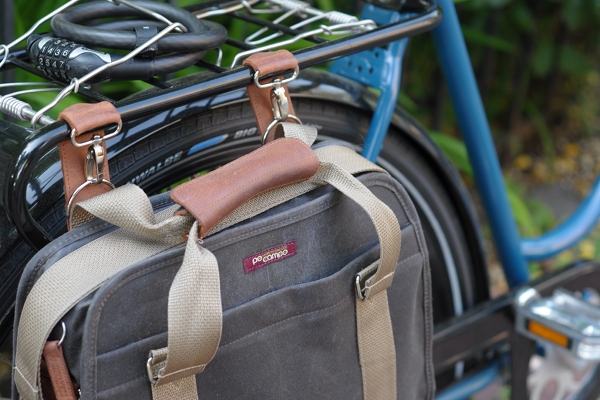
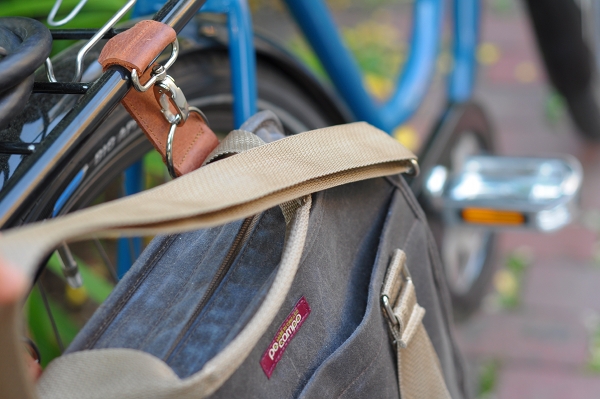
The Po Campo attachment system consists of leather straps with sturdy metal clasps. When I saw this, it was one of those "why did no one else think of this earlier?" moments. The benefit of this design is that it can fit bicycle racks with any tubing diameter. Other quick-release systems max out at 16mm tops, which means that they will not fit some heavy-duty Dutch and Roadster racks. None of our other panniers are compatible with the monstrous tubing on this Pilen rack - but the Po Campo straps have plenty of room to spare.

While using the clasps is not quite as instantaneous as the sort of quick release where you lift up the handle and the hooks open up, it is still easy and quick.

Since the straps are soft and flexible, they also offer the benefit of being adaptable to the rack's layout. Some racks have complicated rat-trap setups that can interfere with typical pannier hooks. The Po Campo straps can simply be looped around them. The more I used this system, the more I began to appreciate the design. Those who dislike plastic hooks will also rejoice at the complete lack of plastic here; it's all metal.

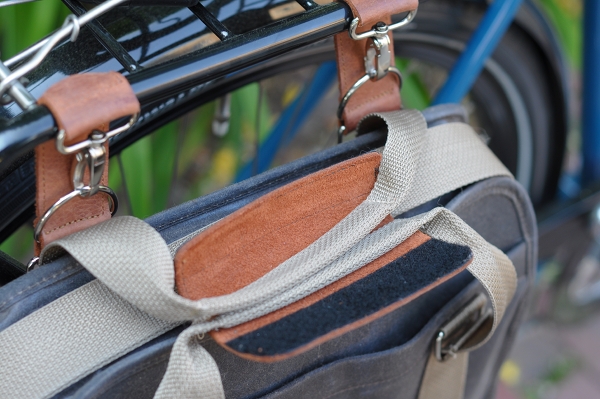
There are two short straps integrated into the pannier, and a longer detachable shoulder strap. While initially managing the system of straps seems complicated, it ends up being very intuitive.

The long shoulder strap folds over the top of the bag. Then, the second of the short straps gets tucked into the leather handle attached to the first, which closes with velcro. This keeps all three straps neatly tucked in and away from the spokes.

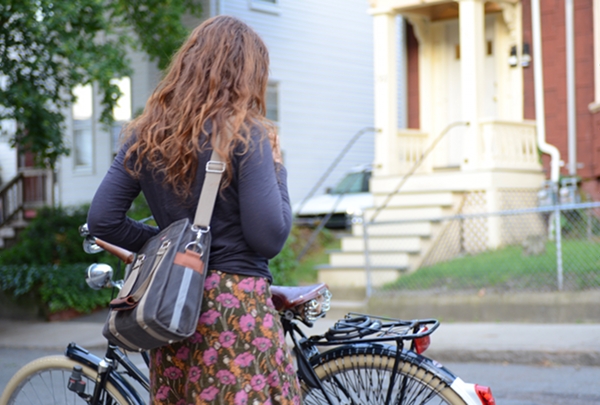
When the bag is off the bike, it can either be handheld, or used as a shoulder or messenger bag. I prefer the latter, especially since adjusting the shoulder strap on the go is very easy - the adjustment buckle slides freely.

I have walked around with the bag as pictured for a couple of miles and it felt fine. I've also shortened the strap and have worn it over one shoulder, like a handbag. Either way is pretty comfortable and the clasps absolutely do not catch on my clothing. It basically feels like a normal bag to carry, not like a bicycle-specific pannier.

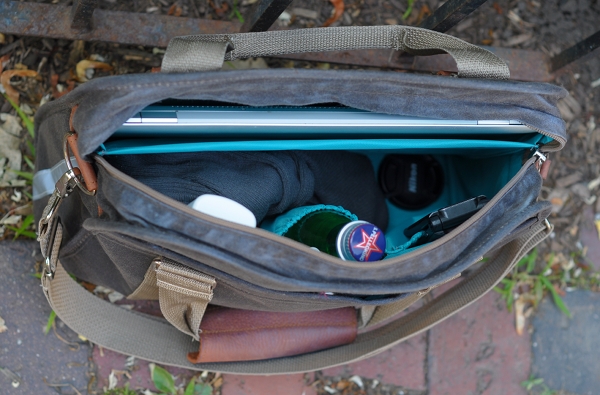
Another feature of the Po Campo I appreciate is the way it is organised inside. There is a large main compartment, and a side compartment that they refer to as a "file/lock pocket." However, I use it for my laptop, which is a MacBook Air and is the perfect size for it. I use the main compartment for clothing, books, notebooks and my DSLR camera.

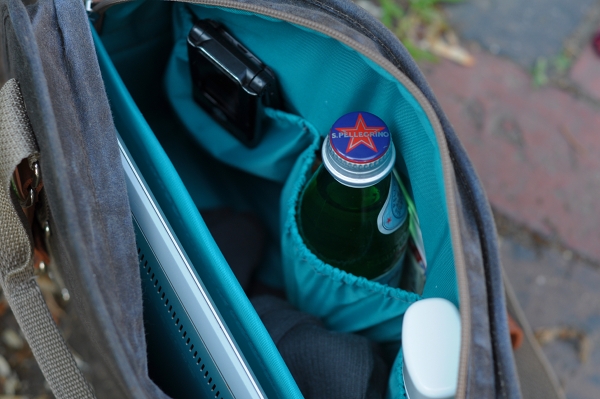
There are also three elasticised interior pockets that will each fit a wallet, phone, writing instruments, or even a small bottle of water.

The exterior pocket is quite roomy. It is especially useful for those times you need to remove a sweater or grab some water in traffic.

I tend to overpack whenever I leave the house, so this pannier is always bulging with stuff when I use it. Still, the structured design keeps it all looking neat and presentable.

The reflective strip along the back is nice for extra visibility.

I have tried the Po Campo pannier on five different bikes with different types of racks, and it works well on all of them. I cannot imagine a rack design with which this bag will be incompatible, and in my view that is one of its most valuable features. Other strong points include the durable construction, the professional look, and the ease with which the bag can be used off the bike. This is a small pannier and you will not be able to fit groceries in it; it is really meant as a briefcase/ professional bag and will accommodate only the smaller laptop models. But the compact size has the added benefit of preventing heel strike on bicycles with shorter chainstays.

All things considered, I only have one critical suggestion for Po Campo: Think about making a version for men. When I ordered the waxed canvas finish, I was hoping that the Co-Habitant could use it too. He was delighted that the bag fit the unusually fat tubing of his Pashley Roadster rack (no other quick-release pannier we've tried will fit it), but he thinks its shape is too feminine. While Po Campo designs their products with women in mind, I think the versatile attachment system and the elegant briefcase construction of this pannier is too good not to share with the menfolk.

Sunday, 15 May 2011

Custom Leather Pannier by Cristobal &Co

[edited to add: Cristobal &Co was not a sponsor at the time this review was written.]

Since having written my "short chainstay lament" some time ago, I've connected with a number of small manufacturers and artisans who have developed panniers specifically to solve this problem. And yes, I will be reviewing them all to the best of my ability! This month I bring you Cristobal &Co. I am familiar with the owner of Cristobal via bikeforums and obtained this pannier in an equal value trade.

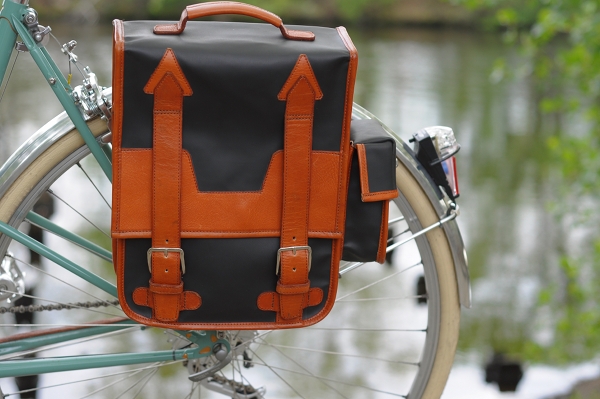
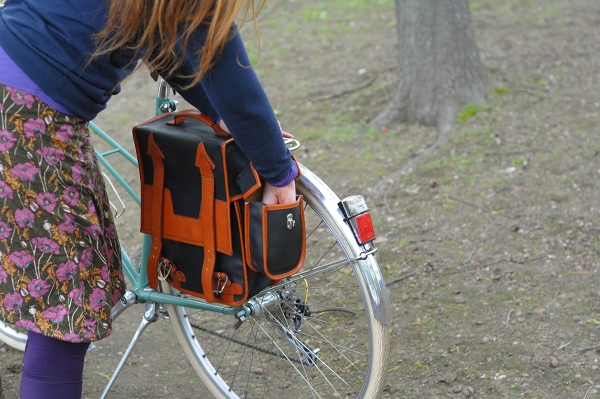
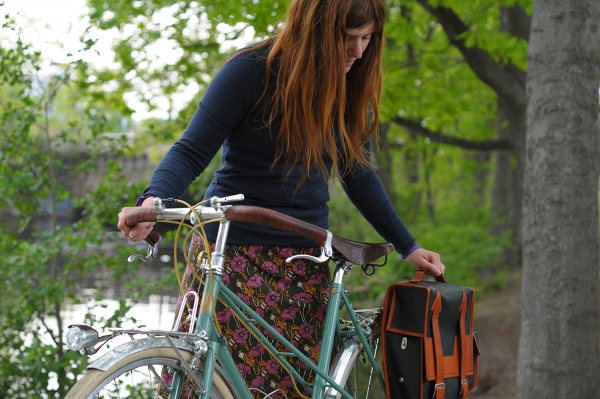
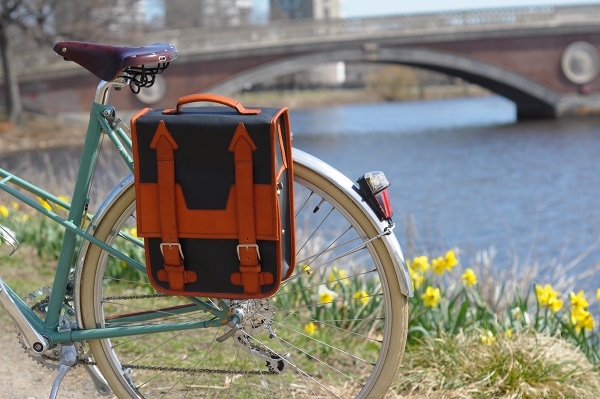
Cristobal panniers are custom-made by hand by traditional artisans in Mexico. They are made of leather and covered with a thin layer of weatherproof and UV-resistant synthetic fabric. Although standard models are available, the nicest thing about Cristobal is the possibility for customisation. I asked for a pannier that would fit my MacBook without inducing heel strike when used on my mixte. I sent measurements of my bike's chainstays and rear rack, we discussed dimensions, and I also indicated how high I wanted the pannier to sit. Shortly thereafter I received the cute, boxy Cristobal with honey leather and removable side-pocket. It fits my MacBook with much room to spare without a hint of heel strike.

Having used a variety of leather satchels in the past, I would describe the Cristobal pannier as exceptionally well made. The leather is of high quality and the stitching is precise. There are no loose threads, no botched edges. 

The underside of the leather is soft to the touch. There is an option to get a flap that will cover the rivets holding up the hooks on the back of the pannier, and I asked for this feature - making the interior completely safe for my laptop and camera equipment. 

The removable pocket can be fitted to either side of the pannier via a built-in attachment system.

It is large enough to fit a mobile phone and a small digital camera at the same time, which is useful.

The extra long leather straps with metal buckles are designed to hold a jacket when closed.

However, I usually just leave mine open, because it takes too long to mess with them (a quick release design could work nicely here). 

The attachment system consists of straps with buckles and two hooks. The open hooks go over the rack's tubing to keep it stable, and the straps are used to secure it. The hooks are standardly sized - similar to those used by Arkel - and will not fit racks with thick tubing, such as heavy duty Dutch bike racks. 

A lower pair of straps attaches to the rack's stays for greater stability. You can see in the pictures that the straps are easily moveable via the slots in the leather, which makes it possible to adjust the pannier to fit different bikes. You could also remove the lower straps altogether if you do not feel them to be necessary.

I found the Cristobal pannier convenient to use in that it makes for a great carry-all. With its rigid boxy shape, it is like a bottomless trunk that I can keep stuffing and stuffing with my personal belongings and groceries. On the other hand, the pannier takes some time to affix and detach, and its hooks are only compatible with some of my bicycle racks. Without a more versatile quick release system, I consider this to be more of a touring pannier than a commuter's pannier. Cristobal is willing to use alternative attachment systems upon customer's request, and I suggest getting something like the R&K Klickfix if you need an easy on-off feature that is compatible with a wide variety of racks (I didn't opt for that, because I was curious what the standard attachment system was like).

It is also worth noting that while leather is more durable than cloth, it is also heavier. If you value durability, waterproofness and craftsmanship over weight, then this shouldn't bother you. But if you are seeking the lightest set-up possible, leather is generally not the way to go. 

Cristobal panniers are starting to appear in bicycle shops across the US, and can be ordered directly from the manufacturer with various degrees of personalisation. Prices vary depending on dimensions and the amount of custom work, so please inquire with them directly. I am impressed with the craftsmanship and design of the pannier, and will consider retrofitting mine with a quick release system. 

Tuesday, 3 May 2011

Simple Solution for Unforeseen Groceries

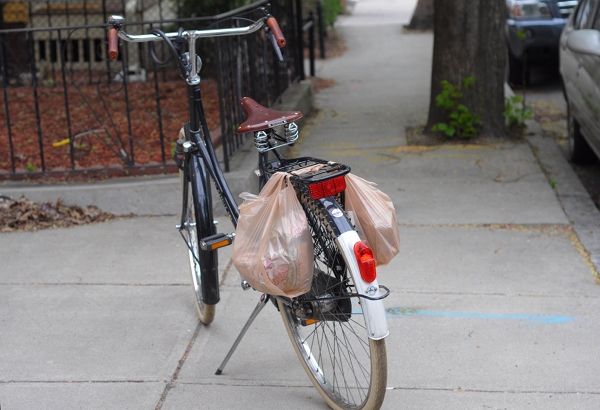
I have now stopped using the Urbana bike that I was test-riding in April and have gone back to my Gazelle. While overall I prefer the Gazelle, I do miss some of the Urbana's neat features and have been trying to devise ways of making the Gazelle just as accommodating. Among other things, I want to find a DIY solution that will emulate the utility of Urbana's fantastic rack that accommodates any grocery bag without requiring panniers. I thought hard, but could not come up with anything... until fate did it for me. If you haven't fainted yet from my use of plastic bags, perhaps you'll appreciate this.

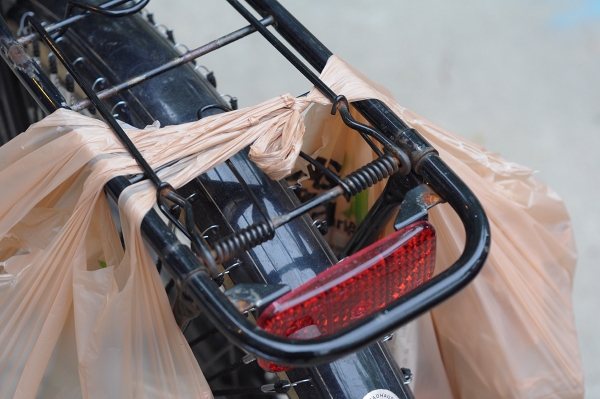
Yes, two bags tied together and turned into "panniers." It was totally impromptu. We were cycling past a grocery store just as it was about to close, when we realised that we had neither anything to eat at home, nor anything to carry it in if purchased. We ran in and bought some food, thinking we'd carry it home on the handlebars. But then, in a flash of brilliance, the Co-Habitant created the objet d'art you see here. We cycled home ridiculously happy. I guess this is what one of my readers meant when he wrote that "a peasant in any number of countries with a million plastic bags can figure out and equal number of ways of carrying their stuff."

Question: Why would one even buy dedicated grocery panniers, if they can take a pair of reusable canvas bags, connect them by the handles (with an S-hook or a bungee cord), and secure them to the rack either via rat trap or via the same bungee? I realise that the plastic bags in my pictures look horrible, but a pair of nice reusable shoppers could look as good as panniers while also being more versatile and costing just a fraction of the price. Does it just not occur to people in the same way it did not occur to us? While I am delighted to have this method of carrying groceries in a pinch, I am also feeling foolish that I did not think to do it earlier. It takes skill to recognise simple solutions, and that's a skill I would like to develop.

Sunday, 10 April 2011

Philosophy Panniers: Two Versatile Classics

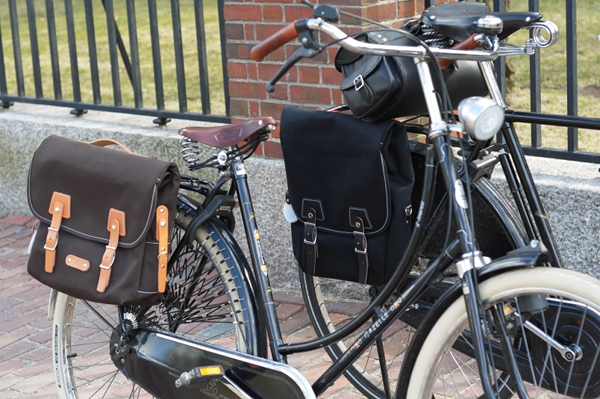
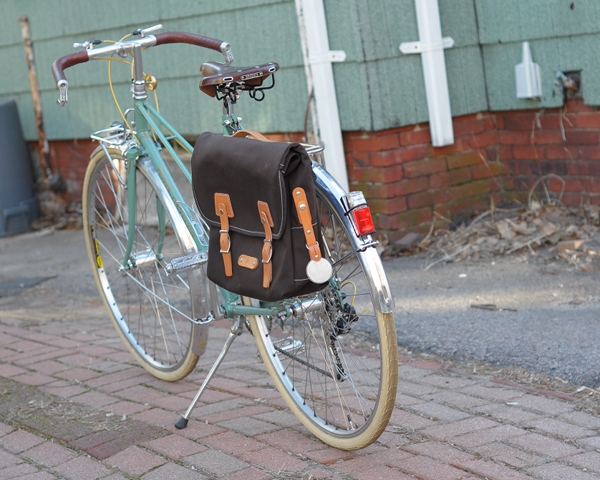
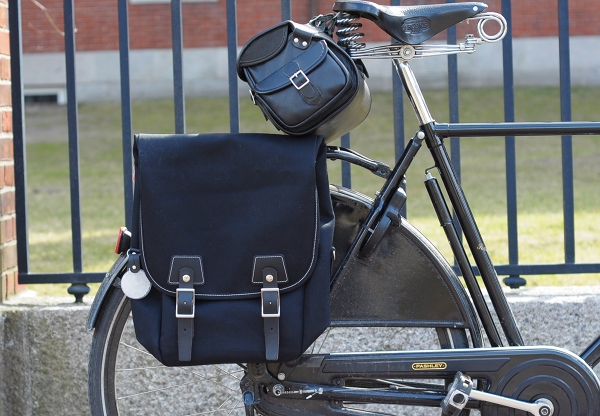
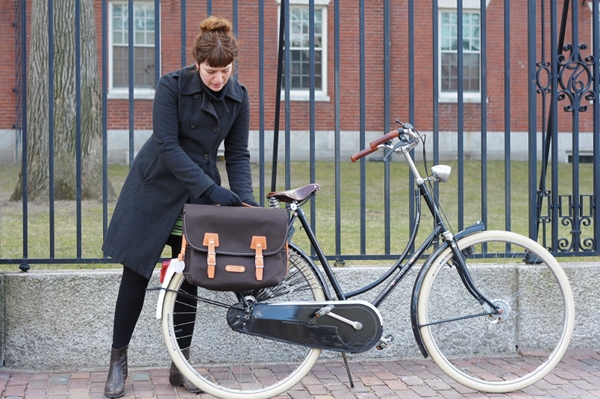
Just as I was lamenting the difficulty of finding classic commuter panniers that fit a variety of bikes and racks, a new company appeared offering just that: Philosophy Bags, based in Portland, OR. Handmade in the USA out of locally sourced materials, the description and looks of these bags were almost too good to believe, so I had to see for myself. Philosophy sent me their two pannier models to review: The Intrans satchel (above left), and two versions of the narrow Burnside (above right). We agreed that I would purchase the ones I wanted to keep, if any, and return the ones I did not.

Overview of the Models

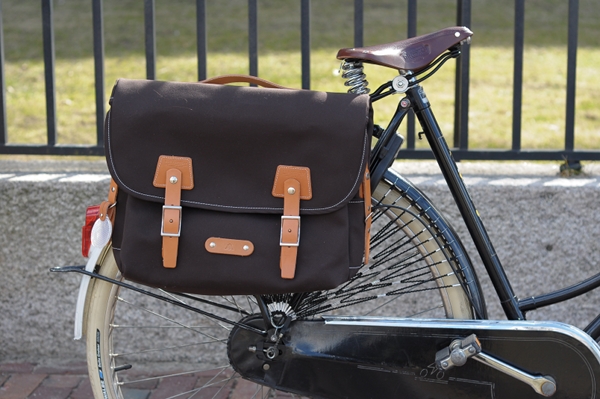
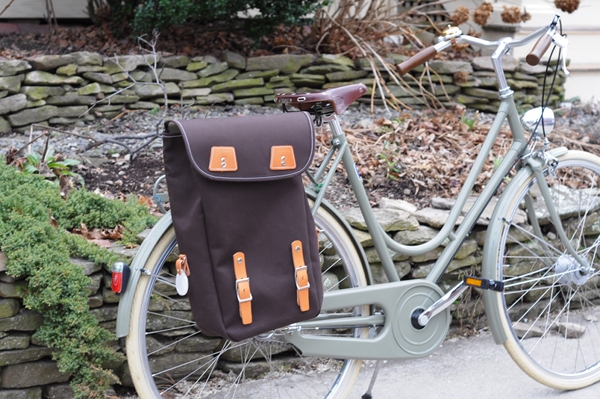
The Philosophy Intrans is a traditional satchel design that will look familiar to all. I asked for the brown and tan model, but there are several other colour schemes to choose from as well. Its dimensions 14.5x12x6", the Intrans will fit a full sized laptop and more.

The proportions of the pannier itself are equally suitable for heavy-duty Dutch bikes and for more delicate roadbikes or mixtes. Although large, it does not give the impression of overwhelming a bike, as many other panniers do. And despite its size, heelstrike can be avoided on the majority of bike and rack combinations thanks to the adjustable hooks of the mounting system (details later in the review).

To my eye the Intrans looks most "at home" on a large, classic, upright bicycle - but this is a matter of personal taste.

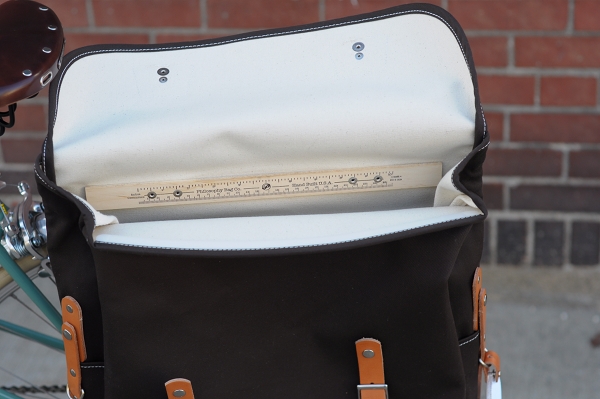
Once opened, the satchel reveals a slight, expandable "roll top" - making it a bit more roomy than it appears to be when closed. The inner fabric is off-white. Inside is a suspended compartment with two medium pockets. A wooden ruler is attached to the base of the outer flap and acts as a support for the leather handle.

The Philosophy Burnside is a more unusual pannier. Narrower and longer than the Intrans, its outside dimensions are 11.5x14x6". The narrower design makes it ideal for bicycles with short chainstays and small racks.

Though it does not look out of place on a heavy upright bicycle either. It is not a small pannier, just a differently oriented one. A clever design that is both roomy and avoidant of heelstrike.

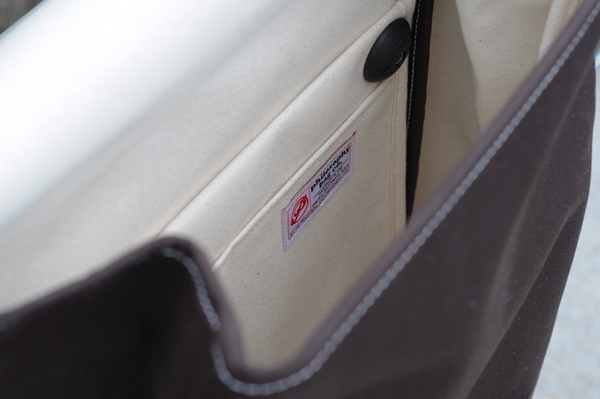
Inside is the same suspended double-pocket as on the Intrans, only narrower.

The genius of the Burnside design is its expandability. While on the outside, it looks like a classic pannier, once opened it reveals itself to be a roll-top, offering considerably more room than one would have expected (the expandability feature is more dramatic than on the Intrans).

Here is the Burnside with the buckles open. Because the roll-top expands upwards, there is no possibility of heelstrike when the bag is opened; you can fill it will groceries and keep cycling.

This is what the Burnside looks like filled with 1.5 bags worth of groceries.

Features

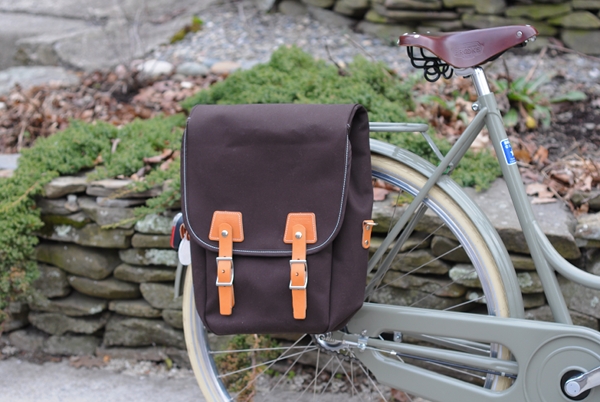
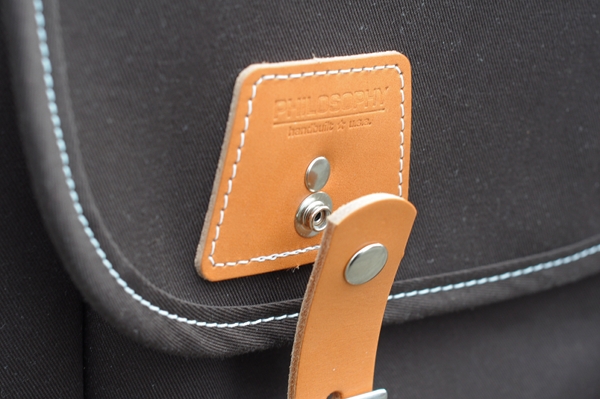
Both the Intrans and the Burnside panniers have a number of distinct and appealing features. The US-made 23oz tri-ply cotton is water resistant, oil resistant, and breathable. The leather is vegetable tanned and likewise made in the USA. Buckles and D-rings are stainless steel.

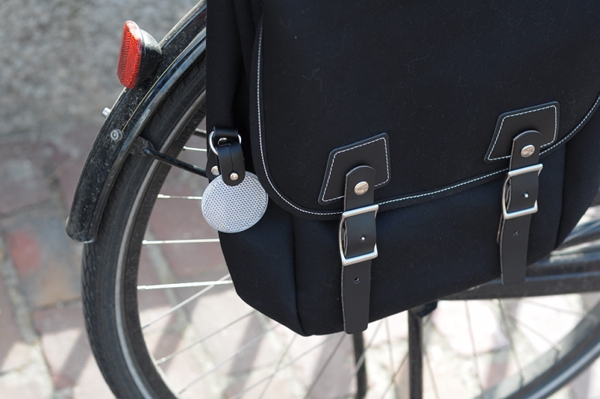
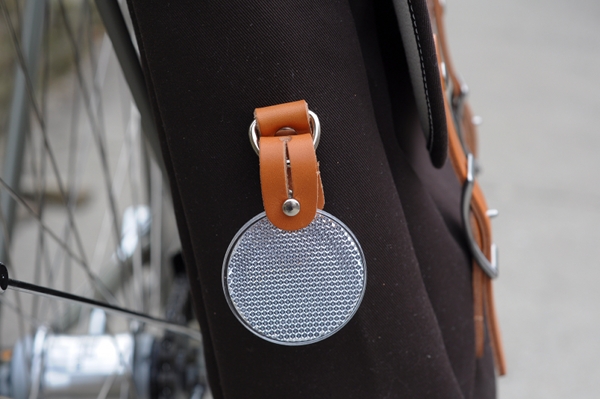
Detachable messenger straps are included with both bags, as are leather teathers for the optional attachment of rear reflectors. The reflector can be moved from one D-ring to another, depending on what side of the bike you attach the pannier to.

The buckles feature snap-closure attachment, making the bags fast and easy to open and close on the go.

The snaps are heavy duty and secure.

The satchel-like Intrans pannier comes standard with a leather handle, and such a handle can also be added to the Burnside as an optional extra feature.

Mounting System

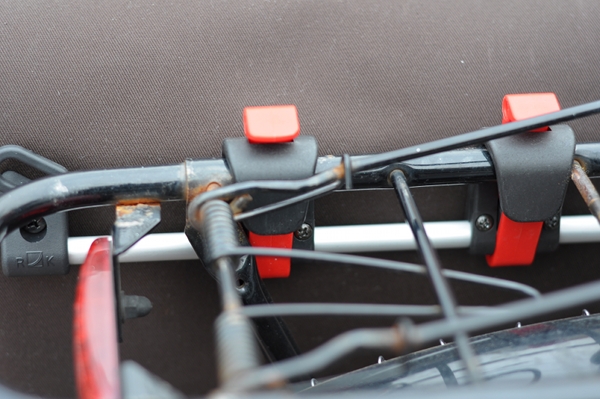
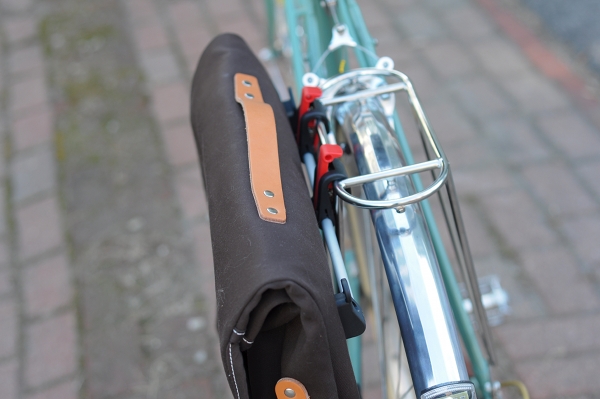
Philosophy panniers feature the Rixen & Kaul Klickfix mounting system - a well-tested system that is also used by Berthoud and Carradice. Having tried several other pannier mounting systems previously, this is my favourite one so far. It took me a few minutes to understand how to operate the hooks so that they close around the rack tubing, but once I got it they were simple and quick to use.

The R&K system is adaptable to racks with a variety of tubing diameters (8-16mm), making it extremely versatile. The hooks are not only large enough for racks with thick tubing, such as my Gazelle, but they are also sprung - which allows them to close just as tightly around racks with thinner tubing, eliminating bouncing.

The hooks are attached to a long aluminum rail, along which they can be slid to a position that avoids heel strike even on bikes with shorter chainstays.

The lower hook is supplementary, and helps keep the bottom of the bag from bouncing or flapping. The plastic side-hook slides along the rail and clips to the racks stays.

I have tried the R&K Klickfix system on four bicycle racks so far: The Velo Orange Constucteur Rack with thin tubing, the handmade Bella Ciao rack with medium tubing, the Gazelle rack with thick tubing, and the Pashley Roadster rack with monstrous (even thicker than the Gazelle) tubing. On the Pashley Roadster rack, the R&K hooks are a tight fit, possibly too tight for recommended use. On all the other racks, the mounting system fits without issues. Regarding the Pashley Roadster rack, note that the large Ortlieb QL-2 hooks fit equally tightly, and note also that the Pashley Princess does not use the same rack as the Roadster and the R&K system should fit it easily. It's possible that the tubing of this particular bike's rack is simply too thick for any pannier.

Criticisms

It took me several weeks to take all the pictures used in this review and to test both panniers, and during all this time I have been trying to come up with something critical, but not having much success. As far as functionality goes, I can't really think of anything substantial. One point to note, is that when I wore the Burnside over my chest "messenger style" off the bike, the lower (supplementary) sliding hook got caught on some of my clothing - namely the hems of cardigans. This only happens when the bag is in some positions, not others, and it does not happen when the bag is worn over one shoulder. I'd prefer it if the Burnside had a leather handle and I could simply carry it in my hand - and as mentioned earlier, Philosophy informs me that this is now an option. My only other suggestion would be to possibly reconsider the colour of the interior and the shoulder strap: The off-white is attractive, but a darker colour would hide stains and age better. Other than that, I honestly cannot think of anything. These panniers are exactly what I wanted in the sense that they are classic, roomy, and can fit all of my bikes without heel strike or rack compatibility issues.

Which to Keep?

The Co-Habitant will be returning the black Burnside, because he does not feel comfortable with the hooks' tight fit over his Pashley's rack. And as much as I love both the Intrans and the Burnside, I will keep just one pannier, as I neither need nor can afford both of them. It's a tough call. The Intrans is a more traditional satchel design and feels somewhat better balanced in my hands. The Burnside fits all of my bikes in such a way that the hooks don't need to be adjusted from one bike to another, which makes it more convenient for multiple-bike use. I think that this feature may end up winning, and I will keep the Burnside while tearfully returning the Intrans. Or maybe not! Either way, Philosophy panniers are high quality, well though-out, versatile and classic products that are well worth their price and are unlikely to disappoint. Best of luck to this new company.

Ping Blog

Step 1
Blog URL:


Blog Title (optional):


Blog RSS Feed (optional):


I agree with terms of service.

Step 2
Copy the following code and put it on your blog/site to help our blog ping tool track your submission (Need help?):
;

 
Design by Free WordPress Themes | Bloggerized by Lasantha - Premium Blogger Themes | Best Buy Coupons