Showing posts with label bicycle reviews. Show all posts

Friday, 5 August 2011

Pilen Lyx: the Pragmatic Romantic

Blue Pilen, Yellow Roses
Earlier this summer, I had a Pilen Lyx lady's bicycle in my possession for over a month, on loan from the US distributor BoxCycles. During this time I got to know the bicycle fairly well, and it is one of the more unusual classic bikes I have ridden so far - with a combination of qualities that makes it difficult to categorise. A city bike and an off-road bike in one, the Pilen is attractive, durable, amazingly stable, and is capable of hauling a great deal of weight.

Pilen Lyx
When the blue Pilen was delivered to me, I was taken aback by its striking looks. I knew that this bicycle was designed to be practical, not pretty. A Scandinavian friend described its reputation as that of a "tank" - resistant to rust, tolerant of neglect and abuse, and indifferent to getting dropped on the ground or crashed at slow speeds - all around "solid." In a region that is no stranger to heavy-duty bikes, that is quite a statement and it led me to expect a purely no-nonesense machine. But in person the Pilen has a romantic quality to it that transcends the practical aspects.

Pilen, Charles River Trail
It is not a quaint bicycle. But it is graceful and evocative. My imagination immediately went into overdrive with daydreams of seaside forest trails and lush meadows under stormy skies - the Pilen gliding through them with a stack of firewood strapped to its rear rack. While in a way such flights of fancy are absurd, I think that a bicycle's ability to inspire is tremendously important, and the Pilen inspires.

Pilen, Charles River Trail
Aside from the looks in a general sense, I was impressed with the frame construction. I knew that the frame was TIG-welded (not lugged) steel, so I was not expecting to swoon over it. But as far as welded frames go, this is swoon-worthy. The frame joints are beautiful, with the welding marks nearly invisible - visually on par with custom frames.

Pilen Lyx, Seat Cluster
The curved seat stays are capped and meet the seat tube in the most elegant manner. No shortcuts, no ugly blobs here. The top of the seat tube has a "collar" that completes the quality feel.

Pilen Lyx, Fork Crown
The crisp, lugged fork crown balances out the details at the rear. It is really very nicely done and I prefer a frame like this by far to frames where the main tubes are half-heartedly lugged, with a welded rear triangle or a unicrown fork slapped on.

My one criticism of the frame construction, is that while there are details such as a braze-on for the front wheel stabiliser spring, there are no braze-ons for the shifter cable and it is attached along the down tube with black clips. Why not add a couple of braze-ons here?

Long Term Pilen Test Ride... Then Give-Away!
The Pilen headbadge: "cycles from Malilla." The word pilen means "arrow" in Swedish. The bicycles are designed and assembled in-house, with the frames built in Taiwan to their specifications.

Pilen Lyx, Brooks B66S
Pilen bicycles come equipped with Brooks B66 saddles (B66S for the lady's frame) in a selection of colours. Frame colour can also be selected - the other options being black, dark green and dark red.

Pilen Lyx, Bell
Rubber grips and a Pilen-branded bell. You have to spin the bell to ring it, which can work nicely for those whole finger hurts from trigger-style bells.

Pilen, Charles River Trail
The version of the Lyx I had was equipped with a 3-speed Shimano coaster brake hub with a twist shifter. Other possibilities are available, including hand-operated brakes and 8-speed hubs. The bicycle comes with a dynamo hub-powered headlight, which can be attached either below the stem or on the side, via a braze-on on the fork - depending on whether you plan to attach a basket. When the headlight it attached below the stem, the wire is contained within a long spring that attaches to a braze-on on the fork. I have never seen this method before and spent a lot of time examining the spring.

Pilen Rear Rack, Handpainted
The tail light is battery powered - as is increasingly the trend with many European bicycles that previously used dynamo-powered lighting front and rear. I think the trend is an unfortunate one, and wish the Pilen had a dynamo-powered tail light.

Tire and Rock
The tires are 700C x 48mm Schwalbe Big Apples, black with reflective sidewalls.

Long Term Pilen Test Ride... Then Give-Away!
One feature that gives the Pilen its distinct look is the custom rear rack. It is beautifully made, with hand-painted insignia, and is unusually large.

Pilen, Pizza
For reference, this is a large pizza box (17"x17").

Pilen, Pizza
Jammed under the saddle and held in place with a rat-trap spring. Yup, that's all it takes to transport a pizza on this bike.

Po Campo Pannier Attachment
This is the only rack I've seen with not one but two rat-trap springs, and they came in handy when devising creative ways to carry shopping bags. I have also attached stacks of large, heavy boxes to the rack with bungee cords, and it hardly flinched. The platform is so wide, that the packages stay very stable. The one downside of a rack like this, however, is that the tubing is too thick for pannier systems that attach via hooks. Ortlieb, R&K, Fastrider and Basil hooks will not fit around it. Only a system such as the one Po Campo uses (shown above and reviewed here) will work with the Pilen rack.

An optional front rack is also available with the Pilen (shown and reviewed here), but I opted not to install it. This front rack felt excessively heavy, and at 47lb the bicycle was already borderline too much for me to handle without it. I was also told that installing the front rack scratches up the head tube and headbadge, so all in all it did not seem appealing. For all of my needs (workbag, grocery shopping, and the occasional transport of boxes and bulky packages) the huge rear rack was sufficient.

Long Term Pilen Test Ride... Then Give-Away!
While in possession of the Pilen, I went back and forth between riding it and my mid-'90s Gazelle, marveling at the differences between them despite their superficial similarities. While my Gazelle is a prototypically hardy Dutch bike, it seemed almost flimsy in comparison to the Pilen's visibly thicker tubing, wider tires, and overall "heavier set" looks. The Gazelle's rear rack looked downright scrawny next to the Pilen's mighty platform, and the Gazelle's handling at slow speeds was like that of a drunker sailor compared to the Pilen's unwavering stability. On the other hand, the Pilen was slower to accelerate and more effortful to push for me than my old Gazelle - an experience that seems to be a factor of my size and weight, as described here.

Pilen, Neighbourhood
Compared to traditional Dutch bikes or English Roadsters, the Swedish Pilen's geometry is not quite as relaxed, and its handlebars are considerably less swept back - positioning the cyclist's hands almost straight in front of them, mountain bike-style. This makes the handling both more controlled and livelier, with the cyclist's weight more evenly distributed between the front and rear of the bike. While I like the lower positioning of the handlebars, I would prefer it if they had more sweep to them - but this is a matter of personal preference.

Magic Cycling Dress Prototype
The thing that impressed me the most about the Pilen's ride quality, is its stability. When starting and stopping, it feels extremely sturdy and safe. I wrote earlier about all the different things people mean when they describe a bicycle as "stable," and the Pilen is pretty much all of them. It does not want to go down, no matter what - a factor that can be especially important to novices who are worried about faltering at intersections in traffic.

Pilen Bicycle, Castle Island
I also soon discovered that the Pilen handled excellently on a variety of off-road surfaces: grass, dirt, gravel paths, even narrow trails with roots and rocks. This is a very fun and safe bicycle to ride off pavement.

Pilen Bicycle, Castle Island
All in all, I have probably ridden about 100 miles on the Pilen - most of it in the form of short (< 5 mile) trips. The longest I have ridden it in the course of a single ride is 20 miles. Initially I was reluctant to take a longer trip on this bike, because of how relatively effortful it felt to accelerate. But in the course of the longer ride it "blossomed" and we developed a flow that made it faster and easier than I expected. The bike also did surprisingly well on hills, particularly if given a chance to pick up speed beforehand.

Pilen, Charles River Trail
The more experience I gained with the Pilen over time, the less certain I became about how to define or explain it. A classic "swan" frame reminiscent of vintage bicycles, it really handles more like a contemporary mountain bike with upright positioning. The on/off road handling can be especially useful for those who regularly travel through pothole-ridden neighbourhoods, or for those who have access to off road trails for commuting. For those who enjoy touring on an upright bike, the Pilen could be a good candidate as well.

Pilen Lyx, Sunset
The one size only 56cm lady's frame is best suited for taller women, which is good news for those who have been unable to find step-through frames in larger sizes. The heavy-duty tubing and wheels are designed for carrying serious weight, which is great for heavier riders and for those regularly traveling with the bike fully loaded. No bicycle is for everyone, but I think the Pilen fills a niche that needed filling: It is a hard-core, elegant transport bike whose mountain bike-ish handling should be inherently familiar to a North American cyclist. Though I would have liked to see a full chaincase, dressguards and a dynamo-powered tail light on the Pilen, it is otherwise fully equipped for daily transportation. Having housed it outdoors for the duration of my guardianship, I can attest to the bike's resistance to the elements and its general durability: There is not a scratch on the powdercoat and the components are free of rust. 

Last month I hosted a contest to give away the Pilen to one of my readers, and the winner should be receiving the bicycle shortly. I wonder what she will think of it, and how her impressions will compare to my pragmatic and romantic musings. Many thanks once again to Will of BoxCycles for the opportunity to get to know this bicycle, and for so generously donating it to be given away. 

Monday, 11 July 2011

The Brompton: an Extended Test Ride

Brompton P6L-X
About a year ago, I briefly test-rode a Brompton folding bicycle and wrote about it here. We've been toying with the idea of getting Bromptons since before I started this blog, but it just hasn't happened. For one thing, I am not all that attracted to folders. They are fascinating, but they don't excite me in a way that would make purchasing one feel like an absolute priority. On some level, I also just instinctively don't trust that a small folding bike is as versatile and convenient as some claim: Is it really a good idea to ride a tiny bike in city traffic, where you want maximum visibility? Can a bike like this possibly handle hills? And don't those small wheels make for a harsh ride? My short encounter with the bike last year was insufficient to answer these questions, so I decided to test ride it properly once and for all. Harris Cyclery kindly lent me their demo model for this purpose. I left my own bike at Harris and rode home on the Brompton, then brought it back two days later.

Brompton P6L-X
The model I rode was the P6L-X, which means that it is set up with "butterfly" trekking handlebars, 6 speeds, fenders but no rear rack. The "X" at the end indicates that the frame is the lightweight version - with titanium fork and rear triangle. Generally Bromptons are available either all-steel or with titanium parts, either with or without fenders and racks, with a variety of gearing options, with or without dynamo lighting, and with a choice of handlebar styles.

Brompton Handlebars, Harris Cyclery
Here are the three styles of handlebars next to one another: the "S" type (mountain bike style straight bars), the "M" type (traditional upright bars), and the "P" type (trekking or "butterfly" bars).

Brompton P6L-X, Touring Bars
I chose a model with the trekking bars, because I was worried that my hands would bother me in the limited hand positions afforded by the other styles. I have problems with the nerves in my hands that make it difficult to hold them in the straight-in-front position for more than a few minutes at a time, so I did not want to take chances on the 9 mile ride home that awaited me.

Now I know that lots of people find these trekking bars goofy, and I agree. But you know what? The Brompton is already goofy, so to my eye the bars look right at home here. Imagine replacing that expanse of foam with some nice cork tape - I think this could look great.

Brompton P6L-X, Shifter
The gearing on the 6-speed Brompton is interesting in that it includes both a hub and a derailleur. The shifter on the right handlebar operates the 3-speed Sturmey Archer hub, while the shifter on the left operates the 2-speed derailleur.

Brompton P6L-X, Derailleur
Here is a close-up of the hub and derailleur together.

Brompton P6L-X, Ti Rear Triangle
And a panned out view. Notice also the titanium rear triangle in this picture.

Brompton P6L-X, Ti Stays
Titanium fork.

Brompton P6L-X, Ti Fork
The crown on these forks is made in the style of the Raleigh/ Pashley fork, which looks very cute in miniature. On the all-steel models, the fork crowns look like this.

Brompton P6L-X, Ti Fork
There is lots of debate among Brompton owners regarding whether the lightweight option is worth the hefty upcharge it fetches. The titanium parts reduce the weight of the bicycle by 2lb, and some claim that they also improve ride quality. Others claim that there is no difference in ride quality, and that the weight difference is negligible. Even after having tried both versions, I am unsure where I stand on this one. The online consensus appears to be that the lightweight package is not worth the price, but in person more than half of the Brompton owners I meet are sporting the titanium parts - shrugging diplomatically when questioned about its "value." Make what you will of that!

Brompton P6L-X, Fenders
As I wrote in my previous review, everything on the Brompton is impeccably made, proprietary and adorable. The tiny fenders with tiny mudflaps are particularly endearing.

Brompton P6L-X, Rollers
The little wheels mounted at the rear are so that the bicycle can be rolled when folded.

Brompton P6L-X
The staff at Harris Cyclery showed me how to fold and unfold the bike and attached a huge basket to the front, so that I could carry all of my stuff home. I first rode on the streets behind the store without the basket, just to get used to the bike. Because the Brompton is so low to the ground and has such small wheels, it initially gives the impression of being a very long bike and this took me some getting used to. It also felt "different" from normal bikes when starting from a stop: At first there was an odd sensation of momentary front end wobble when starting, so I practiced starting and stopping at intersections until it felt natural. Then I mounted the front basket and set off.

My ride home was just over 9 miles and the first half of it was on fairly busy, hilly roads, in 5pm suburban traffic. The Brompton does not handle like other bikes I am used to, but I did not find this bad or difficult to manage, just different. I soon discovered that the bike was easy to maneuver through tight spaces, and was capable of making dramatic turns gracefully and safely. I used this to my advantage when cycling through town centers in stand-still traffic. I was also pleasantly surprised by how easy it was to cycle up hill; The Brompton had a light, roadish feel to it when climbing. Cycling downhill felt stable, and the brakes were easy to control and modulate. 

Blurry Brompton
There is a lot of talk about small wheeled bikes having a "harsh ride quality," so here is my take on it. When riding the Brompton, I was aware of a constant, but extremely subtle feeling of road vibration regardless of whether the road was smooth or bumpy. This sounds worse than it actually is, so let me clarify: There was no pain or sense of being "knocked about" associated with what I am describing, just a very tiny, barely perceptible "shimmy" type sensation. Interestingly, when the bicycle actually went over bumps - even sizable ones - it handled them better than the average full-sized bike. So: I am okay with the subtle shimmy if it comes with the superior ability to swallow bumps, but others might not agree. Best thing to do is to test ride the bike and see how you feel about the ride quality - but "harsh" would not be a word I'd use to describe it at all. I can imagine riding the Brompton long distances on bad roads.

Brompton P6L-X, Brake Lever
The trekking handlebars were not as helpful as I had hoped in allowing for a variety of hand positions. I mostly kept my hands on the tops and occasionally on the corners. It is not possible to reach the brakes from the other positions, but moreover the other positions are not especially comfortable. I've been told by several Brompton retailers now that many customers prefer the traditional M-bar, but with bar-end attachments that will allow for a more ergonomic hand placement. 

Brompton P6L-X
Both the Co-Habitant and I rode the Brompton repeatedly over the course of the two days I had it on loan. My positive impressions included the high quality of the build, the smoothness over bumps, the maneuverability, the ease of mounting and dismounting (low step-over), the compact size, and the amazing load capacity. This bike is designed for enormous front bags, plus whatever the rear rack can fit - I had no idea it could carry this much stuff. And as far as aesthetics, I find the Brompton charmingly eccentric, and would be fine riding it. My favourite colour option is the raw lacquer, though I also love the new sage green. My not so positive impressions included the weight (a 20lb folding bike?), and the fact that should you not wish to drag the bike around with you everywhere, it is not so easy to lock up safely. While I know that most people are crazy about the famous Brompton fold, I am neutral about it. Maybe I'm just being difficult, but I don't get the miracle there: Okay, so it folds... Isn't that the whole point of a folding bike? But I am only partly serious and I do understand that it folds better than the other folders out there. It is a neat design that is especially conducive for travel - which is precisely why we are considering it.

In reality, our biggest problem with buying Bromptons is that in the course of choosing all the options we'd want (good lighting, 6-speed gearing, fenders, racks, extras) the bikes transform from what initially promises to be reasonably priced to something entirely unaffordable. Depending on the components and options selected, a Brompton can easily double or even nearly triple in cost, so that is something to keep in mind. Is it worth it? That depends on how much you want or need a folding bike. And among folding bikes, the Brompton is widely acknowledged to be "the best." Thank you to Harris Cyclery, in West Newton, MA, for this extended test ride.

Saturday, 18 June 2011

The Surly Cross Check Review: a Colourful Build and a Fender Massage

Two months ago, the Co-Habitant got a Surly Cross Check frame that he wanted to build up as a fun on/off road bike around a touring wheelset with fat tires that we already had in our possession. He is getting a nice roadbike later this summer (waiting for the frame to be finished!), and the Surly was meant to be "the other bike" - a playful, go-anywhere bike built around an inexpensive frame, mostly using components we already had. He swiftly put the bike together and has now cycled about 500 miles on it. The Cross Check is technically a cyclocross frame, but it is versatile and can also be used for touring and commuting. Given its unusual build, we've had many questions about this bike and so I offer a review on the Co-Habitant's behalf.

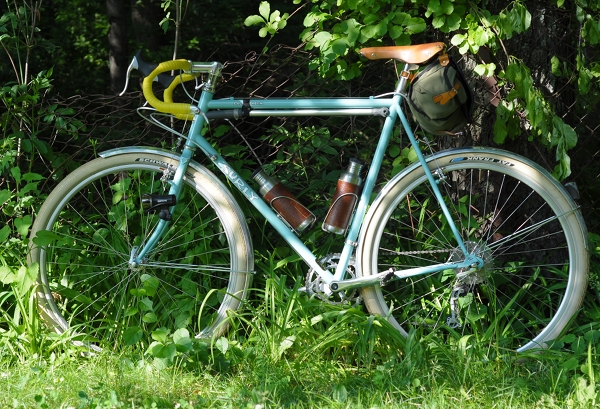
The most noteworthy aspect of the build, is that we were able to fit the frame with Schwalbe Fat Frank tires and metal fenders. This looks great, and the tires feel awesome, but to tell the truth the whole thing was a pain. The Cross Check is described as being able to fit tires up to 45mm with fenders, but the Fat Franks are 50mm. It was a tight fit that required some DIY. Initially we wanted to use Berthoud steel fenders, which are available in 700Cx60mm, but the Co-Habitant was not impressed with their quality upon seeing them in person. He also dislikes plastic fenders and did not want to use SKS. In the end he decided to get the Velo Orange Zeppelin 700c x 52mm fenders (which are rated for 42mm tire), and "massage" them to fit.

Out of the box, the fenders were too tight: The edges touched the sides of the tires and there was not enough space under the brake bridge and behind the seat tube to mount them high. So, the fenders had to be opened up. But when you open up a fender that's 52mm, it no longer follows the line of a 700C tire, instead making the opening much smaller. So while opening the fender, it had to also be stretched out -  taking care not to crimp the edges. To do this, he used a flat low table holding the fender upside down against its surface and pressing down gently, rolling it end to end - opening and pressing down. Pressing down would close the fender and opening it would alter the curvature, so the back and forth balanced out the opposing forces.

For the front fender there was sufficient clearance underneath the fork crown, but in the rear there was less clearance - the brake bridge is quite low and the chainstays are short. He had to dent the top of the rear fender (which isn't visible) in order to get it closer to the brake bridge, then fabricate a custom circular-L-bracket to hold the fender in place, screwed into the eyelet of the brake bridge. To dent the fender, he placed it on some clothing on the top edge of the back of a chair, then hit it with a rubberized end of a pedal wrench, creating a grooved dimple. He also had to dent the ends so that they wouldn't pinch near the bottom bracket. It was a bit of an ordeal, and if you are going to attempt this beware that it is easy to ruin the fender - it may not be a risk worth taking.

Happily, the "massaging" was a success and the Cross-Check looks great with the fat cream tires and the VO Zeppelin fenders. The ride is fast and cushy, and the Co-Habitant is discovering just how addictive wide tires are. On the downside, the clearances between the tires and fenders are so tight, that the set-up is not really practical for serious off-road cycling: stuff can get caught in there and cause problems. But for fire trails and gravel paths it is fine, and if he decides to do anything more serious (like the D2R2!), he will remove the fenders.

The rest of the build for this bicycle has mostly already been described here, but a few changes have been made since then. The original shortish stem has been replaced with a 9cm stem, flipped upside down. The original yellow cloth tape got filthy and tattered fairly quickly, so we replaced it with Fizik tape. Initially, the cloth tape was supposed to be shellacked to a warm caramel - but the bright yellow looked so "right" on this bike, that it began to seem like an inherent part of its personality and he decided to keep it that way. He also added a frame pump, lamenting the lack of pump peg and using a strap to hold it in place.

After two years in a lukewarm relationship with his Brooks Flyer saddle, he decided to sell it and replace it with a Berthoud touring saddle - the male version of the one I now have on my Rivendell. So far he loves it.

He fitted the bike with the Carradice bag that used to be on his old bike.

It now has a patch on it, to cover the tear that happened as a result of the bag rubbing over the brake cable on his old bike.

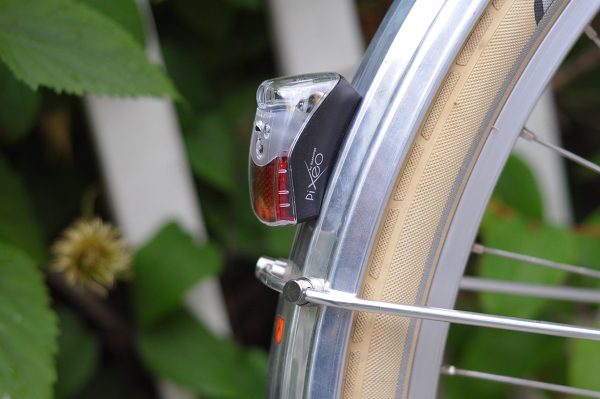
He affixed a CatEye headlight to a braze-on on the front fork, and a Spanninga Pixeo tail light to the rear fender.

He tried to liberate himself from clipless pedals and rode the bike with touring pedals for a few weeks, but ultimately could not take it anymore and put his old clipless pedals back on. Fair enough, but this does limit the versatility he originally had in mind for the bike.

After riding the Surly Cross Check for two months, his main feedback is that the bike is faster than he expected - even with the wide tires and a bunch of weight in the saddlebag. While initially he intended to use the Cross Check in conjunction with his old Motobecane until he got his new roadbike, the Motobecane was retired as soon as he started riding the Surly - no need for it, since the Cross Check did everything it could do and more. He does not find the bike sluggish, and it seems that the tubing is just right for someone of his stature (6ft/ 200lb+). Overall, he is pretty happy. Though he likes lugs, he also likes a nicely done TIG-welded frame and the Surly suits him just fine.

My take on his Cross Check... I think it is a well-made, attractive frame for the price and I am glad that he finds it comfortable and fast. To be honest, I think that at least to some extent this build was not so much about practicality, as about doing a fun and challenging project using a bunch of components that we had acquired but had no use for. If the original purpose of the bike was off-road, then the tire+fender combo with such tight clearances does not really make sense. I have a feeling that he will end up using it mainly on the road, because I can't imagine him bothering to remove and reinstall the fenders every time he wants to take it on serious trails. And this means that when he gets his long-awaited road frame later this summer, the functionalities of the two bikes will overlap considerably. Not that there's anything wrong with that. But given how much he likes the Surly I am almost worried that he might be disappointed with the special bike he's waiting for. Well, hopefully not.

On a more general note, while the Cross Check is clearly versatile enough for commuting and touring, I wonder whether many cyclists actually use it for cyclocross racing. I have a hard time imagining that, given how relatively heavy it is - even the floor models with narrower tires and sportier components. But maybe I'm just biased from having handled too many lightweight bikes recently.

The Surly Cross Check is a fun bike with a cult following, and it is particularly impressive how customisable the frame is. With its happy colours, fat cream tires, elegant fenders and classic touring accessories, the Co-habitant's Cross Check is distinctly his own.

Ping Blog

Step 1
Blog URL:


Blog Title (optional):


Blog RSS Feed (optional):


I agree with terms of service.

Step 2
Copy the following code and put it on your blog/site to help our blog ping tool track your submission (Need help?):
;

 
Design by Free WordPress Themes | Bloggerized by Lasantha - Premium Blogger Themes | Best Buy Coupons