Showing posts with label tires. Show all posts

Monday, 18 April 2011

The Surly Cross Check: a Worthy Host for 700C Fat Franks

What's this... another test ride? a new bike? As a matter of fact, it's a bit of both! A new bike for a certain someone, and a test ride for me as reward for tagging along. And it all began will a spare wheelset...

As part of my brisk trade of hats for bicycle parts over the winter, I've acquired some neat items - including parts I did not necessarily have any use for. Among these were a mint condition handbuilt wheelset and a pair of equally mint Schwalbe Fat Frank tires in 700C. Yes, 700C and not 26" - a monstrous size which made it exceedingly unlikely that I would find a host for them. After coming to that conclusion, I was about to put them up for sale - when I noticed the Co-Habitant looking at them longingly. Upon some prodding, he confessed to harboring a desire for an off-road bicycle with just such a wheelset and tires. Okay then: I wouldn't sell them. But where would we find a frame to fit them? The Fat Franks are 700C x 50mm, limiting the choice to 29er mountain frames, a couple of Rivendell frames, and, of course, custom frames. The latter two options were out of the question, as he decidedly did not want this to be an expensive project. And he didn't want a 29er mountain bike, because he dislikes sloping top tubes. After some feverish research, we discovered that Surly could be an option, and headed to Harris Cyclery (a sponsor) with our own wheels and tires in tow.

The 700C Fat Franks will fit the Surly Cross Check and Long Haul Trucker. We are 60% sure that it is possible to squeeze fenders in there as well. There are not many fender options for tires of this size, but Berthoud and SKS could be possibilities. Any experiences with them with this bike and tire combo?

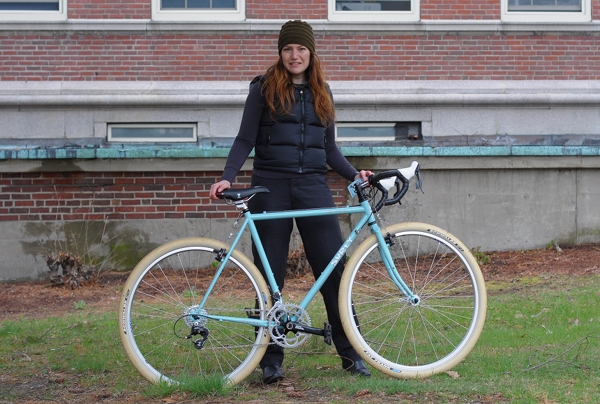
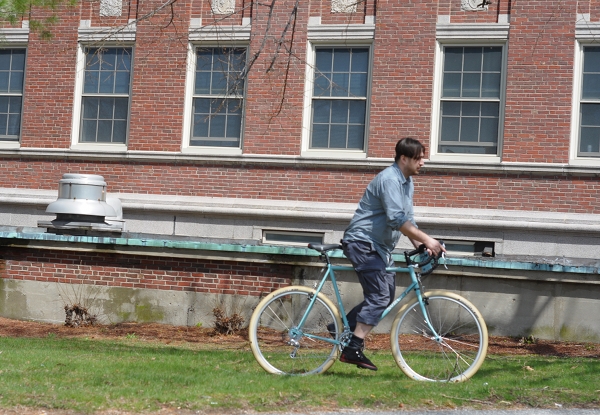
To spare you the suspense, the Co-Habitant is getting a 62cm Surly Cross Check frame, in robin's egg blue - or rather I am getting it for him. We will pick up his actual frame on Saturday. Above he is riding the floor model, with the original wheels and tires.

And here is the same bike fitted with our wheelset and the Fat Franks.

The difference between Surly's Long Haul Trucker and Cross Check models, is that the former is a heavy-duty touring frame, while the latter is a more versatile cyclocross frame - which can be used for anything from commuting, to racing, to off-road, depending on how it is set up. The Cross Check has shorter chainstays and lighter tubing than the Long Haul Trucker - which suits the Co-Habitant fine, as he wants a tough, yet lively ride and does not plan to transport bulky loads on this bike.

It did not take him long to decide that he likes the Cross Check. At around $400 retail for the frame, and many of the needed components already in our possession, this is going to be a quick and exciting build - just in time for our very tardy Spring! Lord knows the boy is long overdue for a new bicycle - and if a Surly is what he wants, I am happy to facilitate.

While the Co-Habitant was consulting with fabulous and wise mechanic Jim about the build, I was not idle. As luck would have it, Harris happened to have a 54cm floor model of the same bike in stock, and I seized the opportunity to test ride it. I've wanted to try a Surly for some time, and what better way to do it than with these delightful tires?

Surly frames are TIG-welded cro-moly steel with lugged fork crowns, and they accept threadless headsets and stems. Still, in their overall look the bicycles are fairly classic, with comfortable, relaxed geometry.

Overall, it's a simple, tidy construction. The canti-lever brakes and numerous braze-ons are useful, without looking cluttered as they do on some utilitarian bikes. I think the powder blue colour is good for this bike - softening up and adding interest to Surly's rugged, no-nonesense aesthetics.

As far as welds go, these are pretty clean. I prefer lugs on this type of bike, but the Co-Habitant likes a variety of frame construction methods.

The floor model I rode was fitted with Salsa stem and handlebars and SRAM "brifters." I found the shape of the handlebars to be quite comfortable - with roomy "shoulders" just like Nitto Noodles. The brifters were all right and squeezing the brakes was easy enough. Compared to regular aero brake levers, I find these combination levers to be too clunky - my grip can't comfortably close around them and I feel as if one bad bump can send my hands flying off the handlebars. Still, over time I think I could get used to them. If I were ever to get a modern roadbike, I would be fine with this type of set-up.

Riding the Surly Cross Check was a better experience than I had anticipated. One common criticism of Surly bicycles, is that they are sluggish and stiff - but perhaps that applies to the Long Haul Trucker specifically and not to the sportier models such as the Cross Check. Giving the tubing differences at least, that would certainly make sense. I did not test ride the bike extensively, as we did not have a great deal of time and it began to rain heavily. But on first impression, the Surly felt similar to my Rivendell in its stability and comfort. As a roadbike, it felt "easy" to ride and it could be a good choice for a beginner for whom a Rivendell is too pricy. On the 54cm frame I rode, there was considerable toe overlap with the 700C x 50mm Fat Franks, so I would not recommend tires this huge on small frames. But on a larger frame like the 62cm size the Co-Habitant is getting, it's not a problem.

The Surly Cross Check strikes me as a versatile, comfortable, attractive, and reasonably priced bicycle that straddles the border between classic and modern. It is also fairly easy to get and test ride: While some shops have more floor models than others, chances are that your local bike store carries Surly. If you do not object to a TIG welded frame and a threadless stem set-up, this is probably one of the best values out there. The Co-Habitant's build will be modestly classic and I hope to share the final result shortly. Any owners of the Surly Cross Check out there?

Thursday, 3 March 2011

Have Delta Cruisers Met Their Match?

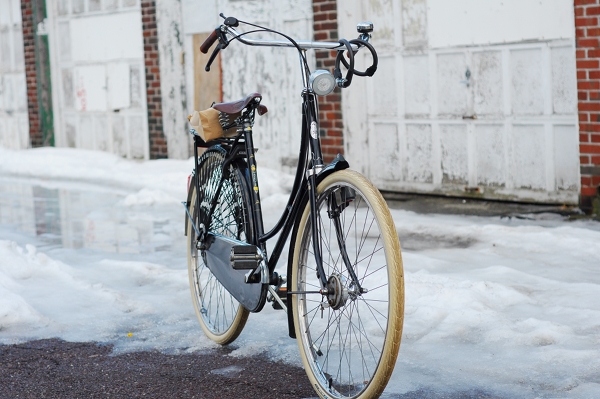
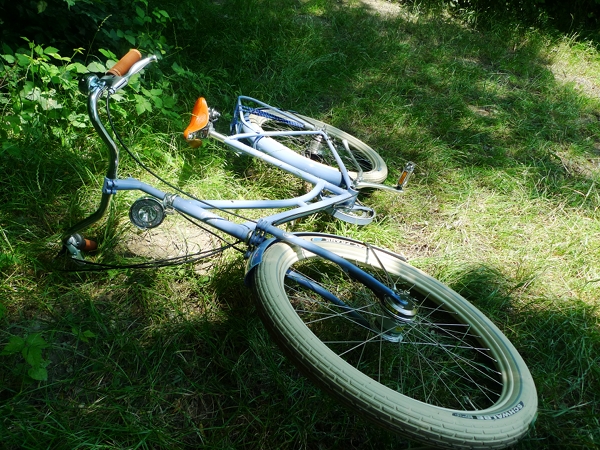
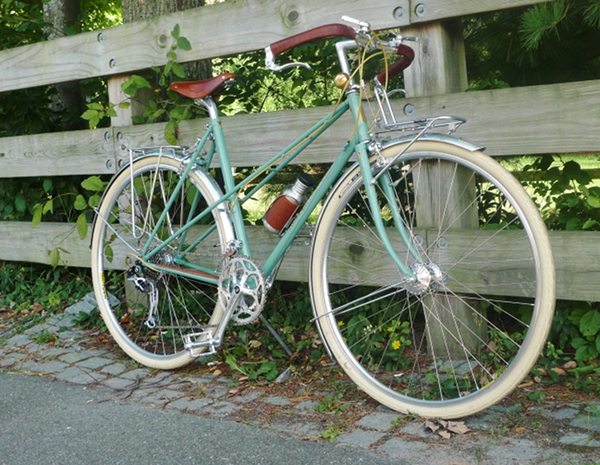
How is this for proof that my aesthetic preferences do not trump all else: I think the old, nondescript tires on my vintage Gazelle may have been ever so slightly more comfortable than the gorgeous, creamy new Delta Cruisers I replaced them with. I replaced the old tires not for the looks, but because they were 15 years old and worn out. I rode with the original tires for the first 5 months of owning the bike, but winter was coming and it seemed like the right time to get new ones. And as long as I was replacing them, the 28" Schwalbe Delta Cruisers were the natural choice: beautiful, gloriously shock absorbent, and puncture resistant. I love them on my Raleigh DL-1, I loved them on the Steyr Waffenrad I rode in Vienna, I love them in the 700C size on my Royal H. mixte, and I loved them in the 26" size on my formerly owned Pashley Princess and Raleigh Sports.

What I like about Delta Cruisers in terms of functionality, is that they are both faster and cushier (i.e. better at dampening road shock) than other tires I've tried in equivalent sizes and widths. Whenever I replace other tires with Delta Cruisers, the change has always resulted in an "Ahhh, much better!" feeling... until now. It's a tiny difference, but I think the old tires on the Gazelle may have felt softer. I am not ready to state this with certainty, because the roads are in such worse condition now than they were before winter's start and part of me hopes there may just be more potholes now than before. But on the other hand, I remember the feeling of going over the potholes themselves as having been a bit better with the old tires.  Darn! Just when I thought I was done with this bike, there is something new to obsess about.

It took me a while to determine the brand of the old tires, as they were quite worn out. But finally I was able to make out "Kenda NL 40-635." Ah, so they are Kendas, made for the Dutch market. The checkered tread pattern looks just like this, but I don't see any 28" tires on Kenda's website. I've been able to find some on ebay that look like they might be the same model - or at least the current version of the same model, as the tires on my bike were made 15 years ago. But will they feel as good as my old ones? I've read so-so reviews of Kenda tires and it's hard for me to believe that they could be more comfortable than Schwalbe Delta Cruisers. Still, I am open minded and will readily admit it if indeed this is so. I don't want to replace the lovely Delta Cruisers, but for me ride quality is an area where comfort wins over aesthetics. Does anyone have 28" Kenda tires on their bike?

Monday, 22 November 2010

Colour Theory for Bikes

As someone who deals with colour all the time - taking pains to get it "just right" for paintings and photography setups - I am fascinated by the role of colour in bicycles. Choosing colour is not just a matter of "what matches what." It is a matter of understanding the psychological mechanisms involved in human colour perception and processing - which to me has always been interesting. But taking it down a notch from the realms of art-speak and neuro-psychology, here are some thoughts on colour choices as they pertain to setting up bicycles:

Handlebars and saddle
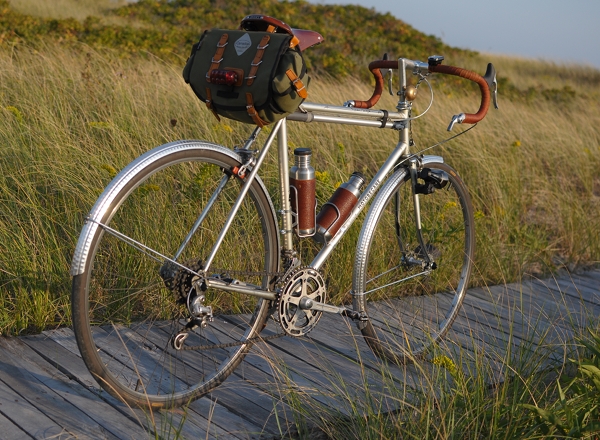
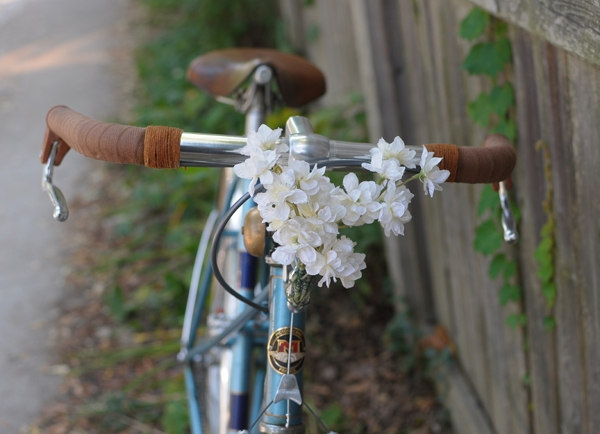
My go-to standard for handlebars and saddles is the brown family. The reason I like to use brown as opposed to black, is that brown enhances the colour of the bicycle frame, whereas black tends to "deaden" it. Being neutral, brown will not compete with the frame colour, just as black will not. But it will make the colour more vibrant, more emphatic - whereas black will leave it flat.

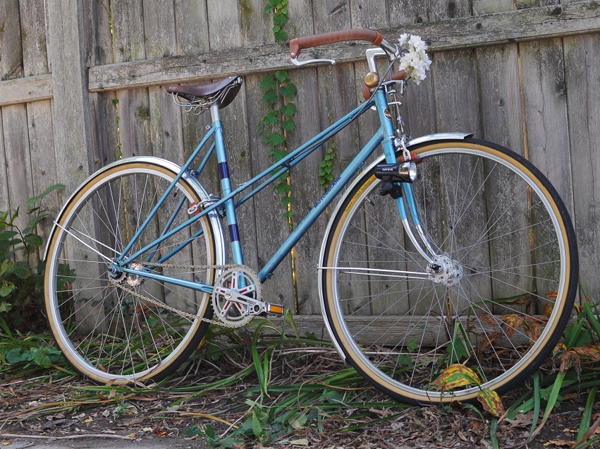
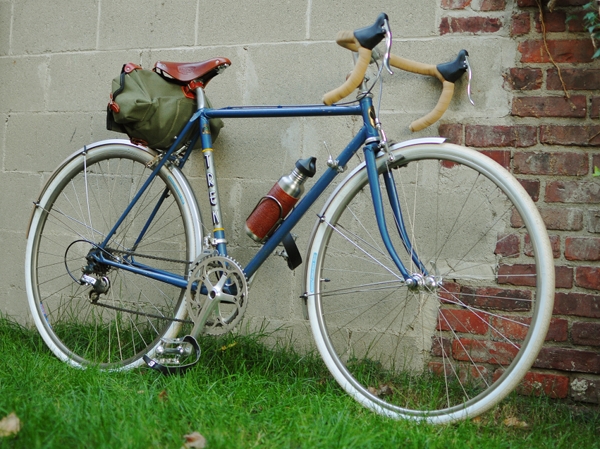
This works especially well on "cool" frame colours - such as blue and silver. And using twine and bits of leather on other parts of the bike (chainstay protector, kickstand, waterbottle, saddlebag straps) will further enhance the "warming" effect.

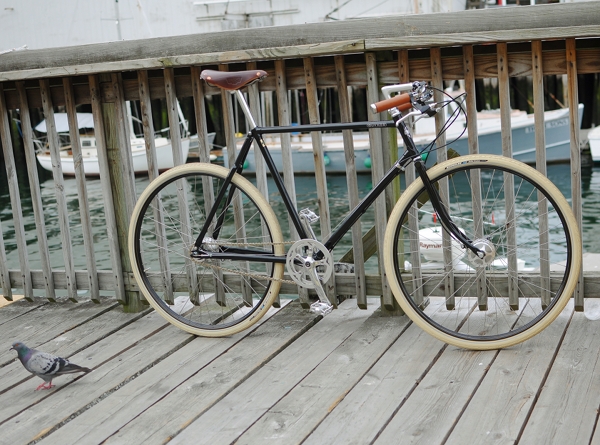
Brown can also make a black frame look less intimidating and more "personable" - as well as bring out the details in what would otherwise be an expanse of black-on-black.

But of course, black has its place as well. Black accessories make a bike seem more aggressive - which can look good on some bicycles. And depending on the "personality" of a particular bike (lady's military bike?), you might not necessarily want the frame colour to be overly vibrant.
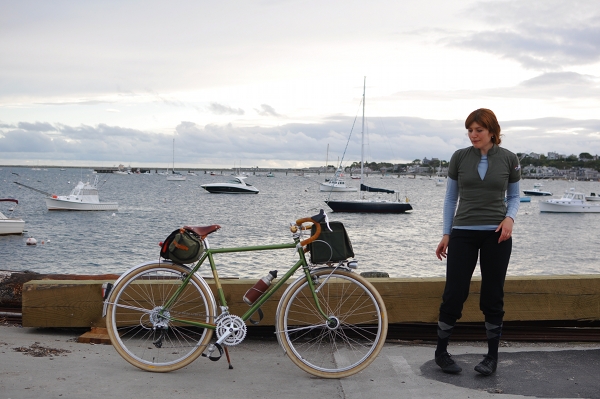
And when it comes to racing bikes, an aggressive or sporty look is usually more fitting than an "earthy" look. This can be achieved either with black, white, or brightly-coloured saddle and tape combinations (ideally in a contrasting colour to the frame). Bright and high-contrast colour schemes are exciting and suggest high energy, fast movement. If that is what you want your bike to communicate - go with it. And if not, you can tone it down with browns and neutrals, as I have done to this bike.

Tires
It goes without saying that performance and not colour should be the first consideration when it comes to tires. But assuming that you can get equally well-performing tires in a variety of colours, it can be nice to play around with that element as well. While I do not hide my crazed preference for cream tires, I do not suggest that they are "the best" option.

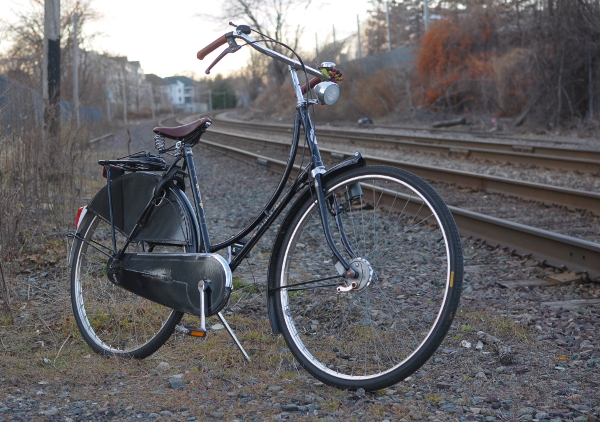
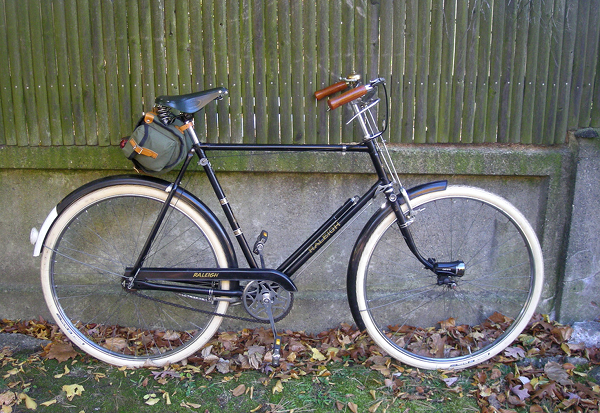
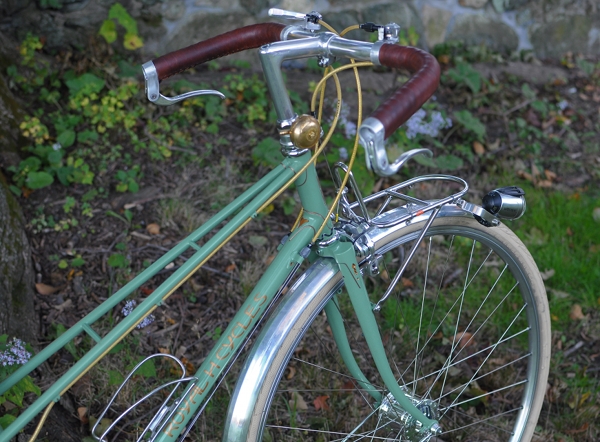
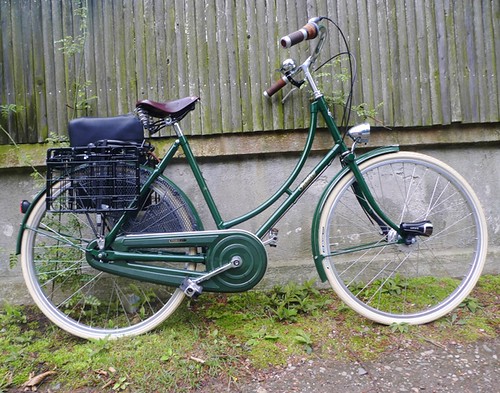
Cream tires can look elegant if you are going for a delicate look and have taken pains not to include any black on your bike. Here they make the bicycle look a lot more "serene" than had I used other tire choices.

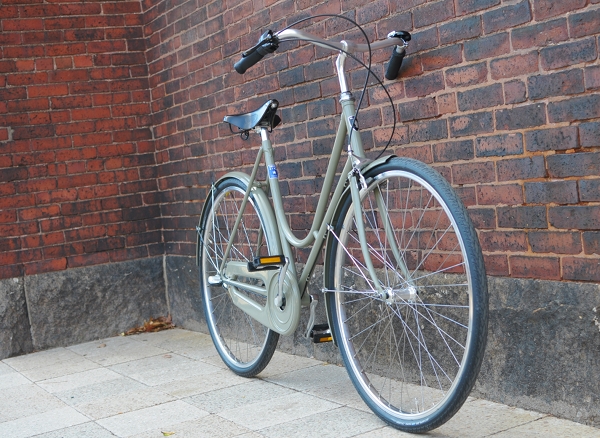
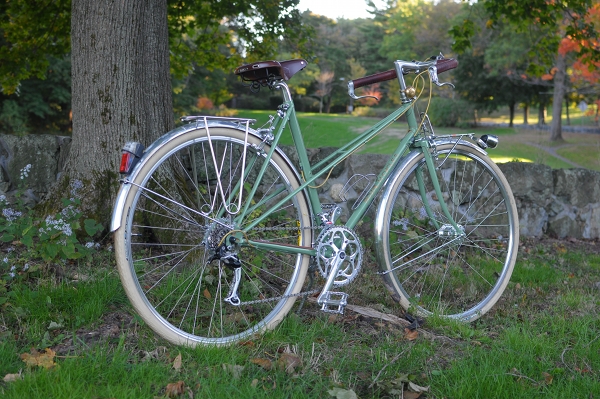
And they can also look elegant as a contrast to the frame. But there comes a point - and for some it arrives much sooner than for others - where cream tires can be just too much and overwhelm the rest of the bike (I think that here I am dangerously approaching that). I also don't think that cream tires look good on a cream or white bicycle. It is too low-contrast and reminds me of "ghost bikes." Achielle does the cream-on-cream look better than others, and if you go in this direction adding prominent brown accessories to break it up a bit is the key.

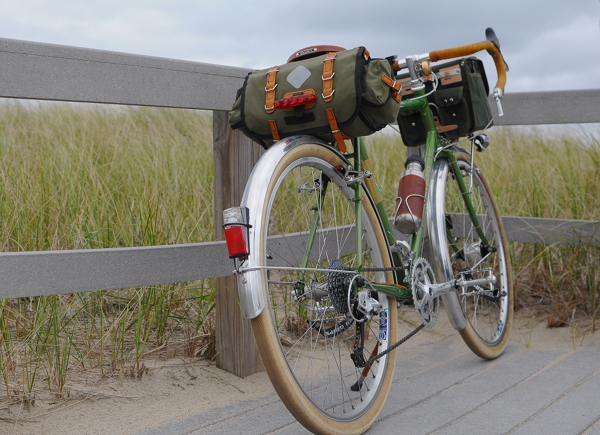
A good, traditional option if you are looking for classic tires, are "gumwalls" - which are tires with back tread but tan sides. The tan fits nicely into the "organic" saddle and handlebar colour scheme, without the tires competing with the rest of the bicycle for prominence. I also like it how the alloy rims, the tan sidewalls and the black tread create the visual impression of 3 circles, one inside the other.

Bags and accessories
I am very conservative when it comes to bicycle "luggage," so perhaps I am not the best person to ask about this one. Mainly, I don't like it when bicycle bags are too distinct in relation to the bicycle itself - whereas the trend now (especially for accessories targeted at women) seems to be brightly coloured luggage with prominent graphics. It's not that I am "against" flowers, polka-dots, curly-cues, and the like. It's more that I want my bicycle to be the main focal point and not the bag. So I prefer to get subtle, classic accessories in neutral colours. As with saddles and handlebars, I think that the brown/olive family works well for a nature-exploring sort of look, whereas black works well for a more aggressive or racy look.

Decorations
Unless intentionally using decorations to distract from the rest of the bike, the colour of the decorations should not stand out too much from the other colours on the bicycle. Otherwise, the eye will get drawn to the decoration itself, with the rest of the bike an afterthought.

Frame Colour
If you are getting a bicycle frame re-painted, or are trying to choose a colour for a custom bike, the colour selection is of course a matter of personal preference. But based on my own experience (and conversations with others), keep a few things in mind:

1. Speaking very generally, super-bright colours work better on sporty bikes, whereas subdued colours work better on touring and transportation bikes.

2. True white is very harsh and almost never looks good. Even if a bicycle you like appears white to you, the actual colour is almost definitely a pale cream, a very light gray, or an off-white. Think twice before asking for a true white paintjob.

3. If you are getting the paintjob (especially powdercoat) done at a "budget" type of establishment, beware of asking for metallic colours. They are easier to mess up, and flaws in them are more visible than with regular colours. Flaws in lighter colours are also more visible than flaws in darker colours.

4. Prepare yourself for the fact that the colour never, ever looks the same on the bike as it does on the tiny colour chip, let alone on the online colour sample. I have seen some pretty amazing discrepancies, where after the person spends a month wringing their hands about the "perfect" shade, the colour on the bike does not even look like the same colour family as the chip they chose. One thing you can do, is give the painter a sample of the colour you want and ask them to find the closest match. They have experience with the way the colours actually looks on a bike. Alternatively, you can find out the colour code of a bike you like, and ask for that exact one.

There are those who take bicycle aesthetics very seriously and start to pull their hair out in despair if they cannot find the exact shade of orange handlebar tape they wanted. And there are those who could not care less about the details, and just use whatever components and accessories are available. I see myself as somewhere in the middle, leaning perhaps just a tad towards the former. (What? You think it's more than just a tad?...) While I enjoy setting up my bicycles in a way that is aesthetically pleasing to me, I do it quickly and intuitively, without dwelling on it too much. Then I ride the bike and get it filthy beyond all recognition - which is part of the fun, at least for me.

Wednesday, 13 October 2010

Cream Tires Directory

It is no secret that I like cream bicycle tires. If you are a fan as well, you will find this recent thread on bikeforums a real treat - loads of pictures of classic and vintage cream tired bicycles. And, since I am asked about this all the time, I have compiled below a directory of cream and white tires in various sizes that are available on the market. My criteria for these selections were reasonable availability and all-over colour (as opposed to white sidewall on a black tire). Unless noted otherwise, all tires listed are puncture-resistant.

Cream Tires for City Bicycles

28"
Schwalbe Delta Cruiser (28 x 1 1/2")
Vredestein Classic  (28 x 1 1/2")*
*available in EU only or from Dutch bike dealers

700C
Schwalbe Delta Cruisers (700C x 35mm)
Kenda Kwest (700C x 35mm)
Specialized Nimbus (700C x 35mm)*
Electra Amsterdam City Tire (700C x 40mm)*
* may not be puncture resistant

26"
Schwalbe Delta Cruiser  (26 x 1 3/8")
Schwalbe Fat Frank (26 x 2.35")
Geax Tattoo (26 x 2.3")
Kenda Cruiser (26 x 2.125)*
Electra Retrorunner (26 x 2.125")*
Electra Vintage Diamond (26 x 2.35")*
Electra Blossom Trail (26 x 2.125")*
* may not be puncture resistant

Cream Tires for Road Bicycles 

650B
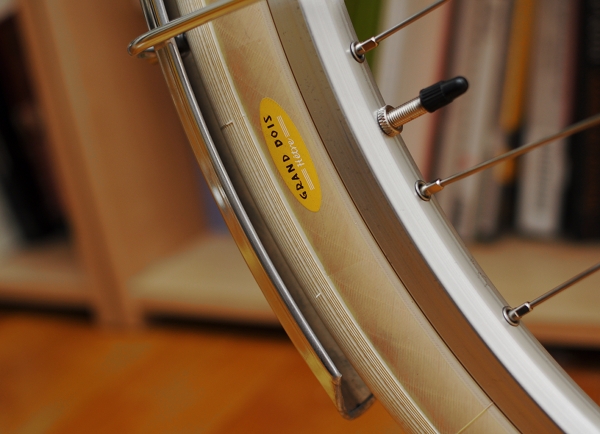
Grand Bois Hetre (650B x 42mm)

700C
Panaracer Pasela (700C x 28mm, 700C x 23mm)
Vittoria Randonneur (700C x 28mm, 700C x 23mm)
Vittoria Zafiro Pro (700C x 23mm)
Origin 8 Elimin-8er (700C x 23mm, 700C x 25mm)
Schwalbe Durano (700C x 23mm, 700C x 25mm, 700C x 28mm)

27"
Cheng Shin CST C-740 (27" x 32mm)

The selection is not huge, but there is something to be had in almost every wheel size. If you know of other cream or white tires I have omitted, please let me know and I will add them.

Friday, 17 September 2010

Full Fat Cream! In Love with My Grand Bois Hetre Tires

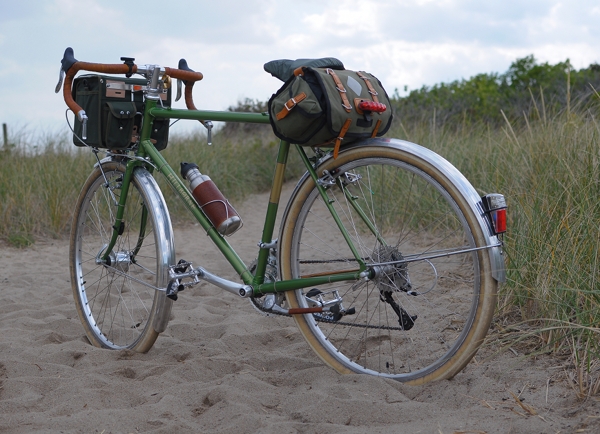
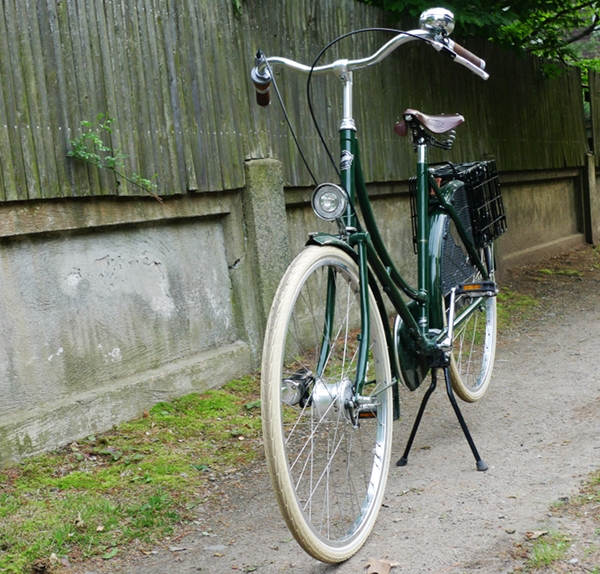
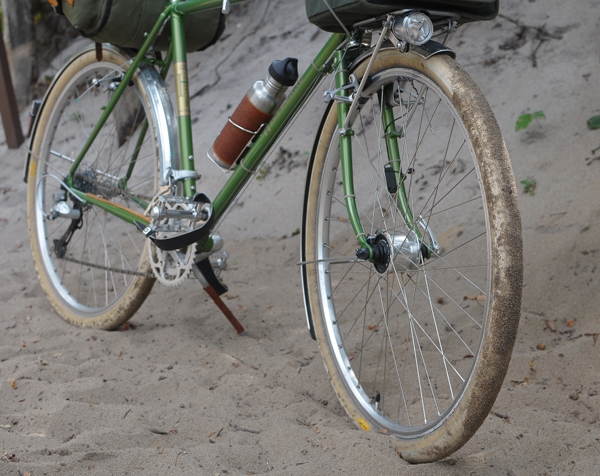
Notice anything interesting about this picture?

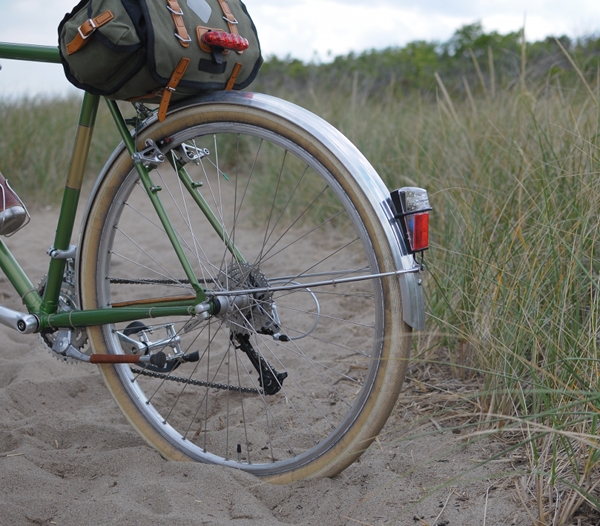
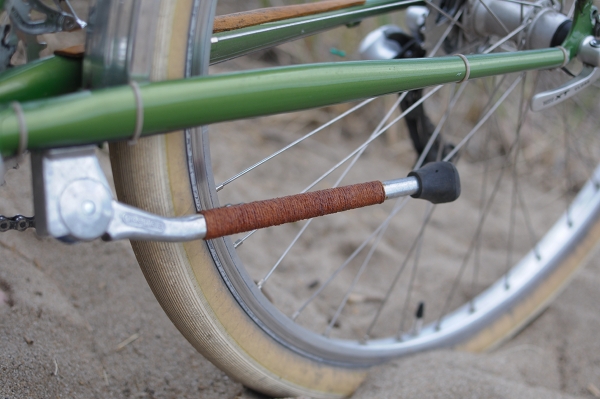
Here is a closer look - And yes, the bicycle is standing in the sand without a kickstand!

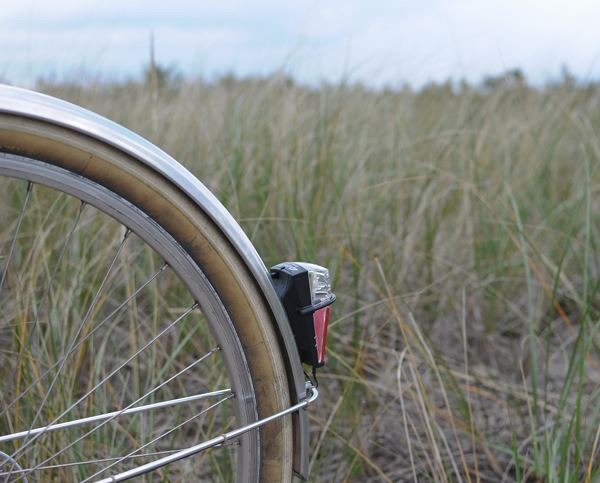
The Grand Bois Hetre tires are 42mm wide and the Velo Orange "Zeppelin" fenders fit over them nicely.

Made to resemble the French randonneuring tires of yore, Grand Bois Hetres are available with either white or red tread, and they are made for 650B wheels only. The white tread version is really a cream colour with tiny little caramel specs, and the red version is really a brick colour. Both look beautiful. The picture above is the only one I have of the tires looking shiny and new.

After 1800 miles, this is what they look like now. Considering that I haven't washed them, I don't think that's too bad actually.

And this is what they look like after going through sand in the rain - though all that caked sand comes off almost immediately once you start cycling on a paved road.

The ride quality of the Grand Bois Hetre tires is truly superb. Better than Schwalbe Delta Cruisers. Better than the famous Fat Frank and Big Apple tires. Faster too. It is worth getting 650B wheels just to get these tires. They are cushy, stable, have excellent puncture protection, and are just as fast as narrower road tires, yet can go off-road. Almost too good to be true!

Also, keep in mind that the width will enlarge your overall wheel diameter - making 650Bs nearly as large as 700Cs with standard, narrower tires. Something to consider if the only thing keeping you from 650B is their slightly smaller size. With the Grand Bois Hetres, they will no longer be smaller.

Grand Bois tires are hand made in Japan and are of extremely high quality. Aside from the fat Hetres, there is a range of other models available, suitable for various wheel sizes. In the US, these can be purchased from a handful of bicycle shops (if you are in Boston - Harris Cyclery had some the last time I was there), or from here directly. If you love the idea of a go-anywhere bicycle that is fast on the road and perfectly at home off-road, the Grand Bois Hetres are surely as good as it gets. Of course, it doesn't hurt that they are beautiful - even after 1800 miles!

Sunday, 23 May 2010

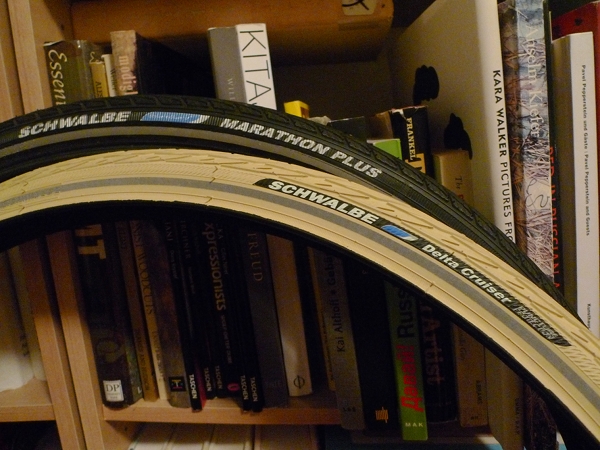
Schwalbe Delta Cruisers vs Marathon Plus

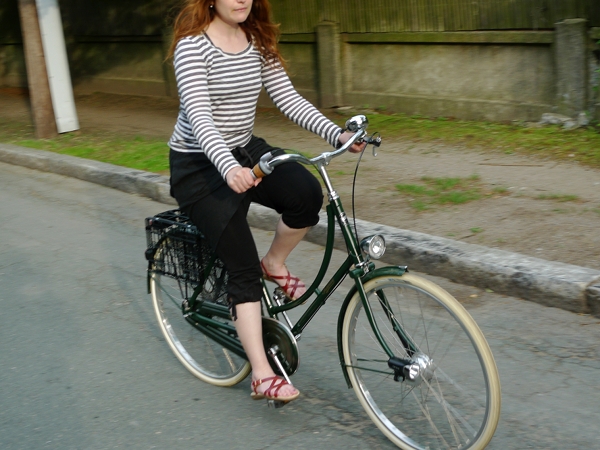
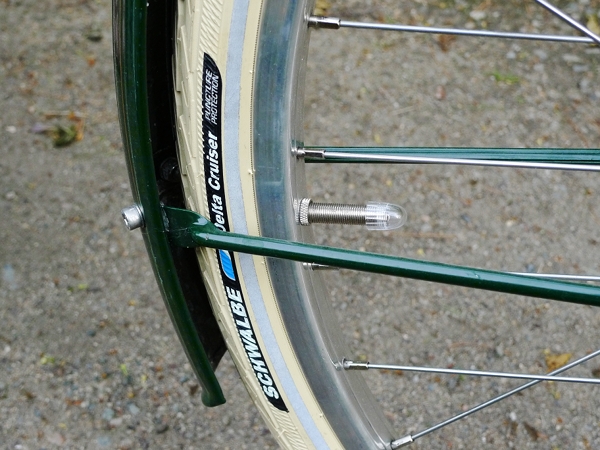
I have written before about how much I like Schwalbe Delta Cruiser tires, and almost a year later I feel the same: These are my favourite tires for commuting. Happily, we have now finally installed them on my Pashley Princess.

I know, my tastes are so predictable! - but how can you beat this gorgeous crème de menthe look? See here for the "before" picture.

Because the Pashley originally came with Marathon Plus tires and I rode it with them since last summer, I thought that the change provided a good opportunity to compare the two tires and to explain why I opted to switch to the cream Cruisers.

One key difference between the Marathon Plus and the Delta Cruisers, is the level of puncture protection they provide: The Marathon Plus are basically the bestest/toughest/kevlarest tires you can get. Delta Cruisers still have plenty of kevlar protection; they are just not the absolute best in this respect. As a result of all that extra armour, Marathon Plus are almost twice as heavy as Delta Cruisers. Additionally, some report that Marathon Plus tires feel sluggish and "leaden" when they roll (I agree) - whereas Delta Cruisers have a zippy, racy quality to them. Delta Cruiser tires are also somewhat balloon-like: cushy and better at swallowing potholes.

Pashley's wheel with the new tire. Removing and re-installing the front wheel was fine, but the rear wheel was a different story. The chaincase was actually pretty easy to deal with, but the custom coaster-brake hub took some figuring out.

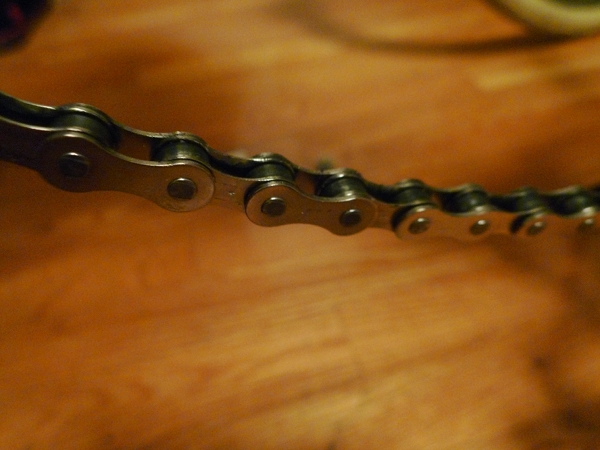
Upon removing the chaincase, we were shocked to discover how clean the chain was. This bicycle lived through a snowy winter! I guess the chaincase really works.

With the wheels successfully re-installed and the coaster-brake hub adjusted (thanks to the Co-Habitant - who can do anything when he has the time for it!), I immediately set off on my daily errands.

Mmmm, yummy cream Delta Cruisers!

In terms of the ride quality, I could feel an immediate difference. The Delta Cruisers are indeed both zippier and cushier than the equivalently sized Marathon Plus. On a bicycle where I have been trying to maximise speed and maneuverability, that is a major benefit. To me, this factor is more important than the super-extra degree of kevlar protection of the Marathon Plus - which for me is overkill anyhow.

Whether you prefer the Delta Cruiser or the Marathon Plus tires, really depends on your needs. Do you consistently puncture all of your tires - even those with kevlar belts? If so, get the Marathon Plus and that is the end of it. On the other hand, if you prefer a faster ride, love cream tires, and are fine with a degree of kevlar protection that is "only" excellent and not unbelievably excellent, then ditch the extra weight and go with the Cruisers.

Ping Blog

Step 1
Blog URL:


Blog Title (optional):


Blog RSS Feed (optional):


I agree with terms of service.

Step 2
Copy the following code and put it on your blog/site to help our blog ping tool track your submission (Need help?):
;

 
Design by Free WordPress Themes | Bloggerized by Lasantha - Premium Blogger Themes | Best Buy Coupons