Showing posts with label traffic. Show all posts

Friday, 26 August 2011

Side Street or Main Street?

Grocery Shopping with Wald Folding Baskets
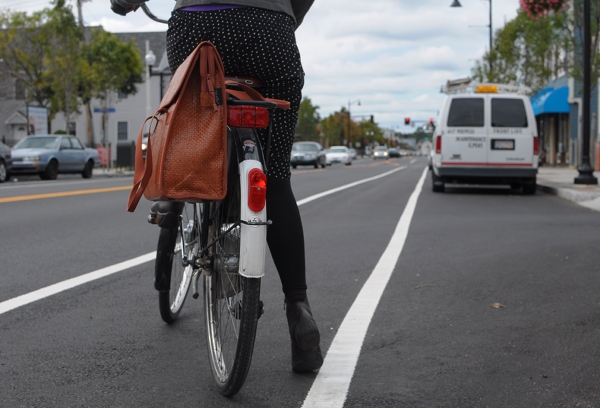
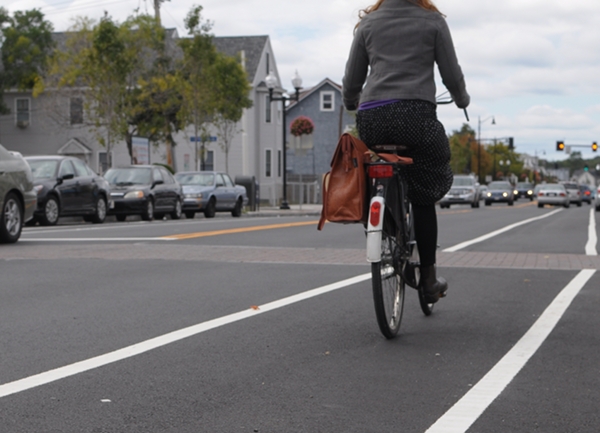
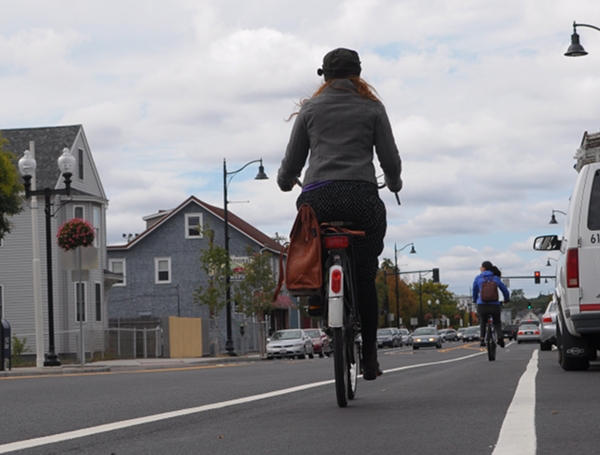
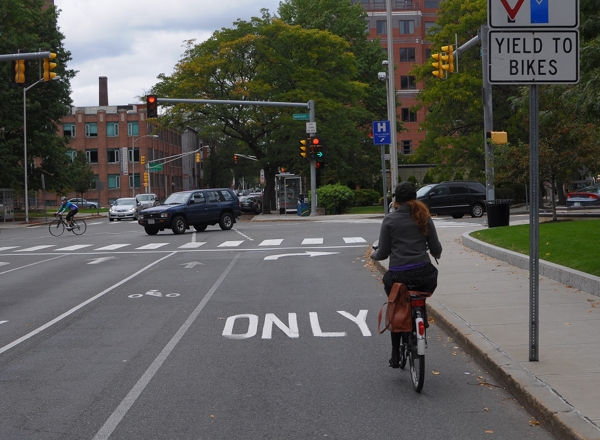
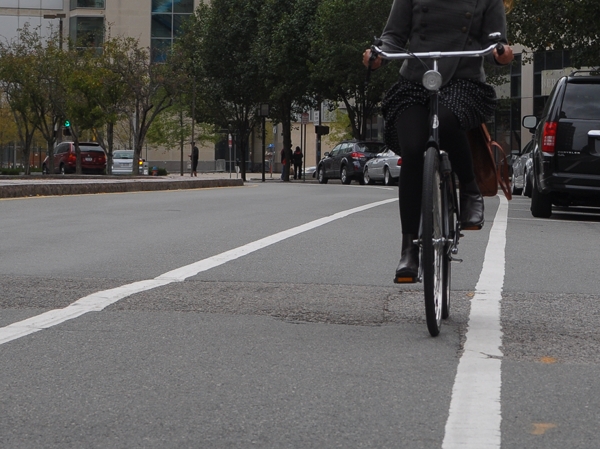
Cycling in greater Boston, I alternate between routes that take me along busy roads and routes that take me through quiet side streets. Each option leaves something to be desired. The busy roads are, well, busy - lots of car traffic, lots of action, lots of chaos. But they do seem to have enough room for everyone, including the processions of cyclists that now travel along them more than ever. The side streets are much quieter and greener, but are often too narrow to fit both a car and a bike side by side - resulting in its own set of challenges. 

I've mentioned before that when I have close calls or memorably negative encounters with cars, it almost always seems to happen on a side street. But the same is definitely not true for everyone, and a recent post on Let's Go Ride a Bike illustrates why many urban cyclists tend to keep away from busy roads. So I keep wondering what it is that, over time, has made me weary of side streets, whereas others see them as a refuge. 

One possibility is that I tend to overcompensate for the danger factor of main streets by being extra-vigilant, extra-focused and extra-careful as a matter of course - expecting the worst from every vehicle out there, and cycling in a way that anticipates that. On the other hand, side-streets lull me into a state of relaxation, because they seem so tranquil and friendly - so when something bad is about happen, I don't see it coming and am less likely to avoid it.

But this factor aside, I also think that drivers are less likely to keep their aggression in check when there are fewer witnesses. On side streets there aren't many people around, and perhaps the drivers with whom I've had confrontations and close calls were well aware of that. A scary thought, to be sure.

What is your take on main streets versus side streets, and what is your preference?

Wednesday, 22 June 2011

The Morning After: Post-Sport Transport

Today is a day like any other. I unlocked my bike from our outdoor storage area, clipped my pannier onto its rear rack and took off for the day, wearing my regular clothing. If I get home after dark, I will give my dynamo bottle a little push and the lights will come on - sustained by my pedaling. I cycle carefully in traffic. I sit upright. Drivers and pedestrians see my old-fashioned loop frame bike and they often wave to me and smile. I have been doing this more or less every day for over two years. As a mode of transportation it is perfect for me; I have truly found something that works. And I enjoy helping others who feel that it could work for them.

But cycling in traffic this morning, I am also remembering what happened last night - and it's like a fuzzy memory of a drunken party in its sheer unreal-ness. I went on another paceline ride, starting off in a faster group this time. Five miles in I dropped my chain accelerating uphill, which was mortifying and had never happened to me before. But disaster was averted ("Chain off!! Slowing!"), the chain was soon back on, and we (the woman who stayed behind to help and I) caught up with the group in no time. The chase was a nice warm-up. Toward the middle of the ride, we ended up splitting in two again, with myself and a couple of others in the front. We received minimal instruction in this slightly more advanced group, and I took frequent turns rotating. I was on a high from the sheer excitement of it, not even feeling my legs - only the speed. As the end of the ride neared, the leader asked who wanted to go on an extra climb instead of straight back, and I was among those who came along. We were allowed to pass each other uphill, and I did - passing the others, then waiting at the bottom of the hill for a good few minutes. Next time, I am told I can join the next group up. There was also discussion of joining the team. Then I cycled home for 10 miles, elated but not particularly tired. Even as I write this, it sounds like I am making it all up. My mind is swirling.

Riding my bike for transportation, I feel at ease and familiar with the city where I used to resent living just a couple of years ago. Everything seems friendlier now, more accessible, more connected to my life. I have a personal map of the city in my mind, where every area includes the sensory experience of riding my bike there. I continue to discover new neighborhoods that surprise me, feeling like an explorer every time I need to venture somewhere new. It's wonderful, and I don't write about it daily only because it has become so incorporated into my everyday routine as to become mundane.

I wonder whether I will ever experience this sense of familiarity and belonging with cycling as a sport. I feel wildly different from the other women doing the paceline rides, who seem so comfortable with the very notion of it all.  They've been running, going to the gym and playing other sports all of their lives, while I've stayed as far away from such activities as possible. And it's not just a matter of being intimidated. The non-athletic have prejudices against the athletic, whether they want to admit it or not. I grew up with perceptions of athletes as shallow, aggressive, cliquish and bullying - nothing us artsy kids wanted to be a part of. It's hard to get away from that mentality, even as an adult, and it's hard to get comfortable with the idea of being something I am not. Hearing things like "put the hammer down, girl!" followed by appreciative cheering, makes me feel conspicuously out of place.

Cycling to the training ride in my shorts, jersey, gloves, styrofoam bonnet and sunglasses yesterday, I got a "Hey, slow down!!" shouted at me by a woman strolling on the wrong side of the bike path, accompanied by a look of pure hatred. I glanced at my computer and confirmed that I was in fact going very slowly. But she saw me as fast, aggressive, and dangerous nonetheless. Would this same woman have waved to me and smiled had I been riding my loop frame bike wearing a dress?

Since I began writing about paceline rides, some readers have told me they feel I am sending "the wrong message" by getting involved in roadcycling and publicising this involvement: My "turning into a roadie" only confirms the stereotype of cycling as an extreme sport. At the same time, the supportive emails I've gotten from the pro-roadcycling camp border on pressure - from suggestions for which local team to join, to being told that I am in a unique position to advance the cause of getting more women into racing. For the most part, I am just confused by it all. I admit that I am now addicted to the paceline rides, and that joining a local cycling team is appealing. At the same time, I am socially uncomfortable both within a group of roadies, and also with being perceived as one. Call it a mild cycling-identity crisis.

I cannot take seriously the idea that to take part in paceline rides is to "betray" transportation cycling. I see the two as completely independent activities that can be pursued in parallel. Am I being unrealistic? Today I am cycling for transport while daydreaming of sport, and it seems completely natural.

Thursday, 9 June 2011

Skirt Police


Yesterday there seemed to be an unusual number of disconcerting bicycle stories floating around. Among the more bizarre were the news that a woman was stopped by the NYPD for wearing a skirt on her bike. Says a representative of the New Amsterdam Bicycle Show:
Our friend Jasmijn was stopped in SOHO by NYPD for riding in a skirt! The officer said she could distract drivers and cause an accident...and should go home and put pants on.
Cycling in a skirt is, of course, perfectly legal. So when this sort of thing happens, one has to wonder how best to respond to it. After all, it has been shown that just because the officer is technically in the wrong, does not mean that the cyclist will not be ticketed, or even arrested and tried.

But what's more, is that when this story was posted on twitter other women replied that they too have been stopped by police while cycling dressed up - seemingly for no particular reason other than for the officer to comment on their appearance. It happened to me last summer as well. A policeman gestured for me to pull over, only to ask some random question about my bike. When I politely replied, he proceeded to comment on my outfit. Nervously, I kept wondering what law I broke and when he was going to get to the point. Was I required to chat with him? Was there some protocol to treat me as hostile if I didn't? When I finally asked "Excuse me, but can I go now?" He seemed hurt and simply said, "Yeah, sure..." adding "Be careful out there!" half-heartedly. For a while I kept going over the incident in my mind and trying to make sense of it, but it seems he stopped me without any legal purpose what so ever.

On a bicycle we are more noticeable than we are inside a car, and at the same time we can be legitimately pulled over as vehicles. Does us cycling make it easier for the police to abuse their power by supplying them with a reason to pull us over? That's an uncomfortable thought.

How would you respond if a police officer stopped you to comment on your appearance, or to tell you that you can't ride a bike dressed as you are?

Sunday, 29 May 2011

Right of Way and Driver Education

Last night we were returning home on our bikes. As we approached an intersection where we needed to make a left turn, we signaled and moved to the leftmost part of the lane. A motorist approaching the same intersection behind us began to honk. We turned around, confused. The light had just turned red and all three of us were stopped at the intersection. She continued to honk. We asked what the problem was. She rolled down her window, and the conversation went something like this:

Motorist:  What the hell are you doing?!
We:  What do you mean?
Motorist: You're not supposed to be in front of me like that, you're blocking the road!
We: We're using the road just like you. Why are you honking?
Motorist: What the hell am I supposed to do when you're blocking my way?!
We: You're supposed to wait for us to turn.
Motorist: But you're not supposed to be there if I need to get by. You don't have the right of way!
We: What? Of course we have the right of way, we were here first.
Motorist: Unless you're in the bike lane, you do not have the right of way! You're supposed to let me get by!
We: Bicycles have the right of way just like any other vehicle.
Motorist: Not if you're not in the bike lane!
We: Yes. Check your facts.
Motorist: No! You check your facts!

I don't know how things would have gone had the light not turned green at that point, but it did. The motorist floored the gas pedal and veered around us in order to proceed straight as we made our left turn.

It's not so much the motorist's rudeness that I found alarming  (she was screaming at us), but the fact that she genuinely believed that cyclists did not have the right of way unless they were in the bike lane. In other words, she thought that if a cyclist needed to make a left turn, they must stand aside and wait for all the cars behind them to pass before they were allowed to proceed. This is blatantly incorrect, but that doesn't help any in situations like this.

In my view, lack of drivers' awareness about bicycling laws is largely responsible for cyclist-motorist confrontations. When I first began riding a bike in Boston, drivers would occasionally scold me for "breaking the law" (i.e. cycling on the road). Now that bicycles have become more common this seldom happens, but yesterday's encounter shows that misunderstanding of road rules still exists. I've read that in areas where this is especially bad, cyclists have taken to carrying copies of local bicycle laws and handing them out to motorists who harass them. That is further than I personally would want to go. But it seems to me that some driver's ed initiative is in order - especially if a city is actively striving to be more "bicycle friendly."

Tuesday, 26 April 2011

When Cyclists Complain About Cyclists

Copenhagen - Strandvejen 1955
[image via Copenhagenize]

Spring is here and the number of new cyclists is multiplying rapidly. It's fantastic to see so many people in Cambridge and Somerville going about their day on two wheels, as if this were entirely normal and natural - which of course it is. But with more bicycles on the roads, this is also the time of the year for complaints: motorists complaining about "scofflaw cyclists" and cyclists themselves complaining about "newbies."

While motorist hostility is nothing new or surprising, there is somewhat of a debate in the bicycle blog world as to whether it's right for cyclists themselves to criticise other cyclists' behaviour. On the one hand, when cyclists don't follow traffic laws and behave recklessly, they not only "make all of us look bad," but actually endanger us. The biggest example of this that I experience in Boston, is when I am intentionally riding toward the left of the bike lane in order to avoid the door zone, and a cyclist passes me on the right. I have also had cyclists nearly crash into me as a result of their running a red light: Ironically, those who do so tend to watch out for cars but not for other bicycles. Naturally, I find such actions disconcerting. I feel no common bond with those who jeopardise my safety - regardless of what mode of transportation they are using.

But when cyclists criticise other cyclists, I wonder about its overall effectiveness. Do the scofflaws feel shamed and curb their transgressive behaviour in response to the critical rants of law-abiding cyclists? Or is it more likely that they carry on just as before, and it's the timid, fledgling cyclists who are scared off from even trying to navigate such a treacherous landscape? This is what I was thinking while reading this post on BostonBiker this morning. While I actually agree with most of the points the author made, the tone just seemed so hostile. It also made me uneasy that the author criticised "new cyclists" - while themselves having only begun cycling this past winter. I have been cycling for over two years in Boston, including winters, and still consider myself to be fairly new at it. While I am safe, law-abiding and friendly, I am not perfect and sometimes make mistakes despite my best intentions. Is there a cyclist ranting about me on their blog because I neglected to signal a right turn last Thursday? A depressing thought.

I would not go so far as to suggest that cyclists must not criticise other cyclists, as part of some Velocipedean Brotherhood Code of Honor. But there has to be a way to discuss these issues in a more constructive manner. Do you complain about other cyclists when you think they are behaving recklessly, or do you opt for a united front? Is there an approach that accomplishes both?

Thursday, 14 April 2011

That Fateful Click

[image via GarySe7en]

So you're pedaling along a bike lane. Ever vigilant and keeping out of the door zone - or at least so you hope. And then, as you are cycling past a particular car - right at the very moment you are parallel to it - you hear that sound... that fateful click which accompanies the pulling of a car's door handle and precedes the flinging open of the door itself. You hear it, and your body reacts before you even have time to register a thought, let alone evaluate the situation and make a decision. Am I in the door zone? Will the swinging door hit me? If I swerve to the left, will I be in the path of car traffic? It hardly matters. The reaction to that click is a knee-jerk response. And what will it be?

Hurrying home at dusk with a pannier full of hot Indian take-out, I heard the blood-chilling click whilst passing a blue sedan. My knee-jerk response was to let out a pitiful yelp and hammer down on the pedals with all my might. I heard the door swing open a fraction of a second later. Would I have cleared it anyway? Very possibly. I really do my best to stay to the left in the bike lane. But our danger-evading instincts are strong and do not always work in our favour. I could have slammed the brakes. I could have swerved into traffic. We can't always control how we react when adrenaline floods our system.

It's times like these I wish that bike lanes weren't placed directly in the door-zone half the time. I know, what a tiresomely clichéd complaint.

Tuesday, 15 February 2011

Misadventures in the Thaw

As you may have inferred from the dearth of personal posts and new pictures, there has not been a great deal of cycling lately. But suddenly, yesterday: a thaw. A cursory glance outside suggested that the streets had somewhat cleared of snow, and so I eagerly dragged out the bike. But what was meant to be a productive day, became instead a frazzled misadventure.

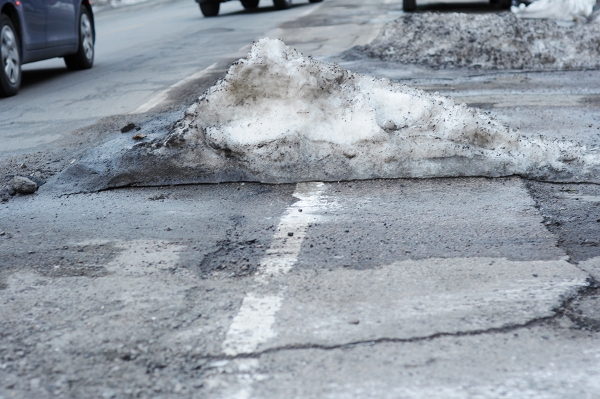
Liberated from the heaps of snow under which it's sat for over a month, my entire street now looks like it's being dug for trenches. I am amazed that this could happen over the course of a single winter, especially since they'd just recently repaved it. There is barely a foot of road where the asphalt is not broken, and it's nearly impossible to cycle through what is essentially one big ditch.

Soon I was on the main road, which has bike lanes in both directions. That is the bike lane in the picture above. When the blizzards were in full force, it was understandable that the bike lanes were not cleared. The whole town was covered in yards of snow, and I don't think bike lanes deserve special treatment compared to traffic lanes and sidewalks. But they do deserve equal treatment, and for the past couple of weeks they have not been getting it, as far as I can see. Everything except for the bike lanes is now cleared.

After a couple of swerves and dodges, I decided to get out of the bike lane altogether and cycle on the road. The drivers thought I was insane. Apparently, they are no longer sympathetic to cyclists being in the traffic lane, because the conditions aren't harsh enough to evoke the "winter weather mode of politeness." I got a couple of "what are you doing??" gestures through rolled down windows, and my feeble attempts to point at the slush and ice in the bike lane elicited only blank stares. The bike lane looked fine to them - at least fine enough to make it no longer acceptable for me to be out in the traffic lane. After this happened a couple of times, I gave in. I didn't want to be right. I just wanted to get where I needed to go without arguing with every third car that passed me. So I got back in the bike lane. And that's when it happened: My first near-accident.

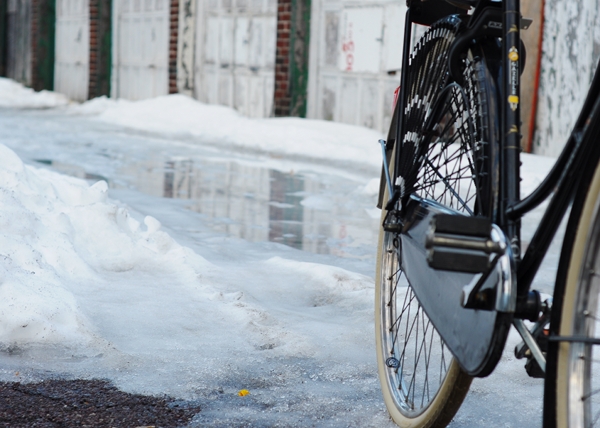
I don't have pictures of what the spot looked like, but it was similar to the watery area you see behind the bike here. I was cycling along a more or less clear portion of the bike lane, when suddenly I approached what looked like water with some slushy edging to it. It was getting dark at this point, and I considered that the water might in fact be covering a layer of ice. But by the time this thought entered my mind, I had a choice to either brake suddenly, swerve around it, or go through it. Looking over my shoulder, there was no room to swerve. And braking seemed like a bad idea in that particular spot. So I went through it. There was indeed ice underneath the water, and the bike's reaction surprised me. It did not slide out from underneath me or flip over upon hitting the ice, but remained upright while "skating" in a zig-zag, much like a car would on an icy road. Incredibly, I kept my balance and tried to contain the zig-zagging within the bike lane, as there was a steady flow of cars to my left. It seemed to me that this went on forever, but in all likelihood it was probably over in less than 10 seconds. I looked back afterward, and the ice-watery stretch was a quarter of a block long. I feel comfortable classifying that as a safety hazard.

I don't mind admitting that the experience left me a bit shaken, and I decided to turn back before reaching my intended destination. I switched on my lights and cycled on the road again, not caring whom I was inconveniencing and how they chose to express that. Then I stopped by a shop near my house to get some olives.

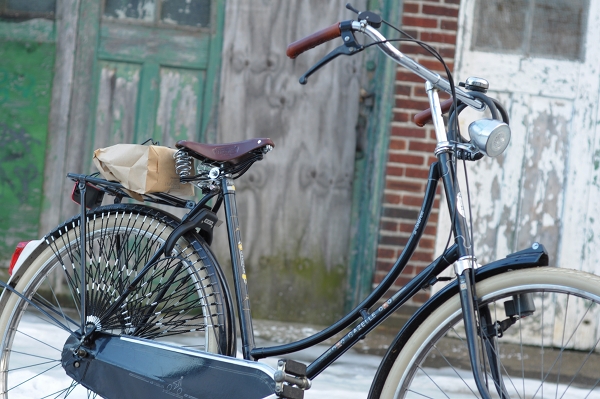
Not having taken my pannier along, I put the olives in a paper bag and secured the package via "rat-trap" - which made me think about rack design again. It is surprising to me that the Gazelle rack, which is rated for a huge amount of weight, has no provisions for bungee cord attachment. I don't really trust these rat trap thingies. I also have mixed feelings about "cafe locks." They are heavy, they are not always easy to use, and you can hurt your fingers if they get in the way of the lever popping back up when the lock is released - which is exactly what happened after my olive purchase.

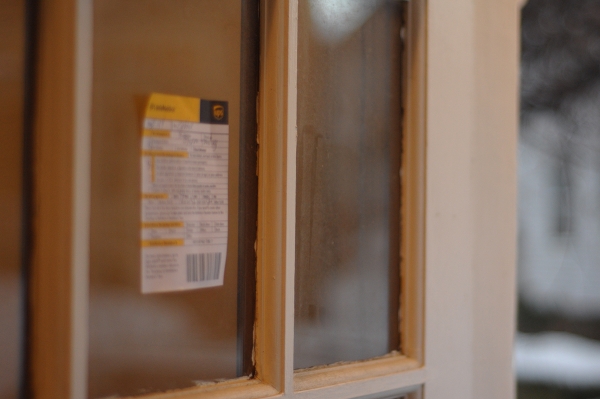
I arrived home without further incident, albeit trailing olive brine from the rat trap having pressed into the container. A notification of a missed package greeted me with a malicious grin, as I removed the leaking packet from my bike rack and prepared to drag the Gazelle up the stairs. A productive afternoon it was not.

But surely there are lessons to be learned from this. The lure of the first thaw is not to be trusted? Water-covered ice is more treacherous than packed snow? Don't let drivers bully you into a bike lane that you feel is unsafe? Yes, all of those certainly seem to fit, but somehow I don't feel a whole lot wiser after the experience. What exactly am I supposed to do next time, cycle on the road and be shouted at the whole way? Or stay off the bike until the city finally decides to clear the sides of the roads? Neither is an appealing option.

Thursday, 3 February 2011

Cycling and Statistics

As someone with a background in the social and natural sciences, I was "raised" on statistics by the academic system. If we compare academia to religion, then making claims without statistical evidence is akin to taking the Lord's name in vain. But even beyond academia, we have an inherent faith in statistics as a culture. We respect numbers and charts, and we turn to them for comfort at times of uncertainty. Consider, for instance, this beautiful bar graph:

Now, some of us may have suspected that diamond frames tend to be ridden by men, whereas step-throughs and mixtes tend to be ridden by women, but only numbers and graphs have the power to lift us from the murky waters of speculation. We can now say that, in a recent poll conducted by Lovely Bicycle, of the 221 respondents who claimed to ride mainly diamond frame bikes for transportation, 76% were male. Of the 95 respondents who claimed to ride mainly step-through bikes for transportation, 80% were female. And of the 39 respondents who claimed to ride mainly mixte bikes for transportation, 66% were female. This numerical evidence we can wield like a mighty weapon the next time someone contradicts these tendencies.

Of course the one little problem with Statistics, is that it's mostly BS. In the words of comedian Vic Reeves, "88.2% of Statistics are made up on the spot" - which may very well be the case. But numbers need not be maliciously forged in order to misrepresent reality. There are multitudes of ways in which a study can be flawed or biased from the start, set up so as to elicit particular responses. Often this is done unintentionally, or at least unconsciously, by researchers eager to find evidence for their pet theories. Other scenarios can include how data is processed, or even how the final results are presented. Statistics are highly prone to human error and bias, which means that they are inherently subjective. This, combined with the fact that we respect them so much, makes our statistics-loving culture susceptible to misinformation.

[image via NHTSA]

The idea of statistics and misinformation brings me to what I really wanted to talk about here, and this is something I've been trying to make sense of for a while. I am puzzled by the use of safety statistics in bicycle advocacy, and I am hoping that someone could explain them to me. For example, many bicycle advocacy talks and internet presentations stress that it is safer to ride a bike than it is to travel in a car. In support of this, they use statistics such as this data from the National Highway Traffic Safety Administration (NHTSA), according to which there were about 30,000 motor vehicle traffic fatalities, and about 600 bicycle fatalities in the USA in 2009. These numbers are used by cycling advocates to point out how much safer it is to cycle than to drive. But unless I am missing something, the figures mean just the opposite.

Yes, the NHTSA numbers suggest that in 2009 there were 50 times more motor vehicle fatalities than there were bicycle fatalities in the US. But those numbers mean nothing until they are weighed against how many cars vs bicycles there are on the roads at large. If there were 50 times more cars on the road than bicycles, than the risks of fatal traffic accident would be equal for each mode of transportation. But I believe that in actuality, there are more like 1,000 more cars on the roads than bicycles... which means that the number of cycling fatalities is disproportionately high.

Obviously, I am not trying to prove that cycling is unsafe. But I do want to understand the reality of the situation. After all, if cycling advocates use statistics incorrectly, they open themselves up to some very harsh critique from unfriendly forces. Where could one go to obtain accurate statistics about the number of cars vs bicycles on the roads, and the number of traffic accidents for each?

Friday, 10 December 2010

A Pedestrian Walking Their Bicycle is Still a Pedestrian

Lately I've felt some hostility from drivers when crossing the street while walking my bicycle. Is it the holiday spirit setting in? Either way, it's as if drivers see the bicycle and are incapable of processing me as a pedestrian, even though I am walking. The reactions have ranged from impatience at crosswalks - including honking, presumably so that I'd cross faster - to downright continuing to drive as if I were not there, even when I am already in the process of crossing the street. I have seen it happen to others as well.

A pedestrian with a bicycle is still a pedestrian. They are not any slower than a person wheeling a shopping cart or a baby stroller, so there is no reason why they should be any more "annoying." Does the mere sight of a bicycle enrage some drivers so such an extent, so as to warrant the extra hostility? That would be a sad state of affairs.

Friday, 22 October 2010

Taking It Personally or Taking It in Stride?

When drivers behave rudely towards us, we tend to perceive them as being "hostile to cyclists".  But what I wonder sometimes, is whether this is a fair assessment given how drivers behave to one another.

Consider that...
Drivers honk at each other all the time.
Drivers cut each other off.
Drivers roll down their windows and shout "learn how to drive, you moron!" at one another while making indecent hand gestures - even if they are the ones at fault.

Is driver behaviour towards cyclists really worse than their behaviour towards other drivers? And if not, should we just take it in stride, rather than taking it personally? One could make that argument.

Of course, the big difference between intimidating other drivers and intimidating cyclists, is that cyclists are considerably more vulnerable - something I am highly aware of when a driver plays "chicken" with me while turning left at full speed as I am trying to go straight through an intersection, on a green light. Bike lanes and protected bike paths do little if anything to solve this problem if there are no cyclist-specific lights at intersections. It is difficult to take things in stride when the competition is stacked against me both in terms of speed and in terms of safety. But I try to remember not to take it personally.

Sunday, 3 October 2010

Bike Lane Etiquette?

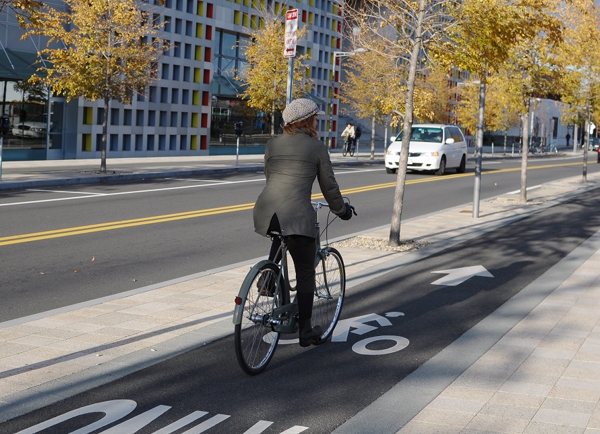
Having just returned from our stay on Cape Cod, I am greeted with a remarkable development: There are now bike lanes on one of the most hated stretches of road near my neighborhood. While normally I avoid this road, today I found reasons to travel along it multiple times just to experience its Disneyfication - for the city has also planted trees and installed decorative streetlights, in attempts to disguise the faded vinyl-siding of the multi-family homes and the peeling storefront signs that say things like "Used Tires". Why if Boston keeps this up, soon the last of the gritty neighborhoods will turn shiny and pleasant and there will be nothing to complain about!

Apparently, we are hardly the only town experiencing such shocking advances in bicycle infrastructure.  A friend from Virginia has written me with the news that there are now bicycle lanes in Harrisonburg, and he - a lifelong cyclist sans lanes - does not quite know how to behave in them.  Where is one supposed to pass? How to deal with joggers in the lane?

While I am by no means an authority, I will contribute my ideas on bike lane etiquette. Please note that although these contain commentary on safety, they are meant as thoughts on polite behaviour and are not safety tips.

1. Positioning within the bike lane
It is a good idea to cycle in the left half of the bike lane, as this positioning places you out of the "door zone" (i.e. you will not get struck by a car's door, should one suddenly fling open). Occasionally, a misguided cyclist or driver may shout at you to scoot over to the right, so that they can pass you easier - but don't allow yourself to be guilted into listening to them. Instead, politely explain about the door zone and why your positioning in the lane is necessary.

Try to keep to a consistent line within the bike lane; don't weave. Drivers and other cyclists can get freaked out by weaving cyclists, and in turn behave irrationally.

2. Passing other cyclists 
Passing other cyclists should be done on the left, never on the right.  If you pass on the right, you endanger both yourself and the cyclist you pass, by nullifying the distance between the two of you and the door zone. Pass the slower cyclist by going around them on the left (into the traffic lane), naturally checking that the lane is clear first.  Should another cyclist attempt to pass you on the right (you can sometimes sense them coming up behind you), I think it is perfectly fine to tell them not to do this ("Please don't pass on the right" or "Please pass me on the left").

3. Yielding to turning vehicles
Yield to turning vehicles in the lane, be they cars or other bicycles, instead of attempting to go around them as they are making the turn. Even if you manage to do this safely, it is disturbing to the vehicle to suddenly see you beside them as they attempt to execute a traffic maneuver.

4. Yielding to pedestrians
If the bike lane intersects a crosswalk, yield to pedestrians in a way that makes them feel safe - don't just cycle around them within inches of their person... And please don't even think of ringing your bell at pedestrians to make them cross faster (I have witnessed cyclists do this in Boston). It is the pedestrian's right to be in the crosswalk and your obligation to yield.

On the other hand, it is not the pedestrian's right to be in the bike lane itself, whether they are jogging or rolling a baby carriage, or whether it is a group of people caught up in chatting. If a pedestrian is blocking a bike lane, I think it is only fair to ring your bell and/or politely say something like "Excuse me, bike lane!" so that they move out of your way. It is rude of them to block the lane; it is not rude of you to point out that they are blocking it and ask them to move.

5. Positioning when stopped at intersections
When stopped at an intersection, stop before the crosswalk - as opposed to blocking it (as shown above), as some cyclists do in order to get a head start. It's not very nice to make pedestrians go around you as they attempt to cross the street.

If other cyclists are already stopped at the intersection when you arrive, it is generally considered polite to stop behind them - as opposed to next to them, in an attempt to compete for who goes first when the light turns green.

6. Turning
Communicate your intention to turn by signaling and merging into the turn lane early on, rather than at the last moment, so that drivers are not surprised and can yield to you properly.

Observe the same rules as if you were a motor vehicle: When making a left turn, yield to oncoming traffic; when turning right on red, yield to pedestrians crossing and to cross-traffic.

7. Wrong way in the bike lane?
I think the reason some cyclists engage in this behaviour, is to make an easier left turn.  However, it is wrong and inconsiderate to "salmon" in the bike lanes; please don't do it.  And I think it is perfectly acceptable to ask other cyclists not to do it.

8. Cycling onto the sidewalk
Upon reaching their destination, some cyclists transition onto the sidewalk and continue to cycle - dismounting when they reach the bike rack, or the front door of the building they will be entering.  My view is that cyclists should dismount upon reaching the sidewalk, and walk their bike thereafter.

9. Speed 
As while driving, it is common sense and common courtesy to slow down when executing delicate maneuvers in traffic. It is also common courtesy not to jeopardise the safety of other cyclists, even if you are in a hurry. Sometimes you just have to go with the flow of bicycle traffic, even if technically you are capable of going faster.

10. Interaction with drivers and other cyclists
Please... just be polite. If you are annoyed or frightened by a driver or another cyclist, it is never a good idea to express that sentiment by immediately insulting them or shouting obscenities. An urgent tone of voice does not need to be abusive. "You almost killed me!" in an alarmed voice is more effective than "You almost killed me, you goddamn idiot!" in a hostile voice. While it may be tempting to shout the latter version, consider that doing so can actually escalate conflict and further endanger you.

With more cities across the US creating bicycle lanes, the numbers of new cyclists out on the roads is growing. And while different states have different degrees of regulations when it comes to cycling, I think there are certain aspects of using the bike lanes that are a matter of common sense and courtesy. I hope my suggestions are useful to new users of bike lanes. Your feedback, whether in agreement or disagreement, is welcome.

Saturday, 4 September 2010

Crime vs. Accident?

I was cycling across town with a friend today, who suggested that we take the side streets instead of my usual route along the major roads. We were cycling on one of these quiet streets, when a sedan passed us too closely and hit my friend's bicycle with the side of their car.

The impact was not strong enough to knock the bicycle over, but it did happen - and the driver kept going until forced to stop at a red light. We caught up to the driver, and my friend quickly took a cell-phone picture of the license plate - at which point the driver stopped the car and came out, expressing annoyance. My friend said, "You hit me with your car." The driver replied, "Well, you should have been more careful!" (More careful? We were cycling in a straight line in broad daylight!) At that point my friend took out their phone and called the police - telling the driver that they were going to file a report. Bewildered ("The police? But you're fine!") the driver got back in their car, pulled over to the side of the road, and we all waited.

The officer arrived and asked whether anybody was injured and whether there was any damage to the bicycle. When we replied in the negative, the officer seemed confused: "So there is nothing to do here then." We repeated that the driver hit my friend with their car, to which the officer (politely) replied, "Well, if nobody was injured and there is no damage to your bicycle, that's not a crime. That's an accident." He then proceeded to file a report of the "accident," stressing verbally that there has been no injury or material damage. Both my friend and the driver gave testimony, and I gave testimony as a witness. We were then informed of where and when we could pick up a copy of the report, and everyone went their separate ways.

And this brings me to my question. Is it correct, that unless a driver actually injures a cyclist or damages a bicycle while hitting them, then hitting a cyclist in itself is not illegal? That is basically what the officer was telling us, but it does not sound right to me. What about the "passing no closer than 3 feet" rule? If a driver hits a cyclist while passing, does that not automatically mean that they were closer than 3 feet?  The driver was unapologetic about what happened, and did not deny that they saw us prior to hitting my friend's bicycle. Yet the officer did not even ask the driver why they did not pass us at a safer distance. Perhaps what the officer meant to express, was that there was no way to determine what actually happened without video cameras or tangible evidence (such as injury or damage to the bicycle) - but his words did not come across that way.

Regardless of the outcome, I am glad that my friend filed a report. As I understand it, these things get entered into the DOT statistical data, and can lead to the development of safer infrastructure on that street if enough such incidents are reported. But I remain confused about what type of collision between motor vehicle and bicycle constitutes an illegal act versus what constitutes an accident. Can any of the cycling activists out there fill me in?

Saturday, 9 January 2010

Say It Loud: We Like Them Plowed!

Dear Boston,

We were so excited to discover that parts of the Charles River trail have been plowed after the latest snowfall! We thank you for this gesture and ask that you please keep doing it - and, just as importantly, that you please do it consistently, so that the plowed trail is something we can count on when deciding what route to take in the winter.

Also - and we know that we are probably pushing it - but when plowing the trail, could you possibly make the clearing a wee bit wider? At the moment, it is not possible for two parties to pass each other safely, making traveling on the trail somewhat precarious when crossing paths with another traveler.

We do not wish to overwhelm you with requests, and so we will not mention at this time our great hope that some day there will be lights installed on the trail, enabling cyclists to use the route after dark. Perhaps another time we can discuss that, but for now we just wish to express our delight with the cleared snow.

Plowing the Charles River Trail is such a useful, wonderful thing for those of us who ride bicycles in the winter, as well as those who wish to walk or run in the fresh air. Please continue to keep us in mind!

Ping Blog

Step 1
Blog URL:


Blog Title (optional):


Blog RSS Feed (optional):


I agree with terms of service.

Step 2
Copy the following code and put it on your blog/site to help our blog ping tool track your submission (Need help?):
;

 
Design by Free WordPress Themes | Bloggerized by Lasantha - Premium Blogger Themes | Best Buy Coupons