Wednesday, 4 August 2010

BSNYC Product Review: Surly Big Dummy

As I mentioned in my Wednesday Bonus Blog today, having acquired Alberto Contador, Bjarne Riis (known as "Mr. 60%" during his riding days in reference to his hair-to-scalp ratio) announced that his new charge will attempt to pull off the so-called "Grand Slam." This, of course, refers to the feat of winning the Giro d'Italia, the Tour de France, and the Vuelta a España all in the same season, and not to the popular Denny's breakfast special of the same name. It's unclear what Contador himself thinks of all this, though he could be seen in the corner during Riis's interview "fingerbanging" himself nervously. Should Contador succeed in winning a "Grand Slam," he would be the only rider ever to do so. Should he fail, he could redeem himself the following year by winning the Vuelta Ciclista al Pais Vasco, the Critérium du Dauphiné, and the Tour de Pologne all in the same season instead--a somewhat less impressive feat known in cycling circles as the "Moons Over My Hammy."

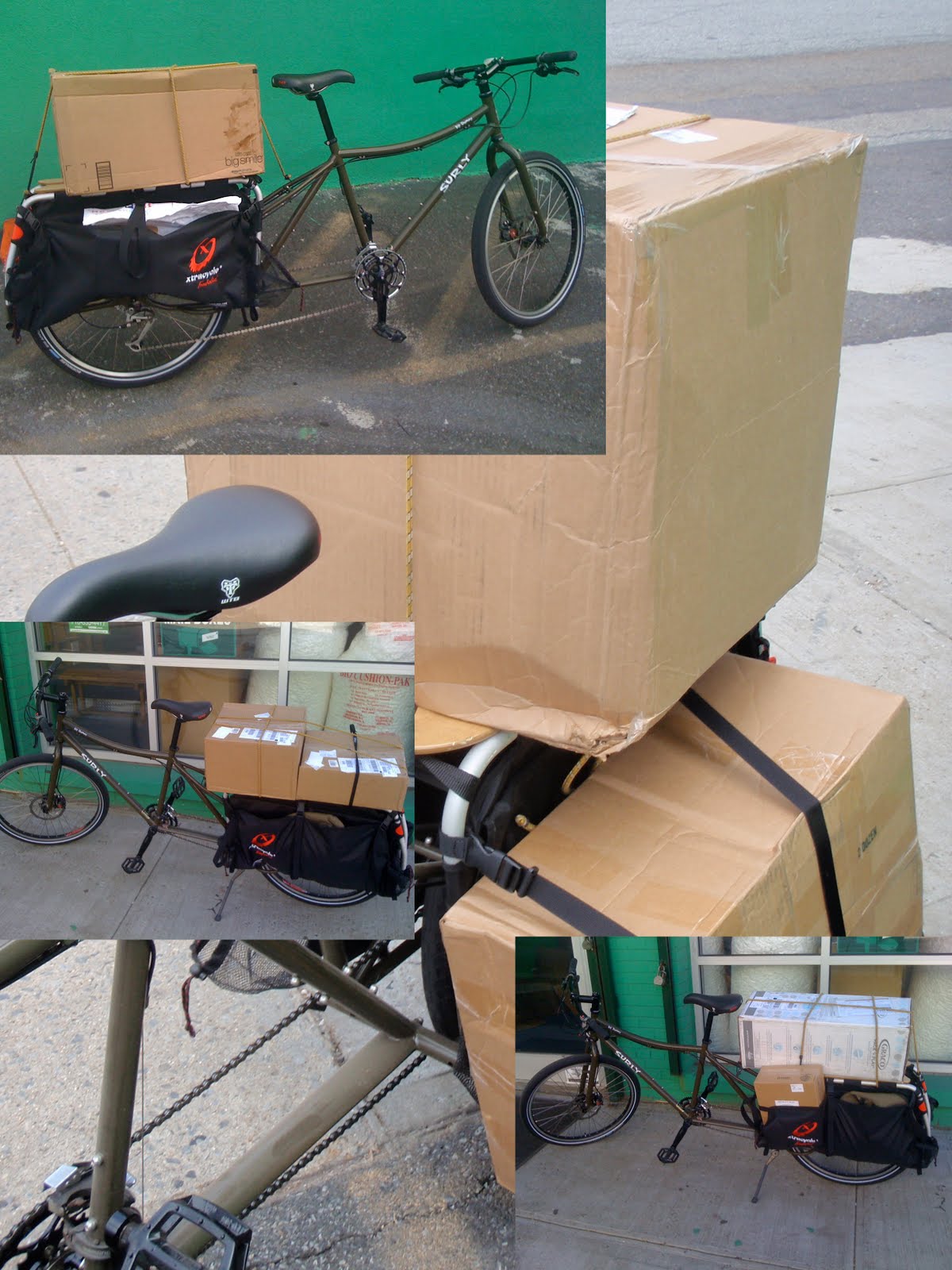
Moving on, yesterday I rode a Surly Big Dummy to my semi-secret shipping hub and storage area along Brooklyn's "Great Hipster Silk Route," where I rallied all my smugness and retrieved and loaded this unwieldy delivery:

(Note haphazard and dangerous "flesh hook"-style bungee cord attachment technique.)

While the large box contained a Russian mail-order simian bride for my helper monkey Vito (the smaller box contained the beautiful Nadia's elegant Vera Wang wedding gown), that information is only tangentially relevant. More to the point, ever since taking delivery of the Big Dummy in like April-ish, I have intended to share my impressions of this large green bicycle. However, I did not want to do so prematurely. Rather, I wanted to "live with it" awhile instead of simply listing the components, hopping on it for 45 minutes, and then declaring it "vertically stiff yet laterally compliant," as is standard industry practice when it comes to both bicycle reviewing and international Internet monkey dating. (By the way, if you're still wondering about Vito's nuptials, they're already married, but the reception will take place in Rhinebeck on an undisclosed date.) I have now lived with the Big Dummy for almost six months--which I suspect is five months longer than Vito's marriage will last.

Moreover, when Surly asked me if I wanted to try a Big Dummy, I accepted not because I wondered if a bicycle like this would be useful for carrying things (obviously it would be), but because I wondered if a bicycle like this would be viable in New York City, a city of well over eight million people--many of whom live in small apartments accessible only by small elevators or multiple flights of stairs (and some of whom share their small apartments with newlywed monkey couples, an arrangement which I assure you is not conducive to either sleep or good hygiene.) In truth, I'd never really thought seriously of owning such a bicycle, for the simple reason that I had no idea where I would keep it.

However, now that I had the opportunity to try one, I wondered if the bicycle would indeed prove as inconvenient as it seemed, or if its practicality would ultimately outweigh its significant tonnage.

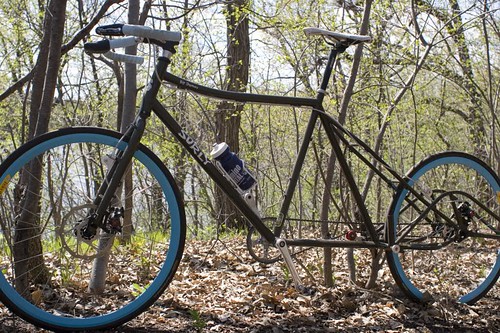
Here is the Obligatory Drive Side Shot (or ODSS) of the Big Dummy, and I had to stand roughly 700 feet away from it to fit it into the frame:

(Yes, this bike needs "wheelbrows.")

Here it is from the front-ish:


And here it is "presenting" itself in almost exactly the same way that Nadia presented herself to Vito when I let her out of that box:

Obviously, the Big Dummy's long wheelbase is what allows it to remain stable while carrying large loads (in the name of good taste, I will refrain from jokes about Nadia's load-bearing ability). Unfortunately, it's also what makes it impossible to fit it into my elevator, very difficult to carry up multiple flights of stairs, and by far the largest item of furniture in my home once I've actually wrestled the thing in there.

Since there was no way I could keep the Big Dummy inside, I realized that I would have to store it outdoors. As it happens, there is a covered area outside my building that has been given over to bicycle parking. It's not totally secure from theft, but it is safer than the street, and it's also protected from the weather. Clearly the Big Dummy (protected by a big lock) would have to take up residence with the Magnas of my neighbors.

Once I'd settled on a home for the Big Dummy, I set about putting it to use. The first thing I learned was that I was now in possession of a bicycle with a "cult following," since as soon as I mentioned it I received helpful emails from people offering Big Dummy advice and insight. I also consulted the "Internet," where I learned of all the exciting things I could do with my Big Dummy. For example, I could install a sound system:


Or I could tow a boat:


Or I could simply strip it down and render it completely useless:

However, I don't want to ride around playing loud music (the San Jose Bike Party was one of the worst experiences of my cycling life), I don't have a boat (are kayaks the "fixies" of the high seas?), and I have no need for an inconveniently long singlespeed.

I do, however, want and need to carry crap, and the Big Dummy immediately proved to be very capable in this regard. In fact, I was surprised to discover that it soon seemed indispensable to me. I used it to procure foodstuffs:


I used it to transport beach-related items:

(That cooler contains a kidney, but I always perform my organ transplants on the beach.)

I used it to "curate" family picnics:

(New York Philharmonic in Prospect Park, otherwise known as "Where the White People Are")

Note I persist in using plastic bags--I need an environmentally insensitive chaser after the cloyingly sweet smugness of cargo bike "palpage." Plus, they often contain delicious takeout.

Speaking of delicious takeout, I've even used it as a mobile dining room table for impromptu burrito feasts:

Most useful of all though is that the Big Dummy has greatly simplified picking up bulky items such as monkey brides and circus peanuts (Vito loves circus peanuts) from my shipping hub:

And thus, to my surprise, did the Big Dummy manage to slot neatly into my "lifestyle" (inasmuch as an existence of producing bicycle-themed wiseassery interspersed with errand-running can be considered a "lifestyle"). I'd simply load or unload it in the lobby and then return it to its place among the Magnas. Unfortunately, though, because it carries so much so easily it's become like a college student's car in that it collects random junk:


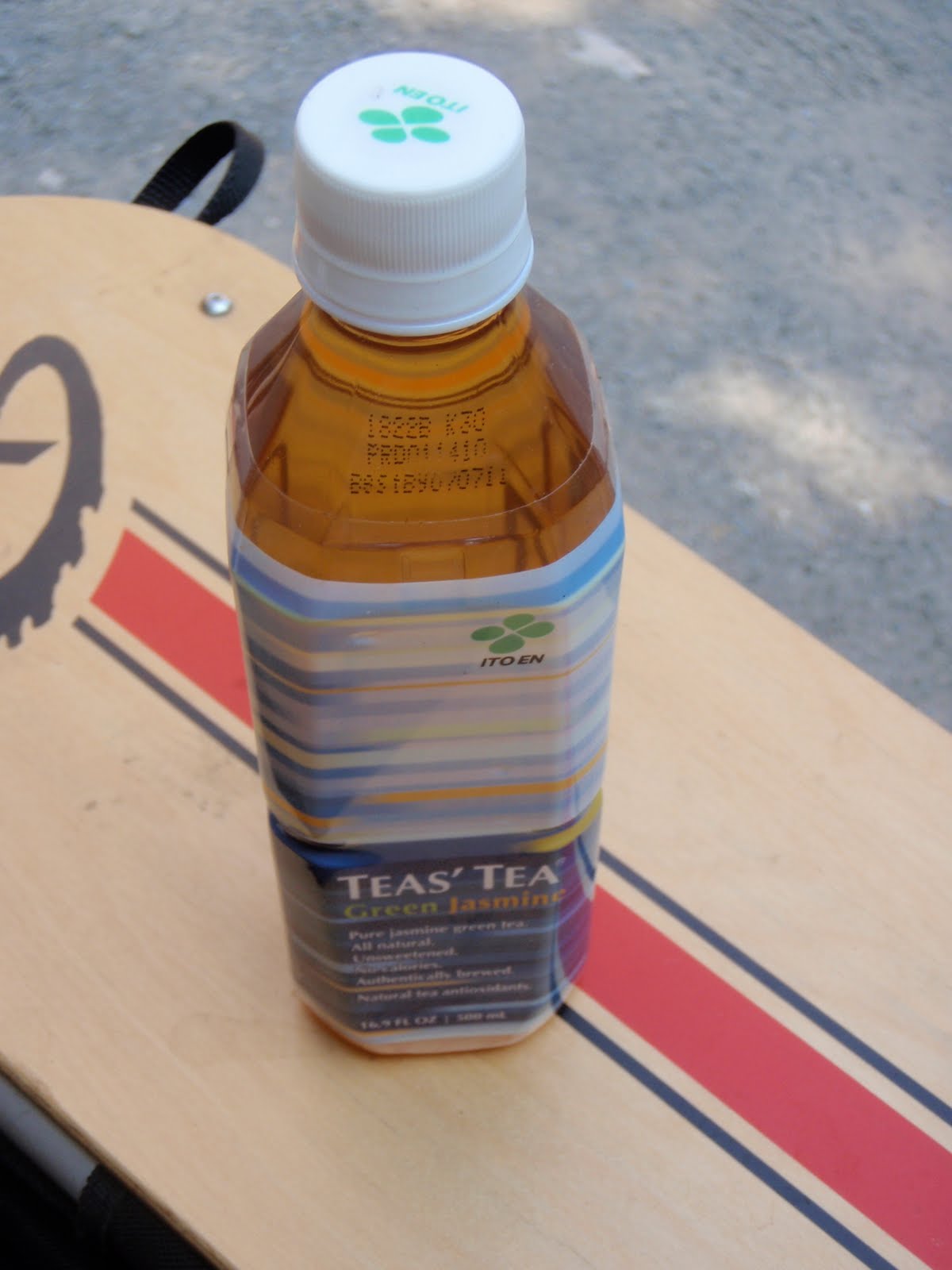
For example, while photographing it earlier, I found an entire bottle of tea in there, and I don't even like tea:

Unless it's full of sugar, is served to me in a plastic bag, and is called "Snapple."

Of course, the only thing that makes this decadent orgy of cycling smugness possible is that I have a relatively safe place to store this bicycle at street level, which is not the case for many people in big cities (unless you're a wealthy person with a hyphenated name--even in 21st century bike-friendly New York, smugness is a luxury). Also, while I'm comfortable trawling the streets of Brooklyn with it and even locking it up occasionally, the stock Big Dummy is an expensive bicycle, and it's too lavishly-appointed to leave unattended in a place like Manhattan for long periods of time. For the same functionality (assuming you have the room), you can obviously bolt an Xtracycle to a crappy old mountain bike, or just get the Big Dummy frame if you're one of those people with a bunch of spare parts, since it's got provisions and braze-ons for pretty much everything.

But while it's a bit lavish, it is pretty nimble despite its size and is in no way cumbersome to ride. While the truly smug prefer their "bakfiets," until the entire city is David Byrnified with protected bike lanes I think a cargo bike built on a more "sporting" chassis like the Big Dummy is a better fit in Brooklyn--where you might have to dodge the World's Scariest Car:

("Are you there, Elohim? It's me, Moishe.")

Confronted with that, there's not a cargo bike in existence that could transport my fear.

Tuesday, 3 August 2010

Power Grips: Foot Retention That Even I Can Use!

[edited to addPower Grips was a sponsor of this website September-October 2010. This review was written before that time.]

I do not like the idea of foot retention and generally feel no need for it - whether cycling for transportation or going on long rides. Perhaps it is more accurate to say that the very thought of having my feet connected to the pedals fills me with terror. The problem is, that I will soon be riding a fixed gear roadbike (Marianne's conversion was practice), for which it is advisable to use foot retention: When cycling over bumps or potholes, your feet can fly off the pedals on a fixed gear bike and the pedals can then "chew up your ankles" before you have a chance to brake. So yes, foot retention is recommended.

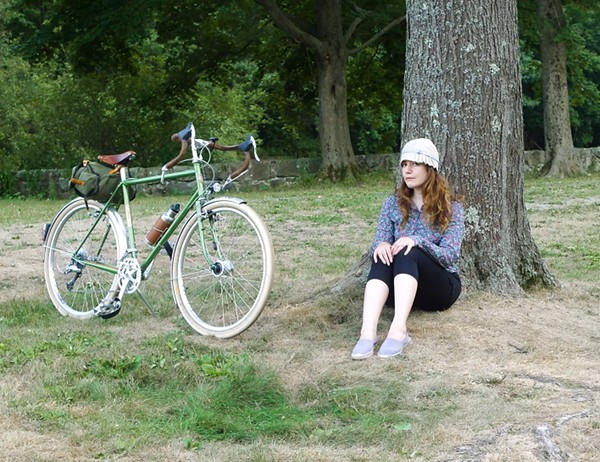
Some have suggested I try Power Grips if I am too nervous to use toe clips or clipless pedals. I have finally gotten up the nerve to give them a try... and so far they have been more or less a success. We installed these first on my Rivendell Sam Hillborne, so that I could get comfortable with them before putting them on the fixed gear. Here are my impressions so far.

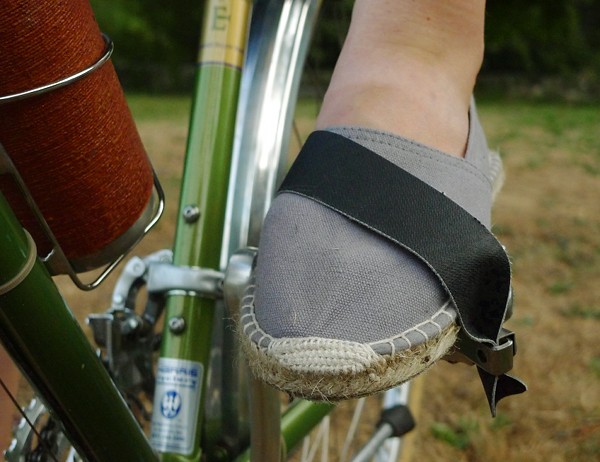
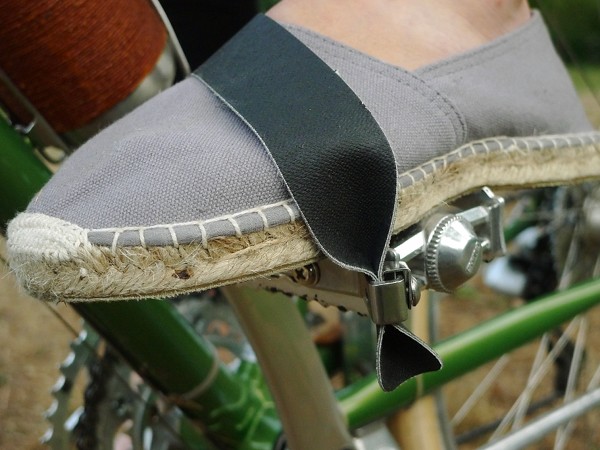
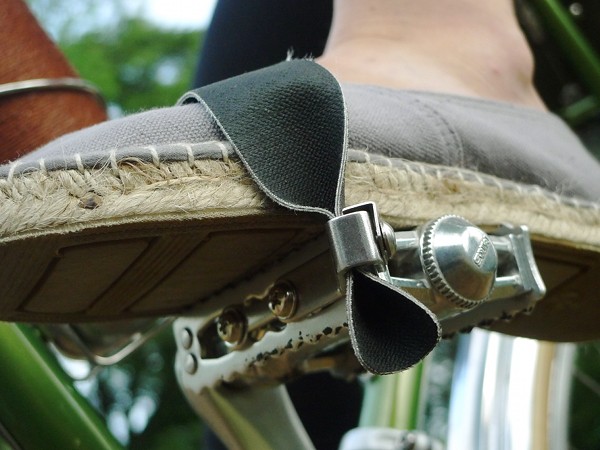
Power Grips are basically straps made of a thick, stiff woven fabric, that mount diagonally on the pedals. It is easy to slide your foot in and out, but the diagonal position grips the foot firmly in place once it is all the way in. Note that we mounted these with the logo on the inside. There is also a beige version with an argyle pattern accompanying the logo.

Even as I write this, it sounds implausible that something can both "grip the foot firmly" and "be easy to slide in and out of," but that is the feeling.  Because the band is diagonal, there is a large escape area as soon as you move your foot back a bit. You can also feel the grip getting tighter/looser as you shift your foot forward or backward on the pedal, so there is a natural bodily awareness of the system that works in your favour.  When approaching a stop, I simply slide one foot off the pedal and step down on the ground. Initially I would remove the second foot at stops as well, but eventually I discovered that it was easier to just keep it inside the grip.

I am not qualified to say how effective the Power Grips are in terms of pedaling efficiency; I simply would not know. It feels as if with the grips I can pedal with more power, but it may very well be an illusion. However, none of that is important to me, and what really matters is safety. The Power Grips keep my feet firmly in place when going over bumps, yet are easy to get out of whenever I need to.

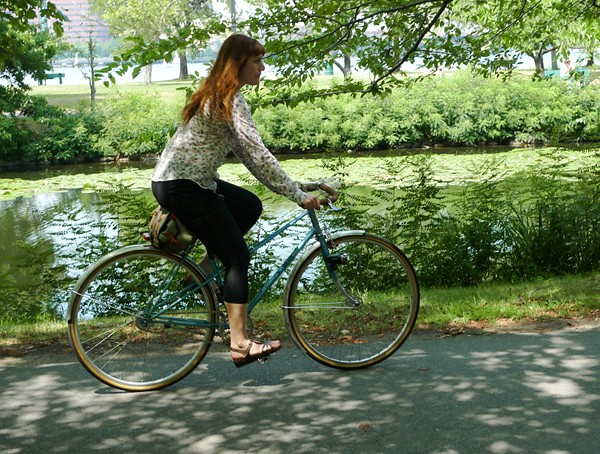
I should mention also that the straps come in several sizes, and are adjustable to fit over different types of footwear. They do not squeeze or rub the top of the foot, so I am pretty sure you could wear them even with sandals. 

Another nice thing about the Power Grips, is that if you want to pedal without them, you can easily use the other side of the pedal.  I do not feel comfortable yet wearing the grips in stop-and-go traffic, so when the traffic gets dense I simply cycle with them upside down and my feet are free. The straps do not hang low enough to scrape against the ground. And even if there is an occasional scrape, it is soft and silent (whereas toe clips make screeching, clunking noises).

Some complain that Power Grips don't look attractive on a bike, but I think they are fine: it is just a strap attached to the pedal. They will soon be moved from my Rivendell to my fixed gear bicycle - though I must say it is tempting to keep them here, too. Unless riding in traffic, it actually feels nice to have my feet in the straps, especially when pedaling fast or going over bumps.

I cannot overstate how scared I am of foot retention: I have tried clips and half clips, and was unable to use them. Power Grips seem easier and safer to me than either of these systems. They are also by far more effective than half-clips or loose toe clips. 

Consumer Innovation: Putting the Solution Before the Problem

Ever since the end of the Tour de France, cycling fans have speculated as to which team winner of no stages Alberto Contador would join next year. Theories ranged from the mundane (he would stay with Astana) to the untenable (he would abandon cycling altogether, move to Bondi Beach, and take up professional surf lifesaving). Well, after over a week of half-assed guessing, the speculation is over, and Contador has finally revealed that he will join Bjarne Riis's team. From the look of it, they're both quite pleased:

In fact, their countenances bely the sort of spiritual ecstasy generally reserved for those who practice asceticism and suspend themselves with flesh hooks:

I suppose that getting one's hooks into a Tour de France winner amounts to more or less the same thing.

Meanwhile, in other cycling news, a company called "Pants'Fix Trousers Solution" (apparently "trousers solution" is clothing tech jargon for "belt") have asked me to introduce their new "Pants'Fix holder" and new "belt opening system" to my "audience:"


Hello guys,

I would like to introduce you a new brand with design products.

Pants'Fix has patented a few diffrents products worldwide as the Pants'Fix holder (very useful for bikers) and a new belt opening system.

Now we would like to put the accent on our new belt collection the 26 Inches ,belts made with a new openning system and bar tabe available since Monday.


We would be very happy if you introduce it to your audience.

As a sarcastic person with a crappy blog about bikes, I'm occasionally asked to promote people's products, events, causes, or grievances, and while I don't often do so I'm making an exception in this case, only because I think Pants'Fix's revolutionary belt closure technology and colorways are going to change the way we think about pant suspension and retention. Consider this World Champion-themed pant waist securing device:
Now you too can be the World Champion of Keeping Your Pants Up--and you can wear a World Champion wrist-adornment solution to match:

(UCI-themed belt and matching FredStrong bracelet)

Sometimes, however, a belt is simply not enough, which is why Pants'Fix are also working on a suspender set (or "vertical trouser solution") for added security and peace of mind:

(The egg now withdrawn from her posterior, Mindy expresses relief.)

I'm surprised that the "bike culture" has not widely adopted suspenders (or "braces" if you're British or, even worse, have an affinity for ska music and Lambrettas). Having already resurrected the "fanny pack," the suspender seems like the next logical step, since it's yet another useless accessory (unless of course you need to hoist seriously heavy garments, like firefighter pants) that can be made from nylon or recycled inner tubes. Plus, they can also feature lots of pockets to store your overpriced artisanal bicycle tools. Sure, Showers Pass does make a pair, but they're not full-on utility suspenders. (Incidentally, in addition to having suspenders, Mork from Ork wore tight-fitting clothing and aged in reverse, thus setting the template for all of "hipster culture.")

Anyway, it's clear that Pants'Fix have done for accessing one's pants what Look did for foot retention, and really the only problem is finding a bicycle to match. One possibility is this Cinelli MASH Histogram 1 of 3 in existence special "collabo" limited edition colorway trackular fixed-gearified bicycle up for auction on eBay, which I saw recently on fixed-gear freestyle impresario, streetwear enthusiast, and master angler Prolly's blog:

The bidding starts at $3,000, but I recommend exercising the $5,ooo "Buy It Now" option, since you don't want to miss out on the opportunity to be one of only three people in the world with a bike this ugly (Landshark owners excluded):

If the picture's not enough to make you want this bicycle, then the description should finish the job:

Up for sale is a beaaaaaaaaaaaautiful fully built out ( parts listed below ) Cinelli x Mash Histogram Fixed Gear Bike purchased from Project Space Gallery in LA and shipped to NYC where it was built out by the famous Chari & Co bike shop. This has been featured on almost every design and bike blog and magazine and there are only 3 in existence, this being the only 55cm one. This has been ridden but literally under 10 miles, around 7 to be exact. I WILL ship anywhere in the world but it, it will be professionally packaged at the UPS store and sent out. Please contact me before bidding with any questions about shipping quotes. I'm located in downtown NYC and pick up is absolutely acceptable ( and preferred ). Payment is due with in 48 hours of the end of auction via paypal or wire transfer.

I was especially impressed to see that it had been "built out" by Chari & Co., since that's better that simply being "built," and is the kind of serious language usually reserved for porches and home extensions. Plus, while you may not be able to bid with total confidence, you can at least bid with optimism, since the seller is a solid B+ eBayer:

Speaking of the superfluous tooling trend and stuff you can keep in your suspenders pockets, yesterday I mentioned the Monkey Like Shiny 15mm U-lock socket, and I'm still trying to figure out the point of a tool that only works in conjunction with a U-lock:

In an attempt to understand, I visited the manufacturer's blog, where I learned that it's because it weighs less than a Craftsman wrench and that I "don't have to carry it:"

In a world filled with mini-tools and multi-tools and "peanut butter wrenches" and small socket wrenches you can attach to your keychain, it seems odd to use a Craftsman wrench of all things as the portable tool size and weight standard. Stranger still is the claim that "you don't have to carry it," which implies it somehow hovers alongside you as you ride. Either that, or they simply mean that you're free to leave it at home, which is also true of the Craftsman wrench, or really of any of the other myriad tools in existence. Really, the only difference between this tool and those is that the Monkey Like Shiny is the only one that is entirely U-lock dependent. Still, they have won the hotly-contested Sears hand tool weight war, so if you're a department store "weight weenie" then this is probably the tool for you.

I do of course realize I'm in the minority, and that the "bike culture" at large is delighted by innovative trouser solutions and aftermarket U-lock add-ons and quirky tools and designer bags and holsters in which to carry them, and that many people find it thrilling to ride around the city in a state of total preparedness rivaled only by rescue workers and people responding to gas leaks. Tiny tools in particular tap into the "urban cyclist's" deepest fantasy--which is of course that he or she is a secret agent of the streets who has been outfitted with all sorts of gadgetry and special weaponry by Q. Increasingly, they look like survivalists with a lot of disposable income.

Granted, special weaponry can come in handy sometimes, especially in New York City traffic, which Portlander Heidi Swift recently declared feels "borderline suicidal:"


Of course, it feels considerably less suicidal when you're used to it, which is why many New Yorkers feel the need to increase the suicide factor a bit by operating their iPhones while riding opposite the bike lane in heavy traffic and towing what may or may not be a cooler containing a human organ:

This sight is so common in New York City that it didn't even distract the gentleman on the sidewalk from petting his imaginary cat.

By the way, as I mentioned not too long ago with regard to "Bowery Bikes," I find it ironic that so many New Yorkers seem to want to emulate the functionality, ubiquity, and unremarkability of cycling in Amsterdam by purchasing costly Dutch bikes when we already have our own functional, ubiquitous, and unremarkable bicycle in New York City in the form of the "old mountain bike." Here's a good example:

It turns out you can simply carry your stuff around the city on a bicycle without spending a lot of money or being "chic," and people have been doing it for a long time. Plus, as a bonus, both the New York Times and the Wall Street Journal will even pretend you don't exist.

But things are changing quickly in New York, and with the recent installation of the Flushing Avenue bike lane in Brooklyn the Great Hipster Silk Route is now almost entirely bike-friendly:

Oddly, the more bike-friendly the city gets, the more popular the expensive "survivalist" look becomes. One wonders what will become of New York City cyclists if we no longer have to fight for our lives.

Monday, 2 August 2010

Itineraries and Agendas: Bicycles at Work and Play

Today is August 2nd, which marks not only the birthday of deceased actor Carroll O'Connor, but also the end of my "Summer Reese's,"--brought to you, paradoxically, by British confectioner and military contractor Cadbury, makers of both the deadly "Cadbury Creme Egg" warhead as well as the delicious Trident II D-5 submarine-launched ballistic missile candy bar. I'm pleased to report that I engaged in a number of pleasurable activities during my absence, both cycling- and non-cycling related. Sadly though, I did not undertake an expensive and life-changing exotic cycling-themed vacation of the sort you can often read about in the New York Times:

Ideally, we would not need such vacations, instead weaving strands of responsibility and pleasure into the laterally stiff yet vertically compliant crabon fribé of a balanced life. However, in today's fast-paced, silicone-enhanced, and exploding dessert-filled world, this can be difficult. So, in the absence of balance, we instead take the "binge and purge" approach to existence, pausing occasionally from overwork in order to undertake brutal and punishing holidays. In this case, it's five days of cycling through Colorado, Utah, and Arizona (cost: $1,895 excluding the airfare), and here's the group that has assembled in order to defibrillate their lives with the invigorating jolt of pre-meditated catharsis:

There are many things you can call this group: fellow vacationers; traveling companions; even siblings-in-arms. However, you cannot call them a "peloton," despite the writer's use of the term. Despite what some people think, a "peloton" is not simply any group of cyclists riding together; in order to be a "peloton," they have to be racing. Groups are defined by their purpose. Similarly, not every group of people on a long line is "a bunch of schmucks;" they have to be waiting for something stupid, like the new iPhone or a pair of limited-edition Nikes.

In any case, unlike Robert Mackey or that Men's Journal guy, the writer at least seems to enjoy his trip. Not only that, but he also gains enlightenment in the process, for he ultimately learns what cycling is all about:

With all due respect to cyclo-cross and kamikaze downhill mountain biking, and every other mutation that two wheels have taken in recent years, this is what a bike was really intended for, no? To spin down a deserted road that’s as straight as a compass arrow, moving fast through big, empty country.

Of course, as anybody named Cees or Geert will tell you, cyclocross is not a "mutation" that has occurred in "recent years;" indeed, people have been racing cyclocross since before much of Colorado, Utah, and Arizona had electricity and running water--which is to say since before 1996. Granted, cyclocross as it is practiced in Portland is a mutation, but I'm pretty sure that's not what he meant. (With regard to downhill racing, I have no issue with his portrayal of that discipline as a mutation, and I'm guessing that most participants feel the same way.) As far as "what a bike was really intended for," this if course is highly subjective, and the real beauty of the invention is that it can be used and enjoyed in any number of ways. But while I would certainly never have the audacity to declare that only I truly understand what "the bike was really intended for," I am reasonably certain that when John Kemp Starley started selling the safety bicycle in 1885 he did not have in mind psychotherapists vacationing in the American West (if only because, back then, they would most assuredly have met with death by scalping).

As I continued to read, I grew concerned that this story would not meet the "epic" vacation's Quota of Misery. Clearly, the editor felt the same way, for towards the end the writer inserts a gratuitous list of cycling-themed ailments that feels a little tacked-on:

By the end of Day 4 — more than 300 miles down, with one day to go — the group was happy but hurting. Muriel had “hot foot.” Bob, a retiree, had “handlebar palsy.” Bruce was considering putting moleskin on a place for which I’m pretty sure moleskin was never intended.

I'm guessing the "place for which...moleskin was never intended" is the "taint," from which I will infer that Bruce was suffering from the dreaded condition known as "randonneur's scranus." While all of these afflictions sound painful, the vacationers can at least take solace in the fact that they managed to avoid other common forms of cycling discomfort such as "crankarm dropsy," "the fixie colic," "grimpeur's toxemia," "swamp crotch," "paroxysms of Fredliness," and of course "velocipedist's vulva."

Speaking of "what the bike was really intended for, while some believe its ostensible purpose is to "spin down a desert road," others feel it is the perfect vehicle with which to draw attention to yourself and your cause. Consider this Paul Revere theme ride in New York City, which apparently had something to do with gardening:


Apparently, some people on the Lower East Side are worried about their community gardens, which aren't going anywhere but I guess could now conceivably go somewhere, so instead of sitting idly by they decided to meet the problem head-on by embarrassing themselves:

The ride seems to have been organized by "Time's Up," which is "NYC's Direct Action Environmental Organization." In case you're wondering what "direct action" is, it means that they will not hesitate to don ridiculous clothing at a moment's notice wherever gentrification and smugness is threatened. Let's say, for example, that the Hasidim make it slightly more difficult for a young Williamsburger to ride his brakeless bicycle in an irresponsible manner, or someone paying a lot of money to live on Avenue C may in theory lose a place to grow his or her own basil. Well, that's when it's time for "direct action," and then this happens:


While I'm all in favor of communities and gardening, and while I realize this display did ultimately net them the press coverage they wanted, I still wish they hadn't implicated bicycles in their display. It would have been fairer to everybody if they'd at least kept everything garden-themed and pushed each other around in wheelbarrows. Instead, by making this into a theme ride they've turned the rest of us who ride bicycles into unwitting social protesters for their cause. It's almost as if, in protesting for better treatment of cyclists, I'd pelted the mayor with homegrown tomatoes.

Still, I suppose I prefer using bicycles to promote gardens to using bicycles to promote cars, as in the Honda Jazz "hipster" commercial which a number of people have forwarded me:

I have nothing against cars or even the marketing of cars (or the mocking of hipsters for that matter), but I do have a problem with this commercial. First of all, why does your bike have to fit in your car? That's what racks are for. Then again, I suppose this is an accurate portrayal of "hipster culture," since a fundamental part of it is dreaming up impractical solutions for carrying things. (The latest example of this is the U-lock-mounted axle nut wrench.) Also, while the commercial is ostensibly humorous, it does have an insidious message:

After mocking "hipsters" for their conformity, it makes them feel self-conscious about their bicycle use:

Implying that they should all drive Honda Jazzes instead, as if somehow this is original:

This in turn could usher in a new "hipster car culture" that will have the world pining for even the worst "bike culture" excesses. It's almost a matter of time before they discover "Cannonball Run" and ironic cross-country races become the new alleycat--or worse, one of them decides to try "running" his Honda Jazz brakeless.

Meanwhile, the "fixie" has also made a cameo in the latest Crate & Barrel catalog, as forwarded to me by Aaron from Boston:

I'm not sure why a bicycle with no brakes and a tilted saddle is supposed to complement a tastefully-appointed living room. It's like putting a pop-up toaster with a fish sticking out of it in the kitchen shot. Then again, bikes with no brakes are more interesting, as forwarded to me by another reader:

Given that they ran into a police car they might otherwise have avoided, I can't really argue with that.

Sunday, 1 August 2010

Cycling and Comfort: When Does It Hurt?

Small confession: For the past couple of days, I have been using my road bike for transportation. Not out of choice, but out of necessity - I can't spend more than 2 minutes on any of my upright or semi-upright bicycles right now without pain.

In my excitement about Marianne's conversion, I took her on her longest ride yet as a fixed gear - 28 miles. For the first 20 miles, everything was fine. The bike's geometry has never been the most comfortable, but as a fixed gear it felt better than ever and I was pedaling happily. But then, with just 8 miles to go, I suddenly became aware of a rapidly growing discomfort - not just in one area, but in several: in my shoulders, arms, back, pelvis, joints - pain seemed to be everywhere and it attacked me all at once. By the time I got home, I felt as if I had been run over by a train. I took some Ibuprofen and expected it would go away in the morning. But when I tried to ride my vintage Raleigh the next day, I felt the same pain immediately and barely managed to cycle to my destination a mere mile from home.

Mysteriously, I can still ride my roadbike with zero of the pain I experience on the upright bikes. Somehow being in the drop-bar position on the comfortable Rivendell does not activate any of the same discomfort. So, I am now in the ironic situation where I can go for 35 mile rides on a roadbike, but can't cycle for even a couple of miles on any of my city bicycles. Argh!

My working hypothesis of what happened is that while riding Marianne, my legs grew tired of the fixed gear pedaling, and without realising it I began to put more stress on my arms, hands, butt, and everything else. And because the mixte is semi-upright, this damaged some joints in a way that the pain only shows up in the upright position, but not in a leaned-over position. Does that make any sense as a possibility?

But this particular situation aside, I have been thinking a lot lately about comfort, and, more specifically, about when it is appropriate to declare that a bicycle is "comfortable".  Had I limited my rides on Marianne to 20 miles at a time or less, I would have thought she was perfectly comfortable. I could have ridden her this way for years, thinking that I had a comfortable bike - but I would have been wrong. And that is why it is so difficult to determine a bicycle's comfort based on the sort of test rides you take at the bike shop, or even short rides on your own. Bicycle A might feel better than Bicycle B after a short spin, but how will they compare after mile 20? mile 50? mile 100? You just do not know, until you actually ride the bicycle for that distance.

Ping Blog

Step 1
Blog URL:


Blog Title (optional):


Blog RSS Feed (optional):


I agree with terms of service.

Step 2
Copy the following code and put it on your blog/site to help our blog ping tool track your submission (Need help?):
;

 
Design by Free WordPress Themes | Bloggerized by Lasantha - Premium Blogger Themes | Best Buy Coupons