Showing posts with label road bikes. Show all posts

Tuesday, 3 May 2011

Cropped Out: Delusions of Fredness

As I mentioned yesterday, on Saturday I attended the New Amsterdam Bike Show. In addition to contending with treacherous stairways and ogling stylized Dutch-style bikes in a variety of colorways, I also got my daintily manicured hands on a copy of the June issue of "Bicycling." "Bicycling" is a magazine about bicycle cycling, and a magazine is sort of like a blog or a website, only it's printed on paper and you have to pay for it.

Ordinarily, I have to go to the dentist to read "Bicycling," and even then the issue is usually eight months out of date. (You can date an issue of "Bicycling" by finding the most expensive bicycle in it, measuring the "beefiness" of the bottom bracket in millimeters, and then dividing that figure by the number of rear cogs. In fact, sometimes this is the only way to tell the issues apart.) However, this time someone from "Bicycling" actually gave--gave--it to me, and not only was it "hot off the presses" (that's magazine publishing lingo for "new"), but I didn't even have to have my teeth drilled to get it.

This is because the June issue of "Bicycling" is the debut of the magazine's official redesign, and they want the bicycle cycling world to know it. Here's what the cover looks like:

Nice font, right? And not only have "Bicycling" redesigned the magazine, but they've also made it interactive. As you may have noticed, it says "flip open" in the upper right corner ("flipping" is the paper equivalent of "clicking"), and when you follow the instructions you see this:

That's right, it's two more Freds, making a total of four (4) Freds! That's a Total Fred Increase (TFI) of 100%.

Clearly "Bicycling" means business with this redesign.

But redesigning a magazine isn't just about increasing the cover's Fred Load-Bearing Capacity (FLBC). It also extends to the words and pictures on what publishing professionals call the "inside" of the magazine, and "Bicycling" have "dropped" an "edit" to show you what they've done. Basically, what I think they're trying to say is that the magazine is now less "Vanity Fair" for Freds, and more "Rouleur" for Freds.

In all seriousness, I do think "Bicycling" have done an excellent job with the redesign, and with each successive bathroom visit I'm enjoying the June issue more and more. However, this wasn't the reason I was excited to see it. No, I've been eagerly anticipating this issue because it's the one in which they announce the "Editors' Choice" winners, and since I was one of the testers I really wanted to see some Fred-tastic pictures of myself in crabon-testing action. (In case you care, which I'm sure you don't, my favorite bike in any category was the "Giant Defy Advanced 1," despite the fact that it's name is a full sentence long, and probably because it had 25mm tires whereas most of the other bikes had 23s.)

Now, as you know, as an anonymous blogger whose identity is a closely-guarded secret, I take great pains to obfuscate any and all of my personal details. However, even I have my vanities, and when "Bicycling" told me that on one of the test rides we'd be photographed I resolved immediately to be "ready for my close-up," as Norma Desmond said in "Sunset Boulevard." This was because, as an awful bike racer, I knew that appearing in the world's largest cycling magazine by circulation could very well be my last-ever chance to experience anything even remotely resembling competitive glory.

Or, to put it another way, I wanted some "face time" in Fred-dom's periodical of record.

But there was one problem: "Bicycling" told me that on photo day I had to wear non-team kit. However, I didn't have any non-team kit, since all my cycling clothing is from my stint with Mapei when I played a vital role in their 1996 Paris-Roubaix podium sweep:


I actually crashed out of the race before it even started when I collided with a frites cart on the way to the sign-in, but I still like to think that they couldn't have done it without me.

Anyway, the problem remained that I had no non-team cycling clothes. Generously, "Bicycling" offered to lend me an outfit from their closet, but I cringed at the thought of what Primal monstrosities might lurk in there, and there was no way I was going to be immortalized in dentist offices all over Canada's dickey in a "Tribal Fire" jersey.

Therefore, it became clear what I had to do. Say what you will about their overblown marketing copy, and their studiously "epic" videos, and their even more "epic" pricetags, but if you want to look good on a road bike you're not going to fail with the Rapha. Actually, that's not true. You can fail pretty spectacularly with the Rapha:

(His wardrobe is so "epic" it's making him queasy.)

Nevertheless, I was desperate, so just before departing for Austin I allowed my inner fop his head and obtained a complete Rapha ensemble: socks, shorts, jerseys, armwarmers, the whole schmear. And when photo day arrived, I removed each item from its special Rapha puch and put it on with the nervous excitement of a prom-bound teenager donning his first rental tuxedo. Then, I practiced my "epic" expressions in the bathroom mirror. (Hint: After much experimentation, I finally figured out the best way to attain a Rapha-esque wince is to let your mouth hang slightly open, think about your favorite food, and then concentrate on letting the saliva pool in the bottom half of your mouth without spilling it.) I have to say, the clothing was really nice. Like, surprisingly nice. Finally, it was time to mount my Focus Locus Hocus Pocus or whatever crabon bike I was "testing" that day and roll out with the "Bicycling" crew.

I should add that we were photographed constantly by this guy:

Whether it was eating our morning Cocoa Puffs, inflating our tires, stabbing at our "smarting phones," or even actually riding the bikes, nothing escaped his omniscient lens.

So as the road unfurled itself in front of me and I savored the perfect fit of my jersey and the taintal caress of my arguably overpriced but undeniably comfortable chamois, I just assumed it was a certainty that somewhere in "Bicycling" would appear a glossy photograph of me in full Fredly flight. Instead, imagine my surprise when the only picture of me was this:

Actually, I'm not even sure it's me, but there is the white Rapha arm band which signifies my membership in their "Army of Douche," and my head's also more or less level, which means I'm probably still focussing on not spilling my drool pool.

Of course, I am as Fredly as anybody, and the fact that I'm disappointed over this photo when it's right next to an entire page of my own writing perfectly underscores the Fred psychology--which, to fall back on a cliché, is to fail to see the forest for the trees. Why enjoy the ride when you can fuss over your power meter? Why enjoy amateur bike racing when you can pay a coach to help you take it more seriously? Why be satisfied with ten speeds when you can have eleven? And so forth.

Also, at one point, a urinal auto-flushed so hard as I stepped to it that it overflowed and someone else's urine sloshed all over my Rapha socks:

Now that's "epic."

Still, I'd rather be doused in urine while wearing Rapha then humiliate myself while wearing in a polar bear costume:


I'm not sure if this "protest" does a greater disservice to cyclists or to the polar bears themselves, but either way it's one of the most horrifically cringe-inducing things I've ever seen. If these people really want to pretend to be polar bears while making a point they should go find a rapidly-melting iceberg and film their last days on it Timothy Treadwell-style. As it is, if you're wondering why the NYPD is picking on us so much recently, this is probably part of the reason.

Lastly, I have just received an exciting press release about the "Sanitov CB:"

The Sanitov CB (cargo bicycle), is the product of a cultural meeting between traditional Chinese bicycle design and the functionalistic, Danish design approach. The Bicycle is of a traditional Chinese cargo-bicycle infused with the latest technological Know-how and Scandinavian minimalism.

The Sanitov CB is sophisticated built from the best materials we can find. The Design includes, matching full leather handles and saddle, high quality stainless steel and aluminum frames and rack, a world innovative GPS Tracker-system and a battery-driven engine. The built-in battery-driven engine facilitates the function when going over long distances or when transporting heavy goods; a supplement ensuring the convenience and usability of the bicycle in all situations.

Wow, sounds impressive--except it turns out it's not a bicycle at all. Actually, it's a trike with a cart on it:

I wonder how many polar bears you can "portage" with it.

Thursday, 28 April 2011

Beyond Category: Shock the Monkeys

As I mentioned yesterday, after reading a rave review of the Bianchi Super-Oltre Über-Record Road Bicycle Cycling Machine, I decided I had to have one. Well, I'm pleased to announce I've already taken delivery of my new "steede." Made of special high-modulous or huge-mongulous or whatever-you-call-it-ulous crabon fribé, it is the best cycling bicycle that has ever been made on this or any other planet ever. Here is a picture of it in my living room:
Here's a picture of it in front of the cafe where all the roadies hang out:

And here's a picture of it on top of the hardest climb I've ever done, propped up against a sign that says: "ELEV. 296 FT."


Obviously, the first thing you notice about this cycling bike is that it boasts cutting-edge technology and innovation. Just take a look at this branding:

See, what Bianchi have done here is completely re-engineer the head tube badge and transfer it to the underside of the downtube. This enlarged badge results in branding that is up to 250% more laterally obvious and over 300% more vertically apparent, as measured by the German magazine "Marke Hure." ("Marke Hure" has the most accurate testing methods in the cycling industry, and they test logo effectiveness on highly-calibrated monkeys with disposable income--the closest thing to actual roadies occurring in nature.) While this downtube-mounted oversized headtube badge may not increase actual performance, it will give you a much-needed morale boost as you are passed on sub-300 foot climbs by riders on less expensive bicycles.

But the innovations aren't just skin deep--they even go as far as the copy on the Bianchi website:

A result achieved thanks to the carbon frame fabricated through the innovative X-Tex technology, that increases rigidity while limiting the weight. To push your limit far beyond.

If you're wondering what "X-Tex" is, I consulted a popular search engine and can report to you that it's apparently "Great for use in oil / water separators, stormwater and wastewater filtration systems and water 'polishing' applications." Naturally, these superior filtration qualities also make it ideal for building bicycles. Plus, the highly-calibrated monkeys with disposable income at "Marke Hure" say that "X-Tex" is over 300% more delicious than "Tex-Mex."

At this point you're probably thinking: "Holy crap, did the engineering geniuses at Bianchi come up with all of this themselves?" Of course not. Like all ridiculously expensive bicycle cycles, this was a "collabo:"

In collaboration with specialized companies, Bianchi simulated a structural analysis on carbon products aimed at obtaining, during the design phase, the elements necessary for the correct development of its products.

In other words, it probably came out of the same Taiwanese factory as every other crabon bicycle--though I'm sure the downtube-mounted oversized headtube badge was all Bianchi.

None of this is to say there's anything wrong with Taiwanese bicycles, it's just that $11,000 seems a bit much for some quasi-Italian flair regardless of how "super" the Record is. With that kind of scratch, you could pay eccentric steel-sniffer Dario Pegoretti to make you a frame and experience what it's like to be shouted at and belittled by a true artisan. Of course, buying a custom bike comes with its own set of problems, not least of which is finding appropriately artisanal baubles to bolt onto your artisanal frame, but fortunately one reader tells me you can get a $150 bottle cage that is like a "Samurai sword:"

Yes, it's exactly like a Samurai sword except it's way smaller, isn't sharp, and holds bottles for Freds instead of killing people. I suppose anything hand-crafted in Japan has to be likened to a Samurai sword in the same way that anything made in Italy has to reference "passion," but since this is essentially just a utensil I'd argue it's less like a Samurai sword and more like an overpriced chopstick.

Meanwhile, also further to yesterday's post, a commenter asked:

Anonymous said...

care to comment on the absurdity of limiting bikes to 10mph on the Golden Gate bridge for "safety"?

And then linked to the following article:

(Safety-minded Fred has left the reflectors on his Litespeed.)

If you're unfamiliar with the Golden Gate Bridge, it is a bridge that links the city of San Francisco and the profoundly smug county of Marin, and it also happens to remind me of a Samurai sword, albeit a really big one that spans a large body of water. Anyway, I heard about this proposal during my leave of absence last week, and I would agree that a 10mph speed limit is absurd. However, having ridden over the Golden Gate Bridge a number of times, I would also say that it's like someone took all the most annoying elements of the Brooklyn, Manhattan, Williamsburg, and George Washington Bridges and forced them onto a single path. Freds, tourists, wobbly triathletes... You haven't experienced fear until you've been approached head-on by an oblivious tourist on a rental bike, weaving as he simultaneously smokes a cigarette and attempts to take a photograph of one of the towers, while you brace yourself for a collision that could send you hurtling into the icy waters below. Apparently, though, the owner of the rental bike company resents this indictment of his customers:

Jeff Sears, owner of Blazing Saddles, a bike rental company whose advertising urges visitors to "Bike the Bridge," said it's wrong to demonize a class of bike riders or imply that they shouldn't be allowed access to the span.

"It's not fair to label one group as needing to meet some sort of safety standard of bicycle knowledge to be able to bike across the bridge."


What? How is that not fair? Sure, they shouldn't ban tourists on rental bikes, but I think it's perfectly fine to "demonize" them. Saying it's not fair that they should ride safely is like saying, "It's not fair to need some sort of special knowledge to prepare and serve the potentially deadly Fugu fish." Perhaps Jeff Sears should also open up a bunch of amateur Fugu stands along the span, staffed by idiots with Samurai swords. If the tourists don't kill you, the snack foods will.

But of course the real victims here are riders of tallbikes and unicycles--which, as Cyclelicious reports, could be banned altogether:

Besides the 5 MPH and 10 MPH speed limits, Alta recommends a ban on tallbikes and unicycles because they might tip over the bridge safety railings and fall into the Golden Gate...

That would be a crushing blow to the many thousands of people in Mill Valley who commute into San Francisco every day by unicycle and tallbike. Personally, I think we can reach a compromise, which would go something like this: You're allowed to ride a unicycle or similar circus contraption over the Golden Gate Bridge, just as long as you refrain from juggling while on the span.

But if there's one thing we need less than more tourists on rental bikes, it's more fixed-gear videos--though I do make an exception for filmmakers who push the boundaries of the artform, as in this short film that was forwarded to me by a reader:

FIXED from Tim Whitney on Vimeo.

As you can see, it's sort of a "conceptual meta-edit," and it stars a guy with a pompadour:


Who is being pursued by hipsters with nunchucks:


One of whom has a set of knuckle tattoos which may or may not say "Walk Hard:"

Decidely more traditional and pedestrian is this entry, which I saw on the Trackosaurusrex blog:

Official FIXATION Trailer from Alex Trudeau Viriato on Vimeo.

It touches all the bases, including the crucial explanation of why riding a fixed-gear is a metaphysical experience:

"The bike is aaalways moving. Like, you are the bicycle when you're on a track bike. You're part of it. Your legs are what defines what's happening with the bicycle."

If the bike is aaalways moving, how does he explain the incessant trackstanding? And maybe he's the bicycle when he's on a track bike, but some of us manage to ride our bicycles while simultaneously retaining some sense of individuality and autonomous thought.

There's also the person who answers his own rhetorical question:

Q: "What's it like to be fixed gear, clipped in, riding through traffic in LA?"

A: "I gotta say it's a complete rush."

I will admit that he had me rethinking at least one "fixie" stereotype. Previously I had thought all urban fixed-gear riders were studiously scruffy Bard graduates, but this one looks like he should be playing football for Princeton circa 1932.

Yes, of all the fixed-gear videos I've seen, none of them captures that perfect combination of self-importance and mallification quite like the ones from Los Angeles do. You might remember the film "To Live & Ride in L.A.," and I'm pleased to report that the makers have actually sent me an honest-to-Lobness "press release:"

To Live & Ride in L.A. has been widely received as the freshest movie on fixed-gear culture since Rowe's Fast Friday. Shot entirely on the streets of L.A. To Live & Ride in L.A. has been called an "authentic look into the what, where, and now of aggressive urban biking" by URB Magazine. The film was chosen as official selections at both the 2010 Hawaii International Film Festival and the 2010 Los Angeles Bicycle Film Festival and has toured the world on a screening circuit that included stops in Melbourne, Shanghai, Taipei, Las Vegas, Honolulu, Perth and Adelaide, Australia.

Frankly, I'm not impressed by anything that claims to be the "freshest movie on fixed-gear culture" since the last supposedly "fresh" movie on "fixed-gear culture." That's like saying "Ernest Goes to Jail" was the freshest inept-hillbilly-goes-someplace movie since "Ernest Goes to Camp." Still, that's not stopping them from releasing "exclusive content" like this:


In this particular video, the rider does a footplant and gets like four inches of air:

Now that's what I call "fresh."

By the way, this is the same rider who said "riding an aluminum track bike is more like doing tricks and producing a square feel or something like that and then the steel one would draw a circle."

Between his circles and Pegoretti's smells I'm starting to think these people must drinking LSD-tainted water from their Hattori Hanzo bottle cages.

Wednesday, 16 September 2009

Backwards and Forwards: Old Socks, New Hat

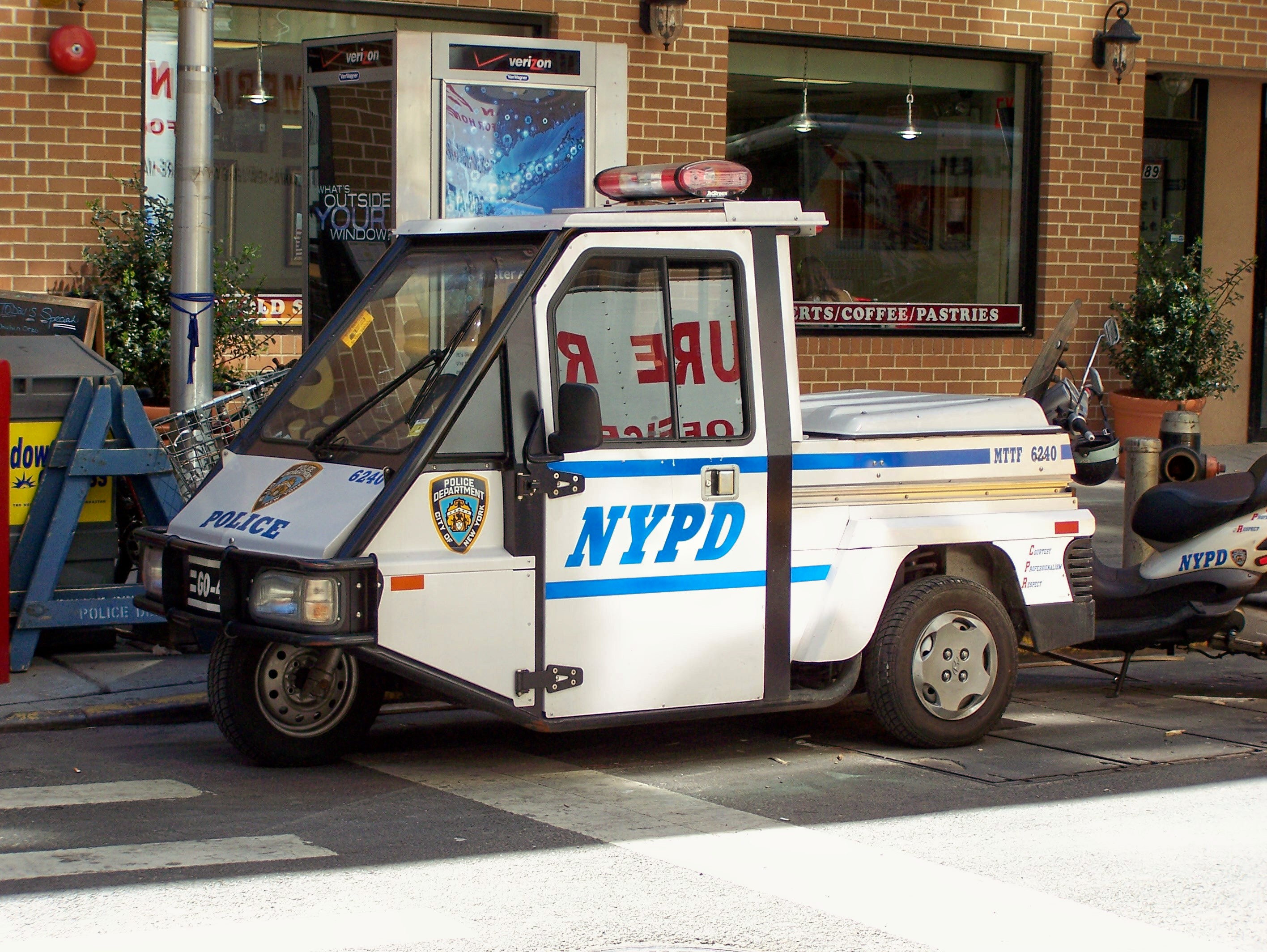
Further to yesterday's post, in which I mentioned that fixed-gear bicycles may be giving way to the moped, there is another vehicular trend which is far more troubling. Some time ago, in an online publication I can no longer recall, I read an article which claimed that the hipsters of Williamsburg were purchasing Cushmans at city auctions and repurposing them for personal use. Well, yesterday evening I once again found myself traveling the Great Hipster Silk Route and I'm dismayed to report that this indeed seems to be the case:

While I was unable to obtain a photograph of the driver, I did make a visual inspection of the cabin, and I can report with 99% certainty that the driver of the above conveyance was indeed a hipster. I would have tried to catch up with him again, except I got stopped at the "Facial Hair Checkpoint" on the Williamsburg/Greenpoint border. Unfortunately, the hairway of my visage was deemed to be insufficiently unironic. Not only that, but I didn't have an official Williamsburg resident identification card. (A Williamsburg resident identification card consists of either a California driver's license or else a student ID from a qualifying college or university such as UC Santa Cruz, Wesleyan, or NYU.) As such, it was only after I paid a toll and assured them that I was only passing through with no intention of stopping that they finally let me go.

Between Cushmans (otherwise known as "Hipster Smarts") and mopeds it may very well be that hipsters are rediscovering the joys of ironic fossil fuel consumption. Furthermore, the moped is an especially potent motorized "gateway drug" for them, since it allows them to keep using most of their fixie accessories, such as messenger bags, chain locks, and sneakers. Really, the only thing hipsters give up when they move to mopeds is the constant pedaling, which they never really seemed to be enjoying that much anyway.

Incidentally, a number of people pointed out yesterday that New York City seems to be late to the moped craze, which has apparently been in full swing in cities like San Francisco and Chicago for some time. However, this is less an indication that New York is behind the times than it is proof of just how seriously people take hipsterism here. It's standard practice among hipsters to hone their city living techniques and "personal brands" in other, smaller cities before moving here and taking part in "The Big Show." Yes, New York City in general and Brooklyn in particular is a vast field of hipster dreams, and a breakout season here can mean the difference between making a down payment on a condo and skulking back to Portland with your tiger tail between the legs of your form-fitting jeans.

Anyway, while the Cushman did have a hipster at the helm, it did not have vanity plates, unlike this trike I encountered yesterday on the Manhattan bridge:

As you can see, the vanity plate reads "Musher-1," which obviously means the rider pilots a dogsled. Moreover, she's obviously preparing for the Iditarod, since triking is a popular form of cross-training among competitive mushers. Eddy Merckx famously said, "The Tour de France is won in bed." (This explains why Lance Armstrong spent the years before his comeback to cycling hanging out with Ashley Olsen.) Similarly, it is also said that "The Ididarod is won on the trike." I only hope the hipsters don't take up dogsledding, since I'd hate to share the bike path with people wearing tight jeans and ironic fur hats being pulled around by pitbulls they found on Craigslist.

In any case, the Ironic Motorized Revolution appears to be yet another indicator that the fixed-gear heyday is over. And if you're still not convinced, consider this JCPenney commercial, forwarded to me by a reader. In it, you'll not only see a brakeless fixed-gear bicycle used as a prop, but you'll also see a model "portaging" it in such a manner as to get drivetrain grime all over his salmon-hued fleece:

Not only that, but if he's going to actually ride that thing (the bike, I mean) he better get some pant-cuff retention or it's going to get caught in his chain. The leg of his trousers is as unruly as his libido.

Meanwhile, in the world of streetwear, it's been a long time since fixed-gear fashion married into the world of hip hop fashion, and now they're having children. Consider this hybrid flat brim/cycling cap, forwarded to me by another reader:

Thanks to the shortened brim, fixed-gear fashionistas will no longer have to suffer the indignity of their hats flying off their heads on those rare occasions when they travel faster than 10mph. However, they must still suffer with the indignity of looking like people who watch drifting videos, drive their Pista Concepts to freestyle spots in customized Scions, and camp out for sneakers. (Camping out for sneakers is like making reservations at Burger King.)

But as much as I hate to see the classic cycling cap integrated with the latest conformists' hat of choice, I stop short of attributing some kind of profound spiritual significance and meaning to cycling's wooly, tubular past. However, if I didn't, I would be slavering all over the latest issue of Rouleur, which the good people at Rapha were kind enough to send me:
This is not to say I don't appreciate Rouleur, because I certainly do; nor is it to say that the magazine is not well put together and pleasant to look at and read, because it certainly is. However, I also don't subscribe to the central tenets of Rouleur, which is that there's a fundamental romance in the rarefied aspects of cycling, and that old stuff is more "soulful" than new stuff. Actually, I don't think any "stuff" is soulful. Granted, I'm not the most romantic person, but I don't find elusive and complicated things seductive, and I especially don't believe that "the tubular tyre has an unquestionable romance" (as Guy Andrews claims in the second installment of his "epic" sew-up report). I certainly understand that tubular tires have their benefits, and I'm even interested in reading about how they're made. But as soon as the prose starts sounding like it was composed on laudanum I can no longer remain engaged. In this sense, the tubular tire is sort of the burrito of the cycling world, since people seem compelled to rhapsodize about both, even though essentially they're just stuff wrapped in a skin with varying degrees of quality.

However, as someone who does not believe in the "soulfulness" of stuff, I was honestly fascinated by this interview with two bicycle collectors, Kadir Guirey and Rohan Dubash:


Here they are sharing an inside joke about a Simplex derailleur pulley:

While I'm not especially interested in "vintage" stuff, I do find other people's bizarre obsessions compelling, so I was amazed by much of what they had to say. For example, here's Rohan on memorabilia:

One year this little boy went to the Kellogg's Tour in Newcastle. It was raining and Maurizio Fondriest had won the time trial. He was just sitting in the car, peeling his wet socks off, and he just dropped them on the floor. His dad was like, just run over to him, and he looked at the socks and Fondriest looked at him, all puzzled, and he said, "Can I have them?" And Fondriest went, "Yeah, take them." So they took them home, washed them and brought them into the shop for me.

Apparently this is supposed to be charming, but personally I find the idea of handling anybody's wet, dirty cycling socks disgusting. Kadir further explains this by saying that things like used water bottles and dirty socks are "tiny little snapshots." By that logic I wonder if there's someone out there holding on to Eddy Merckx's dirty chamois. To me it's just bacteria, pubes, and vintage "frumunda cheese," but to them I guess it's a "tiny little snapshot" of victory--albeit from a crotchal perspective.

Predictably, Rohan is also quite smitten by Campagnolo:

That's why I buy Campagnolo--because I can think of a person making it. I can't think of a person making a Shimano derailleur. I'm not saying they don't, but I can't envisage it.

Why is it so hard to imagine someone making a Shimano derailleur? Is it because that person is Japanese? They have crafstmanship in Japan, too. I guess it's because things made in Italy are somehow imbued with "passion" and are therefore "art." But a derailleur, regardless of where it's made or by whom, is not art--nor is the absence of a derailleur art, despite what the fixed-gear fetishists would have you believe.

And these guys don't just love stuff; they also love the stuff in which the stuff is packaged. Says Kadir:

I like empty boxes.

Well, I guess you could consider an empty box conceptual art.

Having said all that, I certainly do agree that there's beauty in cycling and in the sport of cycling. I also realize that my cynicism with regard to much of what the rest of the cycling world finds "romantic" is probably due to the fact that I ride a Scattante, and everybody knows cheap straight-gauge tubes do not properly conduct those mystical, spiritual vibes. Maybe a new cyclocross bike will remedy the situation. A reader recently sent me a photo of a rider "slaying" some 'cross on a Pedersen, and I'm thinking it might be the way to go:

Winning a cyclocross race on a bike like that would doubtless bring instant fame. I wonder if he'd let me have his shorts.

Thursday, 30 July 2009

Bicycle Marketing: Survival of the Beefiest

(Martha knows great bloggers...and Great Head.)

As you can see from the image above, the BSNYC/RTMS Fat Cyclist Knuckle Tattoo Tribute Contest has heated up and is yielding some stunning submissions. In fact, some of them have rendered me more slack-jawed than Martha Stewart after a 90-minute "hike" around Great Head. However, incredible imagery doesn't only come in the form of contest submissions. Here is a photograph that has absolutely nothing to do with the contest, but which is awe-inspiring nonetheless:

(Taking it lying down.)

The above photo was taken by a reader and comes from the wilds of Canada (actually, the area could be perfectly civilized for all I know, but I just think every part of Canada is "the wilds"--except for the French-speaking parts, which are "Les Sauvages") and as you can see it depicts an actual AYHSMB recumbent. While the AYHSMB rallying cry does have its origins in the fixed-gear "culture," it has subsequently been adopted by the recumbent community as well, since recumbent riders arguably receive more derision than fixed-gear freestylers, off-road unicyclists, freeriders, and men who don't bother to lift the toilet seat before urinating when they visit people's houses combined. Also, it's certainly more fitting, since the recumbent position is far more conducive to receiving testilingus from "haters" than perhaps any other style of cycling.

Speaking of rallying cries, I recently discovered a phrase that could serve as an appealing alternative to AYHSMB, which is "Do Not Put Anything In My Flower Box:"

First of all, unlike AYHSMB, this phrase can be used unironically by those without testicles. Secondly, whereas AYHSMB is confrontational and implies physical contact with your adversary, DNPAIMFB simply calls for your adversary to steer clear of you altogether. Lastly, while ball-sucking is completely lacking in subtlety, putting something in someone's flower box is about as gentle (and fragrant) a metaphor for coitus as any I've ever heard.

The truth is that the world of cycling can be an overly masculine one: too many balls, not enough flower boxes. Take for example the new Gary Fisher road bike, which features a downtube that is "the largest that Fisher or Trek has ever created:"

Honestly, is this really a selling point? Just how large does a downtube need to be? Can you mount twin water bottle cages side by side? Still, many riders will doubtless be seduced by the notion of having a huge downtube swinging back and forth between their legs when they're out of the saddle in that "town line sprint" they're always referring to in the bicycle reviews.

Of course, a great big swollen downtube is worthless if it's not jammed into a "beefy" bottom bracket, so Trek/Fisher have wisely leapfrogged "beefy" and gone right to "robust:"

While crabon fiber is certainly a good material for building race bikes, it also has a dangerous downside. No, I'm not talking about the fact that it can break--after all, steel can break too. I'm talking about something even more dangerous, which is its ability to be molded into all sorts of crazy shapes. This allows bike designers to make all their most engorged phallic visions into reality. If road bikes keep swelling up this way one day you're going to go to Interbike and see a big carbon fiber penis with wheels--though arguably that's what a faired recumbent is already. Maybe that's where all this is going. Once the big bike companies have us all riding bloated bikes, it probably won't be that hard for them to convince us to lie down on them too. It's a recumbent conspiracy, and its insidiousness is matched only by its dorkiness.

That said, The Great Trek Bicycle Making Company and Gary Fisher deserve credit for the "Race Utility" concept, since in addition to making a giant downtube and bottom bracket junction they also took advantage of the opportunity to build some tire clearance and fender mounts into the frame. It's good to see that it's not all about getting us to collectively mount their huge downtube; at least they're offering some practicality, too, and I was genuinely pleased to see it. Still, I think it is important to be wary of "beefy bottom bracket" marketing, since a pair of fender mounts or a few more millimeters of tire clearance will improve the quality of your ride far more than some extra downtube girth or bottom bracket robustitude. In fact, this is a perfect opportunity to try out a new phrase:


Speaking of reviews of bikes with beefy bottom brackets, you may recall that not too long ago I reviewed a Look 566 road bike. Well, I noticed recently that no less a cycling publication than Cyclingnews recently reviewed the very same bike:

Not only that, but they pointed out pretty much the same thing I did, which is that if you're going to build a road bike that "does it all" you might as well include some versatility (or "Race Utility" in Trekspeak) too. Here's what Cyclingnews had to say:

We would have expected a bit more clearance for chubbier, sportive-friendly tyres (25s or maybe even 28s) and single mudguard eyelets also wouldn't hurt – performance is never compromised with slightly larger tyres, and the likelihood of a 566 Origin owner doing a wet brevet/grand fondo/sportive is high.

Of course, they also couched this criticism in the conclusion that the bike is "lively, quick and light for how its specced." (Saying something is "light for how its specced" is kind of like giving someone a discount by charging them 100 cents instead of a dollar; the bike weighs what it weighs, no more and no less.) Furthermore, the reviewer was somehow able to discern that the "squared and twisted chainstays stiffen the ride and soften the bumps." I'm not sure how you'd know that without trying another Look 566 with round and straight chainstays, but then again I'm not a real bike reviewer. Amazingly, though, this has not prevented someone else from sending me a road bike to evaluate, and I plan to "drop" a review in the not-too-distant future. Here's a preview of the bottom bracket shell, in case you're interested:

"Sutured" is the new "robust."

Meanwhile, fashionmonger Marc Jacobs is skipping over beefy bottom brackets and instead harnessing the awesome marketing power of p-fars. Here is the current window display at his store on Bleecker Street in Greenwich Village:


It would appear then that he is moving away from the knuckle tattoo, which I saw recently adorning the Marc Jacobs bag of one fixed-gear rider not too long ago:

Yes, in order to truly understand what's hip you've got to "take it to the streets." And one thing that's certainly not going out of style in New York City is expensive yet poorly-locked track bikes. A reader recently sent me this photo, which depicts a Vivalo that is simply an unbolted wheel away from becoming someone else's:

Basically, the owner is saying, "Help yourself to my bike, but just leave me the front wheel." I realize many people are drawn to track bikes for their air of "urban cool," but maybe they should acquire the street smarts first, then get the fixie.

Another thing that's "blowing up" right now is TWS, or "Texting While Salmoning:"


As well as the triple trends of "vintage" road bikes, skater helmets, and white tires, manifest here on a single bike:


Really "feeling" the tricoloreway. Here's another "vintage" bike, though this one's day-glo:

That's a horse of a different colorway.

Ping Blog

Step 1
Blog URL:


Blog Title (optional):


Blog RSS Feed (optional):


I agree with terms of service.

Step 2
Copy the following code and put it on your blog/site to help our blog ping tool track your submission (Need help?):
;

 
Design by Free WordPress Themes | Bloggerized by Lasantha - Premium Blogger Themes | Best Buy Coupons